


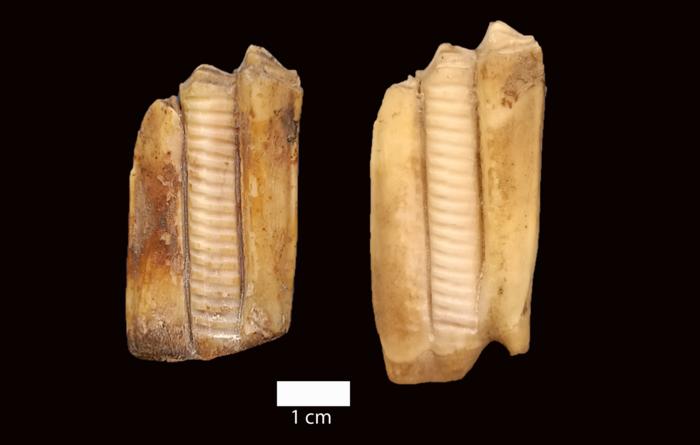
The herding groups of the Southern Iberian Peninsula applied different management strategies for their livestock at the beginning of the Neolithic period, with different breeding, feeding and movement patterns, depending on their ecological and productive needs. This is indicated by a study led by the Universitat Autònoma de Barcelona (UAB) that has reconstructed the feeding practices of the first herding communities occupying the Cueva de El Toro (Antequera, Malaga) 7,200 years ago, with the aim of exploring their feeding strategies and the socioeconomic factors that could have influenced them.

Credit: Alejandro Sierra, UAB
The herding groups of the Southern Iberian Peninsula applied different management strategies for their livestock at the beginning of the Neolithic period, with different breeding, feeding and movement patterns, depending on their ecological and productive needs. This is indicated by a study led by the Universitat Autònoma de Barcelona (UAB) that has reconstructed the feeding practices of the first herding communities occupying the Cueva de El Toro (Antequera, Malaga) 7,200 years ago, with the aim of exploring their feeding strategies and the socioeconomic factors that could have influenced them.
The study, published in the journal PLOS ONE, involved researchers from the Department of Prehistory of the UAB, as well as from the University of La Laguna (Tenerife), Milà i Fontanals Institution of Humanities Research (IMF-CSIC), the University of Cardiff, and the Natural History Museum of Paris.
The agricultural economy in the Iberian Peninsula during the Neolithic period developed very quickly, between 7,600 and 7,400 years ago. However, specific information on the herding strategies of the first Neolithic communities, especially in the south, is limited, mainly due to the difficulty of investigating these management practices in the same place and in such a short archaeological period of time.
The study published today has been able to reconstruct their livestock management practices, including those of altitudinal mobility, in the same site and with a very precise time resolution. By means of high-resolution radiocarbon dating of eight dental specimens from the Cueva de El Toro and the analysis of stable carbon and oxygen isotopes in the enamel, researchers were able to confirm that the animals were managed in the cave during a period of only 240 years, during the Neolithic expansion throughout the Iberian Peninsula, and to establish their feeding patterns.
The results show that the herding communities applied different breeding patterns – in the autumn, winter and spring – thereby controlling the reproduction of their herds; they fed the animals different plants throughout the annual cycle, with some animals consuming species typical of saline areas in the summer and had them graze at different altitudes and in mountainous areas. This large variability indicates that, probably, each sheep was herded in a different way, and that it was possible to apply different patterns within one same flock.
These discoveries question the previous perception of homogeneity in the management of livestock at the beginning of the Neolithic in the western Mediterranean and reinforce the hypothesis of the complexity of the first Neolithic populations of southern Iberia. “The different herding strategies that we have found fit in the economic model proposed for the Neolithic communities of southern Iberia, which have been considered as highly mobile herding communities”, says Alejandro Sierra, researcher at the UAB who coordinated the study.
The variability identified could be explained as an adaptive response of the first agricultural and farming societies for diverse and not unrelated reasons, such as better access to resources, changes in climatic conditions or the dominant socio-economic characteristics of each location. In this sense, the study published today “may have broader implications for understanding the adaptability of the first agricultural and farming communities at the beginning of the Neolithic period in the Iberian Peninsula”, says María Saña, researcher at the UAB and coordinator of the research.
Journal
PLoS ONE
Method of Research
Experimental study
Subject of Research
Animals
Article Title
Shepherding the past: High-resolution data on Neolithic Southern Iberian livestock management at Cueva de El Toro (Antequera, Málaga)
Article Publication Date
3-Apr-2024
Cite Scienmag News
William Thompson. (April 4, 2024). Early herding communities of the Southern Iberian Peninsula used a wide variety of livestock management strategies. Scienmag. https://scienmag.com/early-herding-communities-of-the-southern-iberian-peninsula-used-a-wide-variety-of-livestock-management-strategies/
William Thompson. "Early herding communities of the Southern Iberian Peninsula used a wide variety of livestock management strategies." Scienmag, 4 April 2024, https://scienmag.com/early-herding-communities-of-the-southern-iberian-peninsula-used-a-wide-variety-of-livestock-management-strategies/. Accessed 5 September 2026.
William Thompson. "Early herding communities of the Southern Iberian Peninsula used a wide variety of livestock management strategies." Scienmag. April 4, 2024. https://scienmag.com/early-herding-communities-of-the-southern-iberian-peninsula-used-a-wide-variety-of-livestock-management-strategies/

