


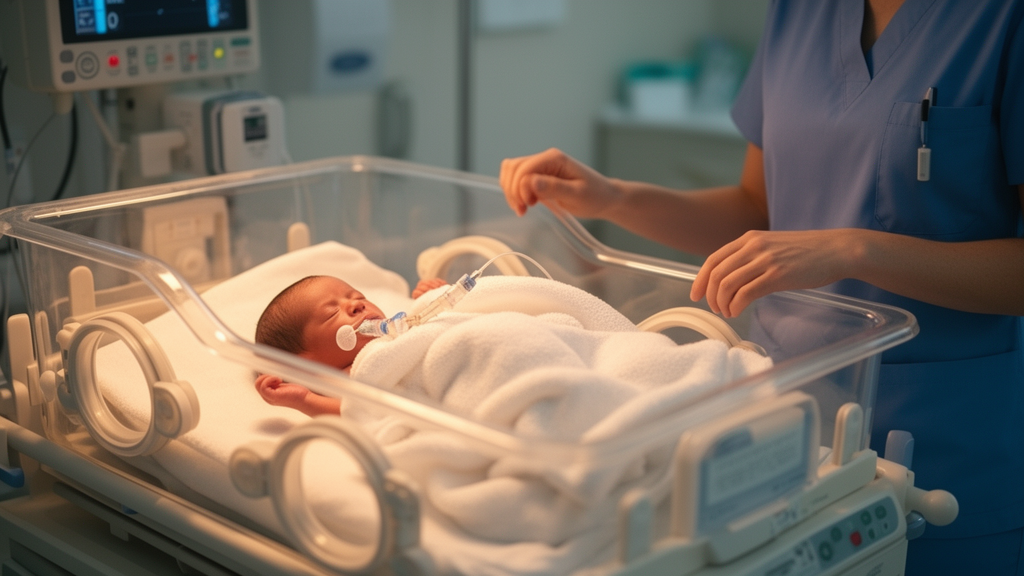
Every year, thousands of the smallest and most fragile newborns undergo intestinal resection, an operation in which surgeons remove damaged or dead segments of bowel. Many of these infants are born extremely preterm, and their intestines have been injured by conditions such as necrotizing enterocolitis, a devastating disease in which the gut wall becomes inflamed and progressively dies. After the operation, these babies face a long and precarious recovery in the neonatal intensive care unit, where clinicians must make dozens of daily decisions about fluids, nutrition, ventilation, and medications. One of the most persistent of those decisions involves albumin, the most abundant protein in human blood plasma, and a new study from China now suggests that the question of how long to give it is far from settled.
Albumin is not simply a structural protein. It is the principal determinant of oncotic pressure, the osmotic force that keeps fluid inside blood vessels rather than allowing it to leak into surrounding tissues. It also serves as a carrier molecule for hormones, fatty acids, drugs, and bilirubin, and it has antioxidant and anti-inflammatory properties that have intrigued intensive care researchers for decades. When a preterm infant’s albumin level drops after major surgery, a logical instinct follows: replace the missing protein and the body’s fluid balance and healing capacity should improve. That instinct has made albumin infusion one of the most commonly used blood products in neonatal units worldwide, despite a long-running and often contentious debate about whether it actually improves outcomes.
The controversy is not new. A landmark randomized trial published in the New England Journal of Medicine in 2004 compared albumin with saline for fluid resuscitation in critically ill adults and found no survival advantage for the protein solution. A Cochrane review examining albumin infusion specifically for low serum albumin in preterm newborns found insufficient evidence of benefit. Yet clinical practice has been slow to change, particularly in the postoperative setting, where hypoalbuminemia is common and appears to correlate with poor wound healing, edema, and mortality. The problem, as researchers increasingly recognize, is that low albumin may be a marker of illness severity rather than a cause of it, and correcting the number on a laboratory report may not correct the underlying disease.
Into this uncertainty steps a study published in Pediatric Research by Xiaofei Ma, Xiaolan Li, Yongjiang Jiang, Yunzhi Liu, and Yueju Cai of Guangzhou Women and Children’s Medical Center and its Liuzhou hospital. The team conducted a two-center retrospective cohort study of 102 preterm infants who underwent intestinal resection in China between 2018 and 2024. Their question was deceptively simple: does the duration of albumin therapy after surgery make any difference to survival? Infants who received albumin for five days or fewer were classified as the short-course group, comprising 69 babies, while the 33 infants treated for more than five days formed the long-course group. The primary outcome was all-cause mortality within 90 days of the operation.
The raw numbers were striking. Crude 90-day mortality was 15.2 percent in the long-course group compared with 4.3 percent in the short-course group, a numerical difference that would immediately catch the eye of any neonatologist. But the investigators, adhering to rigorous epidemiological practice, did not stop at the crude comparison. They recognized that the two groups were not randomly assigned. Instead, treating physicians decided how long to continue albumin based on each infant’s clinical condition, meaning that babies who stayed sicker for longer were more likely to receive prolonged therapy. This phenomenon, known as confounding by indication, is the central challenge of all observational treatment research, and it means the raw mortality gap cannot be interpreted at face value.
To address this, the researchers employed multivariable regression analyses in which treatment duration was modeled as a continuous variable, adjusting for measured baseline characteristics. In this adjusted model, each additional day of albumin therapy was associated with an odds ratio for mortality of 1.36, with a 95 percent confidence interval of 0.98 to 1.97 and a P value of 0.063. In plain terms, the point estimate suggested a possible harm signal, with longer courses trending toward higher mortality, but the confidence interval crossed the threshold of no effect and the result did not reach conventional statistical significance. The team also examined secondary outcomes and repeated their analyses using alternative duration thresholds, finding no statistically significant differences in any of them. Notably, the measured baseline characteristics of the two groups showed no statistically significant differences, which lends some credibility to the comparisons even though unmeasured factors may still differ.
The authors are careful, appropriately so, about what these findings do and do not prove. In their conclusions and impact statements, they emphasize that no statistically significant differences in mortality or major postoperative outcomes were detected between the treatment groups, but they explicitly warn that clinician-determined treatment duration and residual confounding by indication preclude any conclusion about equivalence or about the clinical benefit of prolonged therapy. This is a crucial distinction that is often lost when observational studies circulate on social media and in clinical discussion groups. Absence of statistical significance in a small, confounded cohort is not evidence that two treatments are the same. It is evidence that this particular study, with its 102 patients and its non-randomized design, cannot answer the question definitively.
Why does this matter so much for preterm infants specifically? Neonates, especially those born very early, have physiology that differs profoundly from adults. Their capillary permeability is higher, their plasma volumes are smaller, their livers synthesize albumin at lower rates, and their fluid management windows are extraordinarily narrow. Restricted versus liberal water intake has itself been the subject of decades of Cochrane evidence synthesis in this population, underscoring how sensitive preterm babies are to fluid shifts. Albumin infusions in such patients can expand intravascular volume rapidly, and concerns about volume overload, patent ductus arteriosus, and pulmonary edema are ever-present in the neonatal intensive care unit. Meanwhile, albumin is an expensive, donor-derived blood product, and stewardship of limited resources is a legitimate consideration alongside clinical efficacy. Studies of albumin use in adult and pediatric intensive care have documented substantial practice variation and cost implications, suggesting that clarifying the appropriate duration of therapy could have both clinical and economic consequences.
The study also highlights a broader methodological lesson for neonatology. Many routine practices in newborn intensive care, from fluid strategies to transfusion thresholds to nutritional supplementation, have never been tested in randomized trials, and observational studies like this one serve as essential signals that such trials are needed. The researchers followed the Strengthening the Reporting of Observational Studies in Epidemiology guidelines and conducted sensitivity and subgroup analyses to probe the robustness of their findings, reflecting a maturing standard of rigor in retrospective neonatal research. They also note that their data, while not publicly shareable due to ethical and privacy restrictions, are available to qualified researchers upon reasonable request and institutional approval, an approach that supports future collaborative analyses and meta-analyses.
For clinicians at the bedside, the practical takeaway is one of humility rather than a new protocol. The study does not demonstrate that prolonged albumin therapy harms preterm infants after intestinal resection, nor does it show that short courses are safe and sufficient. What it does show is that the common practice of extending albumin infusions beyond five days in the sickest babies is not supported by clear evidence of benefit, and that a possible signal of harm deserves serious attention. The natural next step, which the authors’ exploratory findings implicitly call for, is a properly powered randomized controlled trial comparing short-course and long-course albumin therapy in this vulnerable population, with mortality and major morbidities such as bronchopulmonary dysplasia, wound complications, and length of intensive care stay as prespecified outcomes. Until such evidence arrives, the decision to continue albumin day after day in a recovering preterm gut will remain one of neonatal medicine’s quiet uncertainties, made infant by infant, at the bedside, in the absence of definitive data.
Subject of Research: Duration of albumin infusion therapy and postoperative outcomes in preterm infants undergoing intestinal resection
Article Title: Albumin therapy in preterm infants after intestinal resection: a two-center retrospective cohort study
Article References: Ma, X., Li, X., Jiang, Y., Liu, Y., & Cai, Y. (2026). Albumin therapy in preterm infants after intestinal resection: a two-center retrospective cohort study. Pediatric Research. https://doi.org/10.1038/s41390-026-05504-4
Image Credits: AI Generated
DOI: 10.1038/s41390-026-05504-4
Keywords: albumin therapy, preterm infants, intestinal resection, neonatal intensive care, necrotizing enterocolitis, retrospective cohort study, 90-day mortality, confounding by indication, hypoalbuminemia, Pediatric Research, fluid management, neonatal surgery
Cite Scienmag News
Ophelia Keating. (October 8, 2026). Longer Albumin Courses Show No Clear Benefit in Preterm Infants After Gut Surgery. Scienmag. https://scienmag.com/longer-albumin-courses-show-no-clear-benefit-in-preterm-infants-after-gut-surgery/
Ophelia Keating. "Longer Albumin Courses Show No Clear Benefit in Preterm Infants After Gut Surgery." Scienmag, 8 October 2026, https://scienmag.com/longer-albumin-courses-show-no-clear-benefit-in-preterm-infants-after-gut-surgery/. Accessed 8 October 2026.
Ophelia Keating. "Longer Albumin Courses Show No Clear Benefit in Preterm Infants After Gut Surgery." Scienmag. October 8, 2026. https://scienmag.com/longer-albumin-courses-show-no-clear-benefit-in-preterm-infants-after-gut-surgery/


