


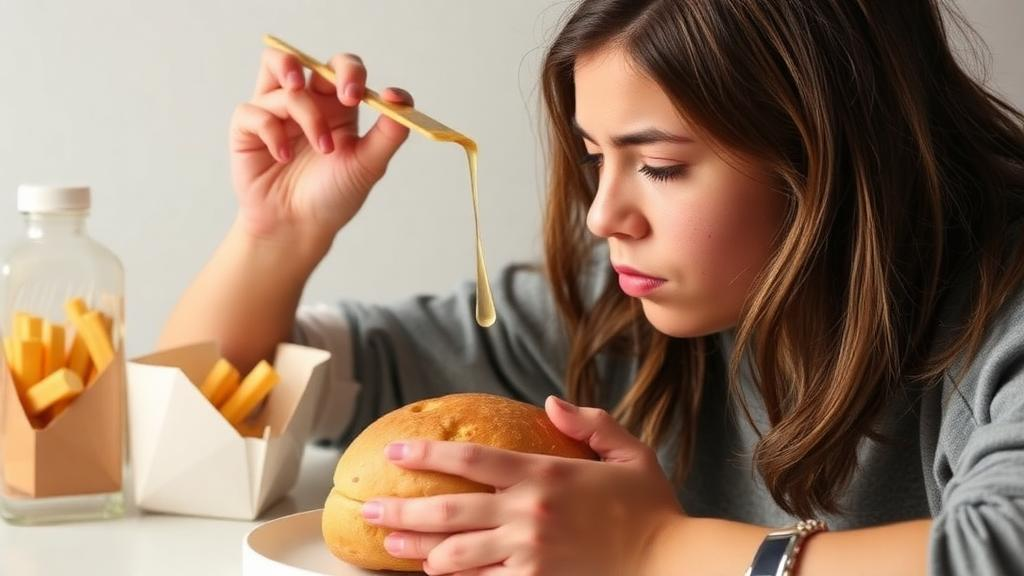
For millions of university students, the pressure of exams, finances and social life does not just weigh on the mind — it shows up on the plate. A new study of more than a thousand Chinese undergraduates has mapped, in unusually fine detail, the psychological route by which perceived stress translates into unhealthy eating, and the findings suggest that anxiety acts as a critical relay station while internalized ideals about appearance determine how much damage stress can do. The research, published in Current Psychology, offers one of the clearest pictures yet of why some students reach for comfort food under pressure while others do not.
The team, led by Long-Wei Qin of Yunnan University of Finance and Economics together with Jun Li, Xiao-Mei Zhou and Kai-Peng Gan, recruited 1,016 students from five Chinese universities. Participants completed validated questionnaires measuring perceived stress, anxiety symptoms, sociocultural attitudes toward appearance and unhealthy eating behavior. The researchers then used SPSS and the PROCESS macro, a widely used statistical tool for testing psychological pathways, to model how these variables interacted. Rather than asking simply whether stress and junk food go together, the design allowed them to test a chain of mechanisms: whether stress raises anxiety, whether anxiety drives unhealthy eating, and whether cultural attitudes about body image amplify the direct link between stress and diet.
The first result confirmed what a growing body of literature has suggested: perceived stress was significantly associated with unhealthy eating behavior. Perceived stress, as measured by instruments such as the Perceived Stress Scale, reflects not the objective number of stressors a person faces but how overwhelming and uncontrollable those demands feel. This distinction matters, because it means the psychological experience of stress — the sense that life has exceeded one’s coping resources — is what predicts dietary deterioration, not merely the presence of exams or deadlines themselves.
The second finding is the study’s central contribution. Anxiety mediated the relationship between stress and eating. In statistical terms, higher perceived stress predicted increased anxiety, and that anxiety in turn predicted more unhealthy eating. This pathway echoes a well-documented phenomenon in psychophysiology: stress triggers negative affect, and negative affect shifts food choices toward energy-dense, palatable options. A classic five-way model proposed by researcher Michael Macht describes how emotions can suppress, intensify or redirect eating depending on their type and intensity, and meta-analytic work by Daryl O’Connor and colleagues has shown that stress reliably alters eating behavior in healthy adults, often in the direction of snacking and reduced dietary quality. The new study places anxiety squarely in the middle of that chain for young adults.
Why would anxiety specifically push students toward unhealthy food? One explanation lies in emotion regulation. Eating palatable food activates reward circuitry that can temporarily dampen distress, a pattern that has been observed in emotional eating research across clinical and non-clinical populations. Studies of patients with obesity have found associations between anxiety and maladaptive eating behaviors, and prospective work in adolescents has linked anxiety to binge-eating tendencies. During the COVID-19 pandemic, researchers documented the same dynamic at scale: coronavirus stress predicted overeating through anxiety and burnout, and systematic reviews confirmed that mental health deterioration during lockdowns was consistently tied to emotional eating. The new findings extend this picture to the ordinary, everyday stress of university life, suggesting the mechanism operates not only in crises but in the background hum of academic pressure.
But stress and anxiety alone did not tell the whole story. The study’s third finding concerned sociocultural attitudes toward appearance — the degree to which individuals have internalized cultural ideals about how bodies should look, often propagated by media, peers and social platforms. These attitudes moderated the direct effect of perceived stress on unhealthy eating: when students had more strongly internalized appearance ideals, the association between stress and unhealthy eating was stronger. In other words, two students under identical stress could respond very differently depending on how much cultural pressure about appearance they carry inside.
This moderation effect fits a broader theoretical framework in body image science. The dual-pathway model of bulimic pathology, proposed by Eric Stice, holds that negative affect and dieting are the two main routes by which body dissatisfaction leads to disordered eating. Decades of research on the internalization of thin ideals — measured with instruments such as the Sociocultural Attitudes Towards Appearance Questionnaire — have shown that internalization is one of the most robust risk factors for eating disturbances, particularly among young women exposed to social media imagery. Work on Instagram use, self-objectification and body dissatisfaction has demonstrated that appearance-focused platforms create mediational pathways from media exposure to disordered eating attitudes. The new study suggests these internalized ideals do not merely cause body dissatisfaction on their own; they act as an amplifier that converts stress into unhealthy eating more efficiently.
The practical implications are significant for universities. The authors argue that their results can inform targeted mental health and nutrition interventions within campus settings. If anxiety is the relay through which stress reaches the diet, then anxiety-reduction programs — cognitive reappraisal training, mindfulness-based eating awareness, stress management workshops — may do double duty, protecting both mental health and dietary quality. Mindfulness-based eating awareness training has already shown promise for treating binge eating, and randomized trials of mindful eating for weight loss have reported positive outcomes. Meanwhile, the moderation finding suggests that interventions addressing body image and media literacy could blunt the stress-to-diet pathway for the most vulnerable students. Programs that foster positive body image and self-compassion have been shown in prospective research to protect against the onset of core eating disorder symptoms.
There are, of course, limits to what a cross-sectional survey can establish. The data capture associations at a single point in time, so the direction of the pathways — stress to anxiety to unhealthy eating — is inferred from the statistical model rather than observed longitudinally. Self-reported questionnaires are also subject to biases, which the authors addressed by following established methodological recommendations for controlling common method bias. The sample, drawn from five Chinese universities, is large but culturally specific, and appearance ideals vary across societies; whether the moderation effect holds equally in other cultural contexts remains to be tested. Still, prior cross-sectional studies in Jordan, Saudi Arabia, Brazil, South Korea and the United States have all reported links between student stress and adverse eating patterns, suggesting the underlying phenomenon is global even if its cultural amplifiers differ.
What makes the study resonate beyond the campus is its demonstration that diet is not simply a matter of knowledge or willpower. The students in this sample were not failing to understand nutrition; their eating was being shaped by an interaction between how much stress they perceived, how much anxiety that stress produced, and how deeply they had absorbed cultural messages about their bodies. Chronic stress is known to affect physical health through many channels, from cardiovascular strain to immune function, and diet is one of the most modifiable of them. By identifying anxiety as the mediating gear and appearance internalization as the accelerator, the research gives clinicians, campus counselors and public health planners two concrete levers to pull. For a generation of students facing rising rates of depression and anxiety — recent epidemiological surveys of Chinese university students confirm the scale of the problem — that combination of psychological insight and practical targeting may prove as nourishing as any meal plan.
Subject of Research: The role of anxiety and sociocultural appearance attitudes in the relationship between perceived stress and unhealthy eating among college students
Article Title: The impact of perceived stress on college students’ eating behaviors: the role of anxiety and sociocultural attitudes toward appearance
Article References: Qin, L.-W., Li, J., Zhou, X.-M., & Gan, K.-P. (2026). The impact of perceived stress on college students’ eating behaviors: the role of anxiety and sociocultural attitudes toward appearance. Current Psychology, 45(18), Article 1513. https://doi.org/10.1007/s12144-026-10028-5
Image Credits: AI Generated
DOI: 10.1007/s12144-026-10028-5
Keywords: perceived stress, anxiety, unhealthy eating, college students, emotional eating, body image, sociocultural attitudes toward appearance, mediation analysis, mental health, nutrition interventions, Current Psychology, Chinese universities
Cite Scienmag News
Glenn Wilkins. (October 8, 2026). Stress Reshapes What Students Eat, With Anxiety and Body Ideals Steering the Damage. Scienmag. https://scienmag.com/stress-reshapes-what-students-eat-with-anxiety-and-body-ideals-steering-the-damage/
Glenn Wilkins. "Stress Reshapes What Students Eat, With Anxiety and Body Ideals Steering the Damage." Scienmag, 8 October 2026, https://scienmag.com/stress-reshapes-what-students-eat-with-anxiety-and-body-ideals-steering-the-damage/. Accessed 8 October 2026.
Glenn Wilkins. "Stress Reshapes What Students Eat, With Anxiety and Body Ideals Steering the Damage." Scienmag. October 8, 2026. https://scienmag.com/stress-reshapes-what-students-eat-with-anxiety-and-body-ideals-steering-the-damage/


