


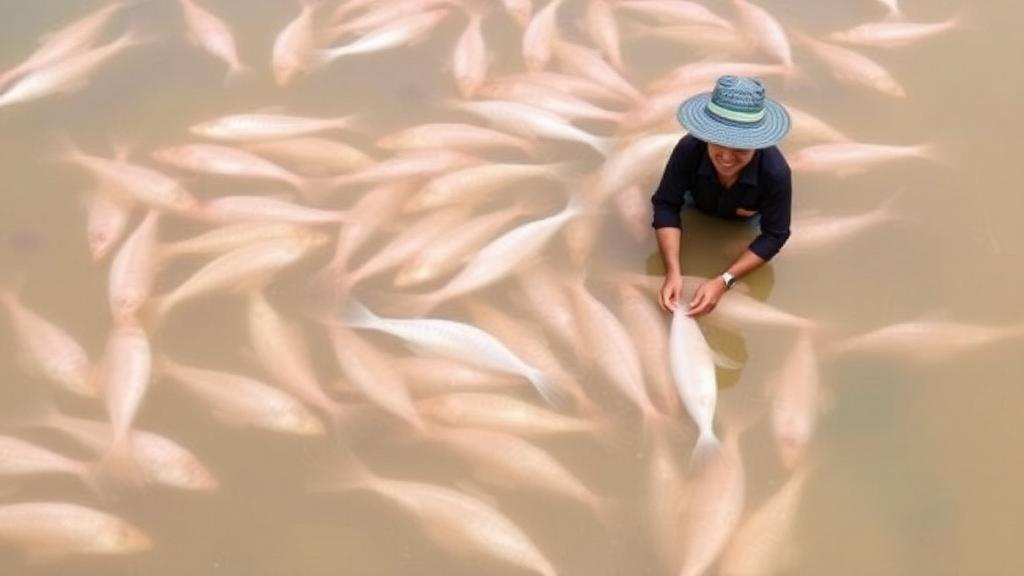
The University of Stirling has secured £2.4 million in funding for a major international research project aimed at confronting one of the most consequential and least visible frontiers of the antimicrobial resistance crisis: the freshwater ponds of Vietnam’s pangasius catfish industry. The 48-month study, led by Professor Margaret Crumlish of Stirling’s Institute of Aquaculture, will assemble specialists from aquaculture, microbiology, veterinary medicine, environmental science, computing, communications and business to develop practical, farm-ready alternatives to antibiotic use in a sector that supplies a vital source of protein to millions of people across Southeast Asia. The award forms part of a broader UK government-backed investment of more than £54 million distributed across 18 new research and innovation projects coordinated through UK Research and Innovation, with co-funding from the Department for Environment, Food and Rural Affairs, the Foreign, Commonwealth and Development Office, and the Department of Health and Social Care.
Antimicrobial resistance, or AMR, is widely described by scientists and policymakers as one of the most pressing global challenges of the coming decades, and it is formally categorised as a ‘One Health’ problem because the forces driving it cut across human, animal and environmental health. Aquatic environments occupy a particularly awkward position in this picture. Water is an exceptional medium for the movement of bacteria and the genetic elements that carry resistance between them, and aquaculture systems both depend on and continuously interact with the rivers, canals and groundwater around them. When antimicrobial compounds enter pond water, whether through deliberate treatment or residual shedding, selective pressure favours bacteria that survive, and resistance genes can circulate through sediment, water columns and microbial communities in ways that are difficult to monitor and even harder to reverse. Professor Crumlish’s team argues that understanding these dynamics in a real production environment is essential to designing interventions that actually work.
Vietnam’s pangasius sector offers what the researchers describe as an ideal natural laboratory. Pangasius catfish farming is one of the world’s most important freshwater aquaculture industries by volume and export value, and its intensification over recent decades has been accompanied by growing recognition of AMR issues in the freshwater environments that host production. Intensive systems concentrate fish at high densities, which raises disease pressure, and when bacterial outbreaks strike, farmers frequently turn to antimicrobials as a first line of defence. The Stirling-led project will examine the causes and complexity behind resistance in these systems, but it will go a step further by also investigating the social and economic barriers that prevent alternative disease-management approaches from being adopted in the first place. That dual focus, on both the biology and the behaviour surrounding antibiotic use, is what the team describes as the study’s defining transdisciplinary character.
Professor Crumlish has been candid about the practical realities that drive antibiotic reliance on farms. When antibiotics stop working effectively in aquaculture, particularly in freshwater systems in Southeast Asia, farmers often have few alternatives available to them, yet they continue to trust antibiotic products even when those products are no longer effective. The result, she explains, is rapid development of resistance that can spill over into human, environmental and animal health, a pattern she identifies as a major concern. Rather than simply documenting the problem, the project has been designed to produce a novel research roadmap and a practical framework that can be adapted and applied in other countries facing similar challenges, an ambition that reflects the global nature of aquaculture and the shared biology of the resistance mechanisms involved.
The methodology at the heart of the project is co-creation. Over the next four years, researchers will work directly with farmers, policymakers, industry leaders and other stakeholders to ensure that any interventions they develop are both scientifically robust and realistically implementable. Alongside colleagues Dr Darren Green and Dr Noel Juvigny-Khenafou from Stirling’s Institute of Aquaculture, Professor Crumlish will collaborate with Dr Andrew Hoyle from the School of Computing, Data and Mathematical Sciences, Dr Saihong Li from the School of Communication, and Dr Till Stowasser from Stirling Business School. The inclusion of social scientists, data scientists and business researchers from the outset, rather than as an afterthought, is intended to surface the economic incentives, communication gaps and decision-making habits that determine whether a technically sound alternative to antibiotics ever reaches the pond.
The new grant builds directly on a body of previous research at Stirling investigating novel fish vaccines, including a recent trial conducted at the university’s National Aquaculture Technology and Innovation Hub, known as NATIH. Vaccination is widely regarded as one of the most promising tools for reducing antimicrobial dependence in finfish aquaculture, because preventing bacterial disease in the first place removes the need for therapeutic treatment. The transdisciplinary project will draw on data generated by these vaccine studies and share the findings with stakeholders as raw material for co-developing viable solutions and promoting better antibiotic stewardship across freshwater aquaculture. In effect, the team hopes to convert laboratory and trial-scale advances into a system-level change in how disease is managed on working farms.
The work will be carried out in partnership with the University of Glasgow, the University of Sydney, Can Tho University and Vietnam National University, a consortium that pairs UK and Australian research strength in microbiology, epidemiology and aquatic disease with Vietnamese institutions embedded in the regions where pangasius is actually farmed. This geographic and institutional spread matters for a problem of this kind. Resistance genes do not respect farm boundaries or national borders, and the conditions that shape antibiotic use, from extension services to market pressures, are locally specific. By grounding the research in Vietnamese production systems while connecting it to international expertise, the consortium aims to produce findings that are both locally actionable and globally transferable.
The funding envelope surrounding the project signals how seriously UK funders now treat the intersection of infection biology and food production. The £54 million programme, coordinated through UK Research and Innovation, is designed to prepare for future epidemics, tackle antimicrobial resistance and accelerate the development of next-generation animal vaccines. Professor Anne Ferguson-Smith, UKRI’s Executive Champion for Tackling Infections and Executive Chair of the Biotechnology and Biological Sciences Research Council, said the investment reflects UKRI’s central role in delivering government priorities and its long-standing commitment to convening partners across government to fund vital One Health research into human, animal and plant health. By pooling expertise from across the UK and global research and innovation ecosystem, she argued, related infectious disease challenges can be tackled in a more coordinated way, getting ahead of emerging biological threats and helping to protect people, animals, plants and the environment both domestically and internationally, advancing knowledge, improving lives and driving growth.
Professor Lucy Chappell, Chief Scientific Adviser at the Department of Health and Social Care and Chief Executive Officer of the National Institute for Health and Care Research, framed the investment in similarly interconnected terms. In a world where human, animal and environmental health are inherently linked and interdependent, she noted, diseases do not respect borders, and countries must work together to address their greatest health threats. Taking a One Health approach and bringing together experts from the UK and around the world, she said, allows threats to be identified earlier, strengthens resilience and delivers better health outcomes for the public. For the pangasius project specifically, that framing translates into a concrete ambition: within 48 months, to understand how resistance emerges in one of the world’s largest freshwater aquaculture industries, to map its impacts on production, and to chart a credible, farmer-endorsed path toward more sustainable disease management.
The stakes extend well beyond Vietnam. Aquaculture is among the fastest-growing food production sectors on the planet, and freshwater systems in Asia supply a substantial share of global fish consumption. If resistance renders existing antibiotics ineffective in these systems while alternatives remain out of economic or practical reach, the consequences will ripple through food security, rural livelihoods and public health simultaneously. What the Stirling-led consortium is proposing is essentially a test case for whether the aquaculture industry can decouple intensification from antimicrobial dependence, not through top-down regulation alone but through solutions built with the people who will have to use them. If the roadmap that emerges proves adaptable to other countries and other species, as the team intends, the humble catfish ponds of the Mekong Delta may end up shaping how the world manages infection far beyond their own waters.
Subject of Research: Antimicrobial resistance in Vietnamese pangasius catfish aquaculture
Article Title: University of Stirling secures £2.4M grant for major aquaculture project
Article References: University of Stirling secures £2.4M grant for major aquaculture project. (n.d.). Original publication
Image Credits: AI Generated
DOI: Not provided
Keywords: antimicrobial resistance, aquaculture, pangasius catfish, Vietnam, One Health, University of Stirling, UKRI, fish vaccines, antibiotic stewardship, freshwater farming, Institute of Aquaculture, transdisciplinary research
Cite Scienmag News
Kristina Jarvis. (October 7, 2026). Stirling-led £2.4M project targets antibiotic resistance in Vietnam’s catfish farms. Scienmag. https://scienmag.com/stirling-led-2-4m-project-targets-antibiotic-resistance-in-vietnams-catfish-farms/
Kristina Jarvis. "Stirling-led £2.4M project targets antibiotic resistance in Vietnam’s catfish farms." Scienmag, 7 October 2026, https://scienmag.com/stirling-led-2-4m-project-targets-antibiotic-resistance-in-vietnams-catfish-farms/. Accessed 7 October 2026.
Kristina Jarvis. "Stirling-led £2.4M project targets antibiotic resistance in Vietnam’s catfish farms." Scienmag. October 7, 2026. https://scienmag.com/stirling-led-2-4m-project-targets-antibiotic-resistance-in-vietnams-catfish-farms/


