


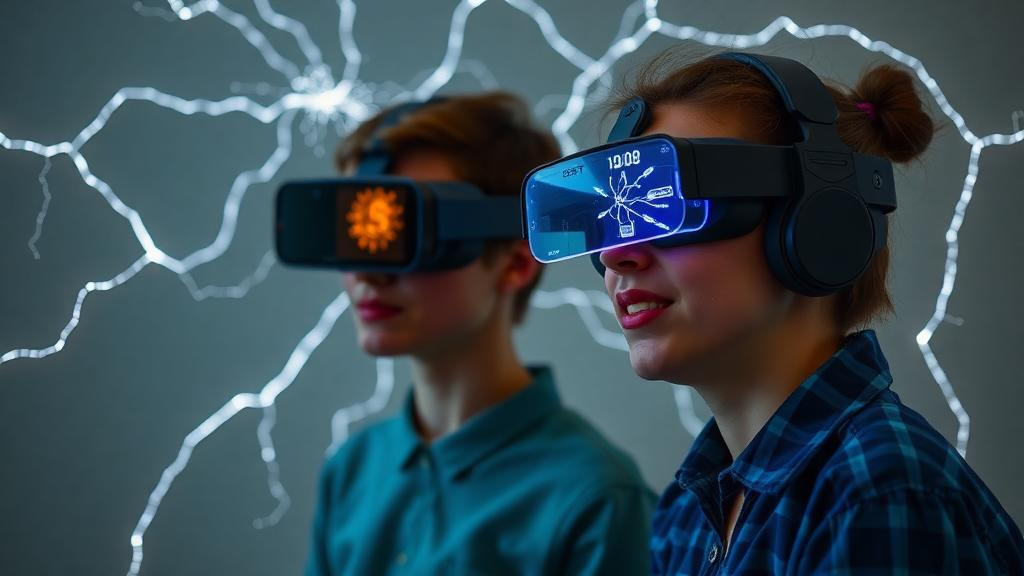
Static electricity is one of those topics that seems simple on the surface and turns out to be deceptively hard underneath. Students see sparks, feel shocks on door handles, and watch balloons cling to walls, yet the invisible choreography of electrons, charges, and fields that explains these events remains hidden from view. When learners try to explain what is happening, they often construct mental models that mix scientific ideas with intuitive but incorrect assumptions. A new study published in SN Social Sciences suggests that a carefully designed combination of augmented reality and refutational text can help twelfth-grade students push those flawed models closer to the scientifically accepted picture.
The research, led by Mohd Zaidi Bin Amiruddin of Universitas Pendidikan Indonesia together with colleagues including Kristóf Fenyvesi of the Finnish Institute for Educational Research at the University of Jyväskylä, focused on a question that has occupied science education researchers for decades: how do you help a student not just memorize the right answer, but genuinely restructure the internal model they use to reason about a physical phenomenon? The team’s answer was a learning intervention they call RefTaR, short for refutational texts assisted by augmented reality, which embeds three-dimensional visualization directly into a text-based strategy for confronting misconceptions.
Refutational texts are a well-established tool in science education. Rather than simply presenting the correct explanation, a refutational text explicitly names the common misconception, acknowledges that it is intuitive and widespread, and then directly refutes it before offering the scientific account. Research stretching back over several decades has shown that this approach outperforms plain expository text when the goal is overturning deeply held intuitive ideas. The catch is that many physics misconceptions involve entities students cannot see at all. Telling a student that their idea about charge transfer is wrong is one thing; giving them something concrete to replace it with is another.
That is where the augmented reality component enters. The RefTaR materials incorporated a macro-micro model, explicitly linking the observable, macroscopic behavior of charged objects with the microscopic behavior of subatomic particles. Students reading the refutational passages could simultaneously view augmented reality renderings and three-dimensional video animations showing what happens at the level of electrons when objects are rubbed together, transferred charge redistributes, or neutral objects become polarized. The design reflects a broader principle from multimedia learning research: multiple representations are most effective when they are coordinated so that the learner can map one onto the other, rather than being presented as disconnected pieces of information.
To test whether this combination actually helped, the researchers ran a group-randomized alternative-treatments design with a pretest. Three available twelfth-grade classes were the pool, and two of them were randomly assigned to the experimental and control conditions. The experimental group, twenty-eight students, received the full RefTaR intervention. The control group, thirty-one students, received refutational texts alone, without the augmented reality and 3D video components. Both groups received the same total amount of instruction, 270 minutes delivered across two sessions, which means any difference in outcomes could be attributed to the nature of the materials rather than to extra time on task.
Measuring mental models is trickier than measuring test scores, and the team took a correspondingly careful approach. Students’ understanding was assessed across six static electricity subconcepts using an open-ended level-of-understanding test. Rather than forcing a binary right-or-wrong judgment, this instrument allowed the researchers to classify each student’s mental model into one of three categories: Initial, meaning the intuitive or everyday conception; Synthetic, a hybrid state where scientific and intuitive ideas coexist and compete; and Scientific, the fully accepted explanation. The open-ended responses were scored independently by three raters, who reached 97.9 percent agreement, corresponding to a Fleiss’ kappa of 0.98, an almost perfect level of inter-rater reliability that lends considerable weight to the classifications.
The results tell a nuanced story that the authors are careful not to overstate. When the researchers used Fisher’s exact tests to compare the proportion of students showing any improvement from pretest to posttest, the so-called acceptable change, they found no statistically significant difference between the RefTaR group and the refutational-text-only group. In other words, both interventions moved students in the right direction at roughly comparable rates, and the addition of augmented reality did not produce a general advantage in the overall likelihood of progress.
But when the researchers narrowed their focus to the most demanding outcome, the proportion of students who reached a fully scientific mental model at posttest, a clear and consistent difference emerged. Across all six static electricity subconcepts, the RefTaR group had a significantly higher proportion of students at the Scientific level, with risk differences ranging from 17.4 to 42.9 percentage points, all statistically significant. This pattern held for every subconcept examined, which is a striking degree of consistency for a classroom-based study with modest sample sizes.
The interpretation the authors offer is that RefTaR’s advantage lies specifically in the final, integrative stage of mental-model reconstruction. Moving a student from an Initial model to a Synthetic one, where scientific and intuitive ideas begin to compete, appears achievable with refutational text alone. But completing the journey, fully displacing the intuitive model so that the scientific one operates alone, seems to benefit from the kind of rich, coordinated visualization that augmented reality and 3D video provide. The microscopic world of electrons and charge distributions, rendered as manipulable three-dimensional objects overlaid on the student’s physical environment, may give learners the concrete anchor they need to consolidate a coherent scientific model rather than a fragile hybrid.
The study’s authors are candid about its limits and about the questions that remain. Because the RefTaR intervention bundled augmented reality with 3D video and a macro-micro representational structure, the design cannot isolate which specific element drove the advantage. It could be the immersive quality of AR itself, the dynamic nature of the animations, the explicit macro-micro linkage, or some synergy among all three. The researchers suggest that future work should separate the contribution of augmented reality from that of general visual support, a step that would sharpen the design principles for technology-based learning materials. They also note that the study involved a small number of intact classes, a common constraint in school-based research, and that the findings are associative rather than proof of a universal causal mechanism.
Even with those caveats, the study lands at a moment when schools worldwide are weighing whether emerging technologies justify their cost and complexity in the classroom. Augmented reality in education has generated enthusiasm for years, but rigorous, controlled comparisons with well-matched non-AR alternatives remain comparatively rare. This study contributes something valuable to that conversation: evidence that visualization technology may matter most not at the beginning of conceptual change, where good text design already does much of the work, but at the end, where the hardest cognitive step, full model replacement, takes place. For physics educators wrestling with topics like electrostatics, where the relevant entities are invisible and the intuitive models are stubborn, that is a practically useful insight. It suggests that the question is not simply whether to use augmented reality, but where in the learning sequence it earns its place, and what representational structure it should carry when it does.
Subject of Research: Augmented reality-assisted refutational texts with a macro-micro model to support secondary students’ mental models
Article Title: Augmented reality-assisted refutational texts with a macro-micro model to support secondary students’ mental models
Article References: Augmented reality-assisted refutational texts with a macro-micro model to support secondary students’ mental models. (n.d.). https://doi.org/10.1007/s43545-026-01788-9
Image Credits: AI Generated
DOI: 10.1007/s43545-026-01788-9
Keywords: Augmented, reality-assisted, refutational, texts, macro-micro, model, support, secondary, students, mental, models, scientific research
Cite Scienmag News
Courtney Benton. (October 7, 2026). Augmented Reality Helps Students Rebuild Their Mental Models of Static Electricity. Scienmag. https://scienmag.com/augmented-reality-helps-students-rebuild-their-mental-models-of-static-electricity/
Courtney Benton. "Augmented Reality Helps Students Rebuild Their Mental Models of Static Electricity." Scienmag, 7 October 2026, https://scienmag.com/augmented-reality-helps-students-rebuild-their-mental-models-of-static-electricity/. Accessed 7 October 2026.
Courtney Benton. "Augmented Reality Helps Students Rebuild Their Mental Models of Static Electricity." Scienmag. October 7, 2026. https://scienmag.com/augmented-reality-helps-students-rebuild-their-mental-models-of-static-electricity/


