


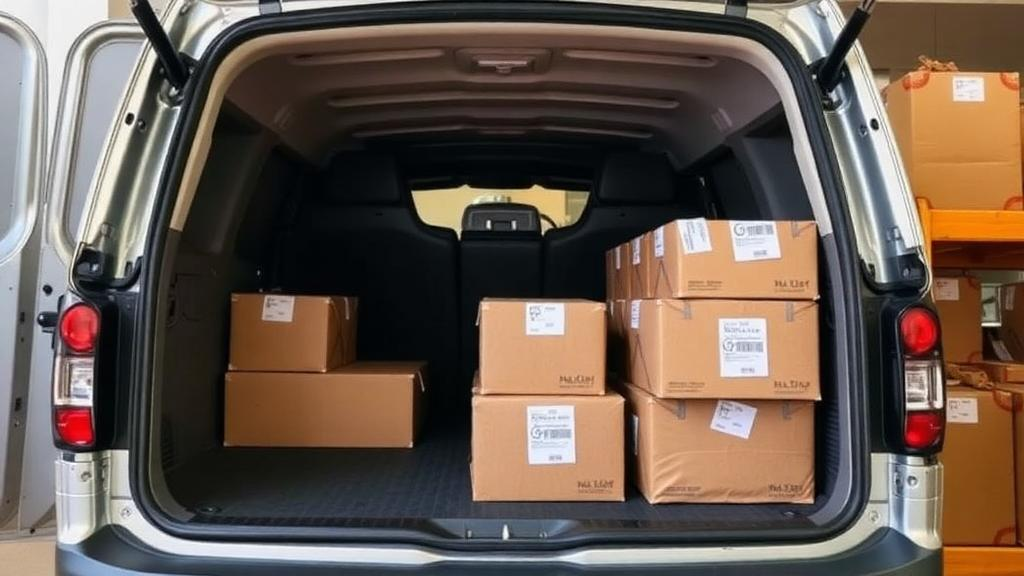
Packing has long been treated by mathematicians and operations researchers as a problem of pure geometry: fit as many objects as possible into a confined space and waste as little room as possible. But anyone who has ever loaded a moving truck, organized a warehouse shelf, or staged equipment for a military deployment knows that the real challenge is not just getting everything in. It is getting the right things in the right places, so that the items needed first come out first, related goods stay together, and the whole load remains safe and stable. A pair of new studies from North Carolina State University now tackles exactly that gap, introducing optimization models that weave item priority, accessibility, grouping and weight distribution directly into the classical packing framework.
The research, led by William Kirschenman, who completed the work as a Ph.D. student at NC State and is now an assistant professor at the Naval Postgraduate School, appears in two peer-reviewed journals: Naval Research Logistics and Omega. For Kirschenman, the problem is not an abstract puzzle. As a former company commander, he experienced firsthand how the order and placement of equipment can determine whether a mission succeeds. Wargaming amphibious landings, he says, revealed just how difficult it becomes to keep a unit organized in the sequence that best supports the mission when the environment is chaotic or contested. That practical frustration became the mathematical motivation for a new generation of packing models.
At the technical core of the first study is a two-dimensional orthogonal packing problem, a variant of the classic bin packing problem in which rectangular items must be placed without overlap inside a confined rectangular container. Traditional formulations of this problem typically minimize the number of bins used or the amount of unused space. The NC State team instead embedded a prioritization matrix into the bin packing framework, allowing items to be clustered with one another or pulled toward specific access points based on assigned priority weights. In other words, the model does not merely ask whether an item fits; it asks whether the item sits where it should relative to the doors, hatches or exits through which it will be retrieved, and whether it sits near the other items it belongs with.
This blending of ideas is what the authors describe as combining bin packing principles with facility layout concepts. Facility layout design, a longstanding field within industrial engineering, concerns itself with the spatial arrangement of departments and workstations to optimize flows and adjacencies. By importing that spatial-priority logic into packing, the researchers created a single mixed-integer linear programming model, or MILP, capable of balancing space efficiency against proximity to access points and adjacency among functionally related items. The result is a formulation that extends the utility of packing optimization to applications demanding far more nuanced layout preferences than simple volume maximization.
There was, however, an immediate computational obstacle. Every additional constraint, every priority level, every adjacency requirement multiplies the number of possible configurations the optimizer must consider. The researchers found that the potential combinations quickly outstripped available computing power when the full model was handed to a commercial solver as one monolithic problem. Their answer was a sliding-window matheuristic, a hybrid technique that breaks the large optimization problem into a sequence of smaller, overlapping subproblems. The algorithm solves each window of the packing space in turn, carrying forward the consequences of earlier decisions, and thereby obtains a good overall solution in a fraction of the time a direct solve would require.
The computational experiments were striking. When the sliding-window matheuristic was tested against a direct MILP solve using a commercially available optimization solver, the matheuristic consistently outperformed the monolithic approach in both runtime and solution quality. It also proved superior among the adapted heuristic and metaheuristic alternatives the team considered. For practitioners, that means high-quality, priority-aware packing plans can be produced on ordinary computing hardware rather than waiting hours or days for an exact solver to grind through an intractable search space, or settling for a crude rule-of-thumb arrangement.
The second study pushed the framework into an even more demanding arena: loading large maritime vessels. On a ship, geometry is only half the battle. Too much weight placed too high or too far to one side can cause the vessel to list, tilting dangerously, so load stability becomes a hard constraint that the packing plan must satisfy. As co-author Brandon McConnell, a research associate professor in NC State’s Edward P. Fitts Department of Industrial and Systems Engineering, explains, adding the stability constraint means working around a fixed center of gravity, and the correctness of the balance cannot be confirmed until the entire area has been packed, which usually forces adjustments. The team studied three solution approaches for this globally constrained problem: a monolithic MILP model, a sliding-window matheuristic, and a sliding-window matheuristic augmented with in-stride load balancing penalties applied during the solve.
Testing revealed a clear winner. The most efficient path was to run the existing sliding-window model first and then adjust selected lower-priority items at the end as needed to achieve stability, a post-processing strategy that selectively relaxes and re-optimizes item positions with minimal disruption to the prioritized layout. This simpler pipeline of matheuristic followed by repair emerged as the recommended practical configuration, offering the strongest overall combination of balance success, solution quality and runtime. The in-stride variant, which enforces balance during the initial solve, remains a narrower alternative for cases where achieving balance in the first stage is paramount. Notably, the matheuristic pipelines generated high-quality, load-balanced solutions for single-vessel scenarios within a few minutes on average, fast enough to let planners rapidly evaluate multiple loading configurations during time-critical deployment planning.
The implications stretch well beyond the military context that inspired the work, although combat loading, the art of arranging equipment on maritime transport so that mission-critical gear can be offloaded first while units stay cohesive and the vessel stays stable, remains the flagship application. The same mathematics applies to warehouse storage, where fast-moving goods should sit nearest the packing stations, and to multi-drop delivery services, where parcels for the last stops on a route must be loaded deepest and parcels for the first stops must be within easy reach. In every case, the model’s ability to encode multiple levels of prioritization, enforce groupings of related items, and respect physical constraints like balance turns a notoriously fiddly human judgment call into a reproducible computation.
The research team also included H. Sebastian Heese, Owens Distinguished Professor of Supply Chain Management; Michael Kay, associate professor of industrial and systems engineering; and Russell King, the Dopaco Distinguished Professor of Industrial and Systems Engineering, all of NC State. Kirschenman, a two-time selectee for the General Omar Bradley Research Fellowship in Mathematics, which helped support the research, sees the work as a bridge between abstract optimization and the messy realities of logistics. As McConnell puts it, the model could help ensure that mission-critical gear is offloaded first, save a warehouse worker’s time and energy, and lead to faster goods retrieval with fewer mistakes for any delivery business. In a world where supply chains are under unprecedented strain, teaching computers to pack with both intelligence and speed may prove one of the quiet but consequential advances of applied operations research.
Subject of Research: Prioritized two-dimensional orthogonal packing optimization with load balancing for military and commercial logistics
Article Title: Cracking the packing code – new models incorporate item priority, location and weight distribution
Article References: Cracking the packing code – new models incorporate item priority, location and weight distribution. (n.d.). Original publication
Image Credits: AI Generated
DOI: Not provided
Keywords: packing problem, optimization, mixed-integer linear programming, matheuristic, military logistics, load planning, warehouse storage, supply chain, vessel stability, operations research, bin packing, Naval Research Logistics
Cite Scienmag News
Reid Dalton. (October 7, 2026). New Packing Models Put Priority, Placement and Balance Into the Loading Equation. Scienmag. https://scienmag.com/new-packing-models-put-priority-placement-and-balance-into-the-loading-equation/
Reid Dalton. "New Packing Models Put Priority, Placement and Balance Into the Loading Equation." Scienmag, 7 October 2026, https://scienmag.com/new-packing-models-put-priority-placement-and-balance-into-the-loading-equation/. Accessed 7 October 2026.
Reid Dalton. "New Packing Models Put Priority, Placement and Balance Into the Loading Equation." Scienmag. October 7, 2026. https://scienmag.com/new-packing-models-put-priority-placement-and-balance-into-the-loading-equation/


