


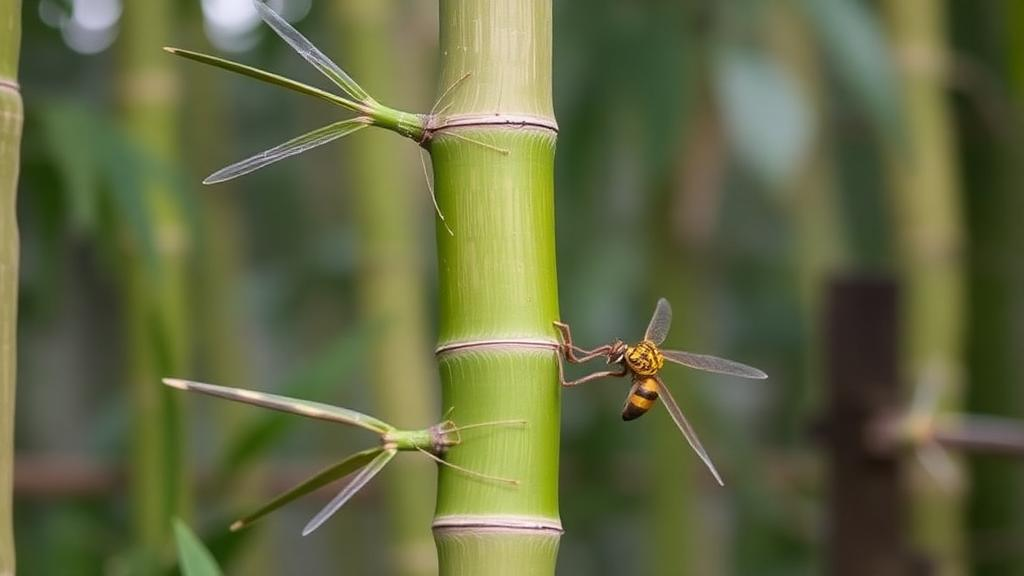
A tiny beetle that tunnels through bamboo culms and quietly destroys one of the world’s most valuable renewable resources is poised for a dramatic geographic expansion, according to a new modeling study published in Discover Plants. Researchers Deepak Kumar Mahanta of the Forest Research Institute in Dehradun and Tanmaya Kumar Bhoi of the Arid Forest Research Institute in Jodhpur used the Maximum Entropy, or MaxEnt, modeling framework to map the current and future climatic suitability of the bamboo borer, Dinoderus minutus, across the entire planet. Their projections, based on the latest generation of CMIP6 climate models, suggest that the fraction of global land area favorable to the pest could nearly double by the end of the twenty-first century, with new suitable habitat emerging in regions that today seem safely too cool for the insect to establish.
The bamboo borer is a powderpost beetle in the family Bostrichidae, and it is widely regarded as one of the most destructive post-harvest pests of bamboo worldwide. Unlike pests that attack living plants in the field, D. minutus infests both seasoned and unseasoned bamboo after harvest, boring into culms and feeding on the starch-rich tissues inside. This concealed feeding habit reduces the structural integrity of the material and renders it unsuitable for commercial use, undermining storage life, utilization potential, and market value. Because the beetle spends most of its life cycle hidden inside the culm, early detection is notoriously difficult, and infestations often spread silently during storage and transportation. The consequences ripple through bamboo-based economies, particularly in tropical and subtropical developing countries where bamboo supports rural livelihoods, handicraft industries, construction, and paper production.
The biology of the species makes it especially sensitive to climate. D. minutus thrives under warm, humid conditions, with optimal development occurring between roughly 25 and 35 degrees Celsius, temperatures that accelerate its life cycle and allow multiple overlapping generations each year. Temperature and relative humidity strongly influence its population dynamics, which means that shifts in global climate patterns could profoundly reshape where the beetle can survive and reproduce. Rising temperatures, altered precipitation regimes, and changing seasonality are expected to affect insect physiology, phenology, and distribution across the board, and climate-sensitive species such as the bamboo borer are likely candidates for significant range shifts.
To quantify that risk, the researchers assembled occurrence records for the species from the Global Biodiversity Information Facility. The initial dataset contained 483 records, of which 297 carried usable geographic coordinates. Rigorous cleaning followed: records lacking locality information, those with coordinate errors, and 17 points located in marine environments were removed, along with 172 duplicates sharing identical coordinates. Spatial thinning with a 5-kilometer distance threshold was then applied to reduce sampling bias and spatial autocorrelation arising from uneven survey effort. The final dataset comprised 88 georeferenced presence records spanning latitudes from 42.88 degrees south to 59.12 degrees north, covering the Afrotropical, Indomalayan, Palearctic, and Oceanian biogeographic realms.
Environmental predictors came from the WorldClim version 2.1 database at a resolution of 2.5 arc-minutes, roughly 5 kilometers. The team began with the 19 standard bioclimatic variables plus elevation, then screened for multicollinearity by calculating pairwise Pearson correlations at the species’ occurrence localities. Variables with correlation coefficients above 0.80 in absolute value were pruned, leaving six predictors: mean temperature of the warmest quarter, annual precipitation, precipitation of the warmest quarter, temperature seasonality, temperature annual range, and elevation. Elevation was retained because it indirectly shapes local temperature, humidity, and microclimatic conditions that govern insect survival, and it captures topographic heterogeneity that climate variables alone may miss.
The MaxEnt model itself was implemented in R using the maxnet package, with 10,000 background points sampled from the accessible study extent and complementary log-log output producing suitability scores between 0 and 1. Hinge, linear, and product features were permitted, appropriate for moderate sample sizes, and the regularization multiplier was tuned rather than left at its default to balance model complexity against predictive accuracy. Performance was assessed with five-fold cross-validation, and the results were striking: the model achieved a mean area under the receiver operating characteristic curve, or AUC, of 0.891, indicating excellent discriminatory ability. Omission rates at the 10th percentile training threshold closely matched observed rates on test data, further supporting the model’s calibration and reliability.
Under current climate conditions, the model predicts that only 5.36 percent of the global terrestrial area is climatically suitable for the bamboo borer, concentrated in South and Southeast Asia, sub-Saharan Africa, Central America and the Caribbean, northern Australia, and coastal lowlands of East Asia. The global distribution of suitability was strongly right-skewed, with a median value of just 0.001, meaning that highly favorable habitat occupies a geographically restricted footprint. Only 4.46 percent of terrestrial grid cells exceeded a suitability score of 0.5, and a mere 2.22 percent exceeded 0.7. Boreal forests, temperate continental interiors, hyper-arid deserts, and high montane systems received near-zero scores, reflecting the beetle’s incompatibility with cold winters, extreme thermal seasonality, and moisture deficits.
The variable importance analysis revealed a nuanced ecological picture. Annual precipitation was the top contributor at 26.8 percent, with suitability peaking at roughly 800 to 1,000 millimeters of rainfall per year and declining beyond about 2,000 millimeters, suggesting the beetle is adapted to seasonally dry to sub-humid environments rather than persistently wet tropics. Elevation contributed 24.1 percent, with suitability highest below about 200 meters and declining steadily with altitude. Temperature seasonality and temperature annual range together contributed nearly 30 percent, indicating that climatic stability is critical for population persistence. Notably, mean temperature of the warmest quarter, although fourth in percent contribution, showed the highest permutation importance at 31.1 percent, with suitability peaking between 20 and 25 degrees Celsius, a result consistent with the thermophilic physiology of bostrichid beetles and other stored-product insects.
The future projections are where the study delivers its most consequential findings. Using the MIROC6 global climate model under four Shared Socioeconomic Pathways, from the low-emission SSP126 to the high-emission SSP585, the researchers projected habitat suitability for three future periods: 2041 to 2060, 2061 to 2080, and 2081 to 2100. Across all scenarios and periods, suitable area expanded to between 9.07 and 10.39 percent of global land area, a substantial increase over the current 5.36 percent. The single largest expansion occurred during 2041 to 2060 under SSP370, which produced 1,293,897 suitable cells, or 10.39 percent of terrestrial area. Interestingly, the low-emission SSP126 pathway maintained the most stable suitable area throughout the century, holding between 10.27 and 10.38 percent, while the higher-emission scenarios showed strong early-century gains followed by gradual late-century declines, with SSP585 falling to 9.07 percent by 2081 to 2100.
This pattern suggests that moderate warming may enhance suitability by relaxing climatic constraints in currently marginal regions, whereas more extreme warming could push some tropical areas beyond the beetle’s optimal temperature and moisture envelope. The spatial projections point to new risk zones in southern Europe, the Mediterranean basin, temperate East Asia, and the southern United States, regions where bamboo industries and trade networks could suddenly face a threat they have never contended with. The authors acknowledge limitations, including the absence of globally consistent bamboo distribution layers and land-use data, and the use of a 1970 to 2000 climate baseline that may not fully capture recent shifts. Even so, the message is clear: climate change is likely to facilitate the global spread of D. minutus throughout the twenty-first century, and the researchers argue that strengthened quarantine measures, early-warning systems, and long-term monitoring programs are urgently needed to protect bamboo resources and the economies that depend on them before the beetle arrives.
Subject of Research: Projected global habitat expansion of the bamboo borer Dinoderus minutus under CMIP6 climate change scenarios using MaxEnt species distribution modeling
Article Title: Climate driven habitat expansion of the bamboo borer under CMIP6 climate change scenarios using MaxEnt modeling
Article References: Climate driven habitat expansion of the bamboo borer under CMIP6 climate change scenarios using MaxEnt modeling. (n.d.). https://doi.org/10.1007/s44372-026-00845-0
Image Credits: AI Generated
DOI: 10.1007/s44372-026-00845-0
Keywords: bamboo borer, Dinoderus minutus, MaxEnt, CMIP6, climate change, habitat suitability, species distribution modeling, invasive pests, SSP scenarios, post-harvest pest, biosecurity, WorldClim
Cite Scienmag News
Sloane Callahan. (October 7, 2026). Climate Change Could Nearly Double the Bamboo Borer’s Global Habitat by 2100. Scienmag. https://scienmag.com/climate-change-could-nearly-double-the-bamboo-borers-global-habitat-by-2100/
Sloane Callahan. "Climate Change Could Nearly Double the Bamboo Borer’s Global Habitat by 2100." Scienmag, 7 October 2026, https://scienmag.com/climate-change-could-nearly-double-the-bamboo-borers-global-habitat-by-2100/. Accessed 7 October 2026.
Sloane Callahan. "Climate Change Could Nearly Double the Bamboo Borer’s Global Habitat by 2100." Scienmag. October 7, 2026. https://scienmag.com/climate-change-could-nearly-double-the-bamboo-borers-global-habitat-by-2100/


