


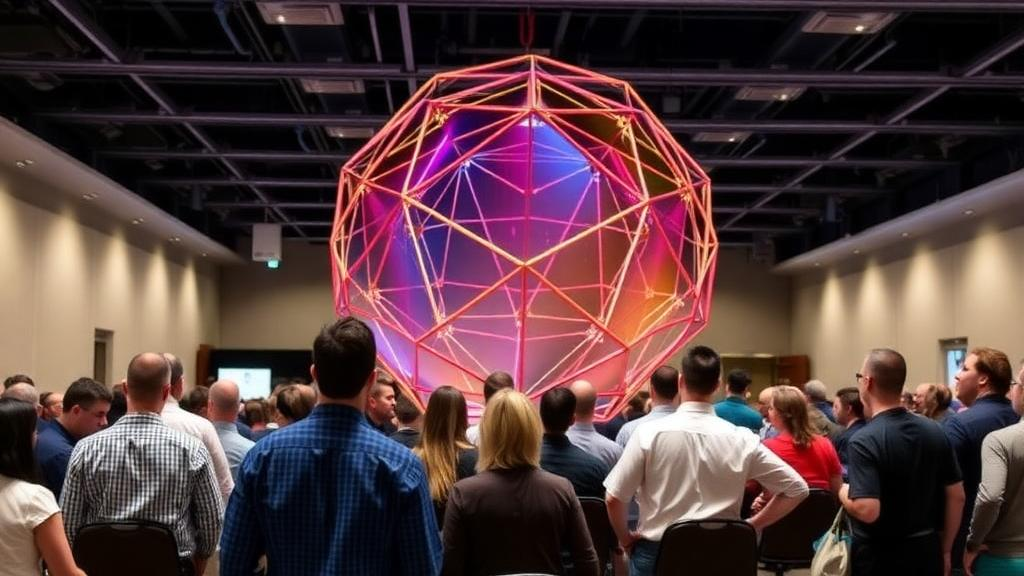
Registration is now open for the SIAM Conference on Mathematics of Data Science, known as MDS26, a meeting that promises to sit at the exact intersection where abstract mathematics collides with the practical machinery of the modern data economy. Organized by the Society for Industrial and Applied Mathematics, the conference will bring together researchers and practitioners from academia, industry, government, and national laboratories to explore advances in the mathematical foundations of data science. For a field that increasingly underpins everything from medical imaging to recommendation engines, the gathering represents a rare moment when the people building the theory and the people deploying it in production share the same rooms and the same whiteboards.
The central theme of this year’s meeting is the mathematics of data science in high dimensions, a phrase that sounds technical but describes one of the most consequential challenges in contemporary computation. Real-world datasets, whether they describe gene expression profiles, pixel intensities in images, or the embeddings that large language models use to represent words, live in spaces with thousands or millions of coordinates. Human intuition, forged in a world of three dimensions, fails spectacularly in such settings. Distances behave strangely, volumes concentrate in unexpected places, and phenomena that seem impossible at small scale become routine. The mathematics needed to navigate these spaces, from concentration inequalities to random matrix theory, has become the invisible scaffolding of modern artificial intelligence.
Dimensionality reduction and embeddings form one of the announced focal topics, and for good reason. Techniques such as principal component analysis, random projections, and manifold learning all attempt the same fundamental task: compressing enormous datasets into smaller representations that preserve the structure that matters. The theoretical guarantees behind these methods, including the Johnson-Lindenstrauss lemma and its many descendants, tell practitioners exactly how much information can be retained and at what computational cost. As embedding-based systems have become the backbone of search, retrieval, and generative models, the demand for sharper theory about when these compressed representations are faithful, and when they silently distort, has grown correspondingly urgent.
Scalability and parallel algorithms constitute a second announced focus, reflecting a reality that every practicing data scientist knows intimately: a beautiful algorithm that cannot run at scale is, for most purposes, not an algorithm at all. The conference program will address how classical numerical methods must be rethought for distributed and parallel architectures, where communication costs between processors often dominate the raw arithmetic. Questions of numerical stability, synchronization, and the trade-offs between exact and approximate computation take on new life when datasets no longer fit on a single machine. Work in this area connects the oldest traditions of numerical analysis with the newest hardware, from GPU clusters to specialized accelerators.
Algebraic and geometric data analysis rounds out the highlighted topics, and it is here that the meeting’s intellectual ambitions are perhaps most visible. Topological data analysis, tensor decomposition, and algebraic approaches to statistical problems treat data not as a table of numbers but as an object with shape and structure. A cloud of points may reveal a loop, a void, or a manifold whose topology explains a hidden variable in the data-generating process. Tensors, the higher-dimensional generalizations of matrices, have become essential for representing multi-way data in neuroscience, chemometrics, and machine learning, and their decomposition theory draws on deep results in multilinear algebra. These methods remain mathematically demanding, which is precisely why a conference devoted to their foundations matters.
MDS26 will not stand alone. The meeting will be held jointly with the SIAM Conference on Imaging Science, IS26, and the SIAM International Conference on Data Mining, SDM26, creating a triple convergence of communities that rarely have the chance to interact at this scale. Imaging science brings its own mathematical culture, built on inverse problems, variational methods, and the physics of measurement, while data mining contributes a strongly applied tradition of pattern discovery, clustering, and graph analytics. Holding the three conferences together means that a single registration opens the door to sessions spanning the full pipeline from sensor and image formation through mathematical modeling to deployed analytical systems.
The joint format reflects a deliberate philosophy about how progress in data science actually happens. Breakthroughs rarely emerge from a single discipline working in isolation. Compressed sensing, one of the defining results of the last two decades, required harmonic analysis, optimization, and signal processing to advance together. The theory of neural networks is being reshaped today by statisticians, dynamical systems experts, and approximation theorists working in parallel. By colocating imaging, data mining, and the mathematics of data science, the organizers have engineered the kind of cross-pollination that historically produces such breakthroughs, allowing a statistician wrestling with high-dimensional inference to wander into a session on inverse problems in tomography and find the missing piece.
Presentations at the meeting will span the full range from foundational theory to real-world applications, according to the announcement. That spectrum is a defining feature of the SIAM conference series, which has long served as a bridge between communities that publish in different journals and attend different meetings. Theoretical results on optimization landscapes or the convergence rates of sampling algorithms may appear on the same program as case studies from national laboratories or industrial research groups. The stated aim is to highlight advances in mathematical, statistical, and computational methods that shape how data are analyzed, modeled, and used to inform decision-making, a formulation that deliberately places decision-making, not computation, at the endpoint of the pipeline.
For attendees, the practical significance of the meeting lies in its timing. The past several years have seen artificial intelligence systems deployed at a pace that has outstripped the theory meant to explain them. Understanding why large models generalize, when embeddings can be trusted, and how to certify the outputs of high-dimensional statistical procedures are open problems with immediate consequences. Conferences like MDS26 function as the venues where the mathematical community organizes its response, identifying which empirical observations deserve theoretical explanation and which theoretical tools are ready to be transferred into practice. The organizers extend an explicit invitation for participants to engage with emerging ideas, share insights, and help define the next generation of mathematics for data science.
Registration for MDS26 is open now through the Society for Industrial and Applied Mathematics, with full details for the conference and its two joint meetings, IS26 and SDM26, available on the SIAM conference website. For researchers whose work lives in the high-dimensional spaces where modern data resides, and for practitioners who depend on the guarantees that mathematics provides, the meeting offers a concentrated survey of where the field stands and where it is heading. In a discipline that increasingly determines how societies analyze, model, and act on information, the mathematics of data science has never mattered more, and MDS26 is positioned as one of the year’s essential gatherings for anyone building its foundations.
Subject of Research: Mathematical foundations of data science, including high-dimensional data analysis, dimensionality reduction, scalable algorithms, and algebraic and geometric methods
Article Title: SIAM Conference on Mathematics of Data Science (MDS26)
Article References: SIAM Conference on Mathematics of Data Science (MDS26). (n.d.). Original publication
Image Credits: AI Generated
DOI: Not provided
Keywords: SIAM, MDS26, mathematics of data science, high-dimensional data, dimensionality reduction, embeddings, parallel algorithms, algebraic data analysis, geometric data analysis, imaging science, data mining, conference
Cite Scienmag News
Reid Dalton. (October 7, 2026). Mathematicians Gather to Decode the Hidden Geometry of Data at SIAM’s MDS26. Scienmag. https://scienmag.com/mathematicians-gather-to-decode-the-hidden-geometry-of-data-at-siams-mds26/
Reid Dalton. "Mathematicians Gather to Decode the Hidden Geometry of Data at SIAM’s MDS26." Scienmag, 7 October 2026, https://scienmag.com/mathematicians-gather-to-decode-the-hidden-geometry-of-data-at-siams-mds26/. Accessed 7 October 2026.
Reid Dalton. "Mathematicians Gather to Decode the Hidden Geometry of Data at SIAM’s MDS26." Scienmag. October 7, 2026. https://scienmag.com/mathematicians-gather-to-decode-the-hidden-geometry-of-data-at-siams-mds26/


