


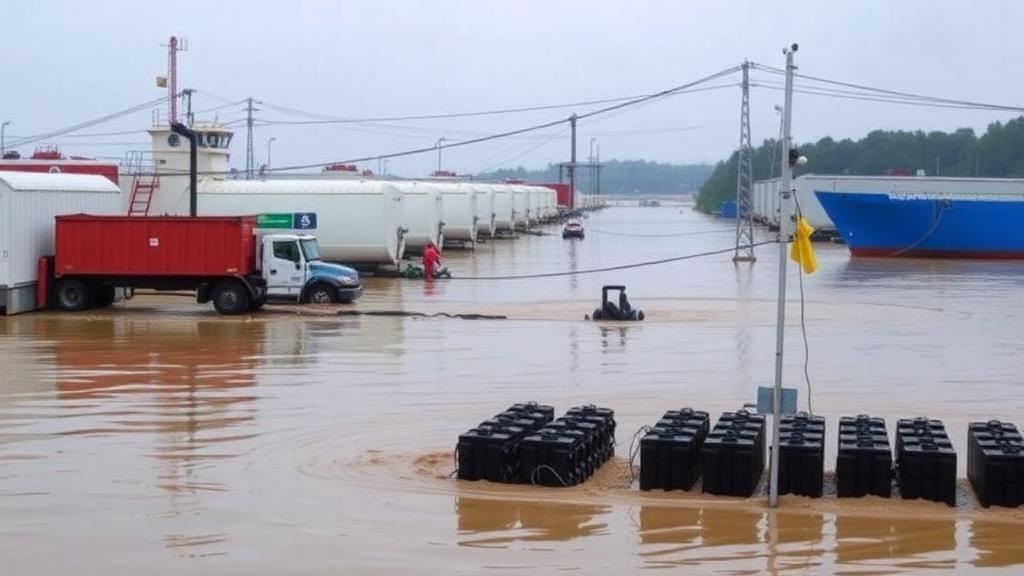
The global race to electrify transportation rests on a surprisingly narrow physical foundation: a handful of chemical plants, clustered in a few flood-prone regions of China, that produce the lithium hydroxide feeding the world’s electric vehicle batteries. A new study published in the Journal of Industrial Ecology has mapped, site by site, how climate-driven flooding could disrupt this critical link in the battery supply chain, and the picture it paints is one of striking concentration risk. According to the research, led by Yin Yang of China Southern Power Grid’s Energy Development Research Institute and the University of Oxford’s Smith School of Enterprise and the Environment, flood exposure in the lithium hydroxide sector is not spread evenly across the landscape. Instead, it is heavily concentrated in a small number of facilities, with a single company, Ganfeng Lithium, emerging as the most exposed node in the entire network, facing potential economic losses of up to 1.2 billion yuan.
The study arrives at a moment when the vulnerability of global supply chains to extreme weather has moved from theoretical concern to lived experience. As the authors note in their introduction, supply chains have become increasingly interconnected, and that connectivity cuts both ways: it enables efficiency and cost reduction, but it also means that a disruption in one segment can propagate across industries, shaking economic stability far from the point of origin. For firms that depend on specific regions for critical inputs, climate change transforms a distant flood from someone else’s problem into a direct threat to production lines, delivery schedules, and ultimately the pace of the energy transition itself.
To quantify that threat, the research team turned to a global flood model, running its outputs under two contrasting climate scenarios drawn from the Shared Socioeconomic Pathway framework: SSP126, which represents a future of relatively strong climate mitigation, and SSP585, a high-emissions pathway with substantially greater warming. By overlaying modeled flood hazards onto the locations of lithium hydroxide production facilities, the researchers could estimate which plants sit in harm’s way, how deep floodwaters might reach at each site, and what the resulting damage could cost. This approach, combining flood depth-damage functions developed by the European Commission’s Joint Research Centre with detailed facility-level data, allowed the team to move beyond coarse regional averages and assess risk at the resolution that actually matters for a factory floor.
The geographic findings are unambiguous. Two Chinese provinces, Jiangxi and Sichuan, stand out as hotspots of flood exposure for lithium hydroxide production. Jiangxi, in southeastern China, has become a hub of lithium processing built around the region’s lepidolite deposits, while Sichuan, in the southwest, hosts significant lithium resources and processing capacity in mountainous terrain where river systems can swell dramatically during monsoon seasons. The study’s flood modeling under both climate scenarios identifies significant exposure in these key production regions, meaning that the raw material backbone of the world’s electric vehicle battery industry is disproportionately located in areas where extreme precipitation and riverine flooding are projected to intensify.
What makes the analysis particularly consequential is its finding that flood risk is highly concentrated in just a few sites. In supply chain terms, this is the definition of a single point of failure: if one or two of the most exposed facilities were knocked offline by a major flood, the shortfall could not be easily absorbed by the rest of the network. The identification of Ganfeng Lithium as the site with the greatest potential losses, up to 1.2 billion yuan, underscores how much value is packed into individual production complexes. For battery manufacturers, automakers, and the investors financing the energy transition, the implication is that climate risk in the lithium supply chain is not a diffuse background hazard but a specific, nameable, and potentially insurable exposure.
Equally important is the study’s methodological warning about how flood risk is measured. The researchers found that flood depth distributions are highly uneven across sites, which means that aggregate indicators, such as the share of a province’s production lying within a flood zone, can seriously mislead. Two facilities in the same region may face radically different water depths under the same storm, and therefore radically different damage. Depth matters because flood damage does not scale linearly: shallow flooding may cause modest cleanup costs, while deeper inundation can destroy electrical systems, corrode equipment, and halt production for months. The authors argue that site-level analysis is essential, and that reliance on aggregate indicators would obscure exactly the concentrations of risk that matter most for resilience planning.
The choice of lithium hydroxide as the focal chemical is itself telling. Lithium hydroxide is the preferred lithium compound for high-nickel cathode chemistries, such as nickel-cobalt-aluminum and high-nickel nickel-cobalt-manganese formulations, which dominate in many long-range electric vehicles. Converting spodumene ore or lithium-rich brines into battery-grade hydroxide is an energy- and capital-intensive process, and the global capacity for it is geographically skewed toward China, which processes the majority of the world’s lithium. That concentration means that climate hazards in a few Chinese provinces ripple through battery plants in Korea, gigafactories in Europe, and assembly lines in North America. The study’s use of the BACI bilateral trade database from the United Nations, covering trade flows for 200 countries across 5,000 product categories, reflects the researchers’ effort to trace these international dependencies rigorously.
The broader context of the research is the scientific consensus, articulated most recently in the Intergovernmental Panel on Climate Change’s Sixth Assessment Report, that extreme precipitation and flooding are intensifying in many regions as the atmosphere warms. A warmer atmosphere holds more moisture, and the statistical distribution of rainfall shifts toward more intense downpours. For industrial facilities sited along rivers or in floodplains, often for historical reasons of water access and transport, this means that the design storms of the twentieth century are no longer reliable guides to twenty-first-century risk. The study’s dual-scenario approach captures this uncertainty: under SSP585, with high emissions and greater warming, flood hazards grow more severe, while SSP126 offers a lower but still significant baseline of exposure, demonstrating that some level of climate risk to lithium hydroxide production is already locked in.
What can be done? The authors’ prescriptions are direct: geographic diversification and flexible supply chain models. Diversification means spreading lithium hydroxide production across more regions and more firms, so that no single flood event can cripple supply. Flexibility means designing supply chains that can reroute flows, substitute inputs, and draw down strategic inventories when a disruption strikes. Both strategies carry costs, and the study is candid that firms have historically prioritized efficiency over resilience, concentrating production where it is cheapest. But as the authors argue, in turbulent times, resilience is not a luxury; it is a condition of survival for firms whose entire business depends on uninterrupted flows of critical materials.
The findings resonate well beyond lithium. The methodological template, combining global flood models under multiple climate scenarios with facility-level exposure mapping and depth-damage estimation, can be applied to any critical input concentrated in hazard-prone regions, from semiconductor fabs to pharmaceutical plants to grain terminals. As climate change accelerates, the study suggests, the invisible architecture of global trade will need to be re-examined not just for cost and carbon, but for water. For the electric vehicle industry in particular, the message is sobering: the clean energy transition depends on a chemical supply chain whose most important nodes are sitting in the path of rising floodwaters, and the time to diversify, relocate, or reinforce them is now, before the next catastrophic monsoon season tests the system’s limits.
Subject of Research: Climate-induced flood risks to lithium hydroxide production and the electric vehicle battery supply chain in China
Article Title: Flood risks to the supply chain of electric vehicle batteries under climate change: a case study of lithium hydroxide production
Article References: Yang, Y., Xie, Q., Hu, X., Pant, R., & Huang, J. (2026). Flood risks to the supply chain of electric vehicle batteries under climate change: a case study of lithium hydroxide production. Journal of Industrial Ecology, 30(4), 1597-1608. https://doi.org/10.1007/s44498-026-00107-y
Image Credits: AI Generated
DOI: 10.1007/s44498-026-00107-y
Keywords: climate change, flooding, lithium hydroxide, electric vehicle batteries, supply chain, China, Jiangxi, Sichuan, Ganfeng Lithium, flood risk modeling, SSP scenarios, supply chain resilience
Cite Scienmag News
Faith Mcneil. (October 7, 2026). Floodwaters Threaten the Heart of the Electric Vehicle Battery Supply Chain. Scienmag. https://scienmag.com/floodwaters-threaten-the-heart-of-the-electric-vehicle-battery-supply-chain/
Faith Mcneil. "Floodwaters Threaten the Heart of the Electric Vehicle Battery Supply Chain." Scienmag, 7 October 2026, https://scienmag.com/floodwaters-threaten-the-heart-of-the-electric-vehicle-battery-supply-chain/. Accessed 7 October 2026.
Faith Mcneil. "Floodwaters Threaten the Heart of the Electric Vehicle Battery Supply Chain." Scienmag. October 7, 2026. https://scienmag.com/floodwaters-threaten-the-heart-of-the-electric-vehicle-battery-supply-chain/


