


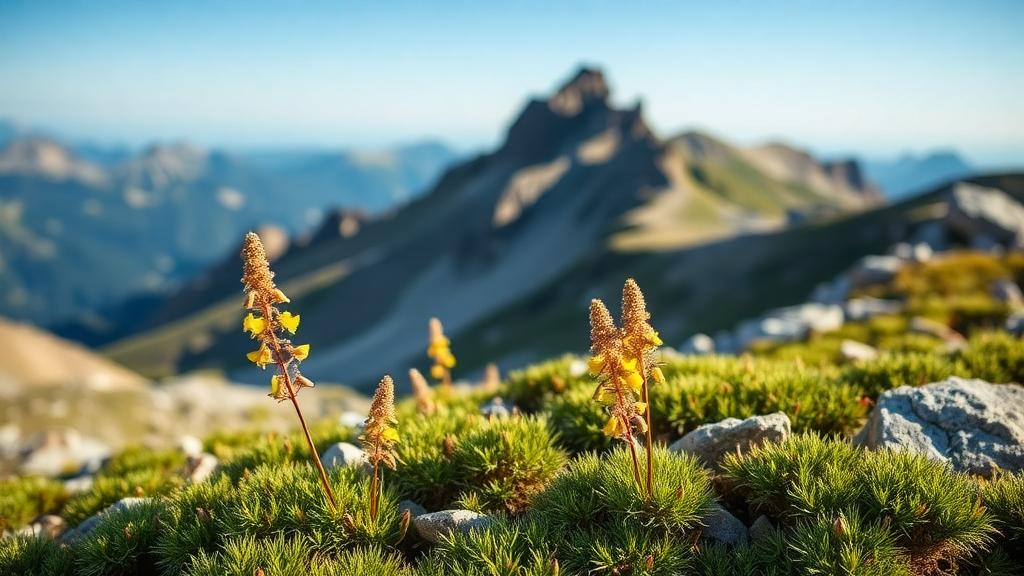
For decades, scientists watching Europe’s mountain summits have reported what looked like a quiet success story of alpine biodiversity. As the climate warmed, cold-tolerant plants from lower elevations crept upward, and the number of species recorded on mountaintops steadily climbed. But a new study published in Science reveals that this apparent boom conceals a troubling counter-current: the plants that truly define Europe’s high-elevation ecosystems are disappearing at an accelerating rate, and the losses are now rising fast enough to challenge the optimistic narrative of ever-richer summit floras.
An international research team led by scientists from the University of Vienna, together with colleagues at BOKU University and the Austrian Academy of Sciences, analysed vegetation records from 62 European mountain summits that were surveyed four times between 2001 and 2022. The plots form part of GLORIA, the Global Observation Research Initiative in Alpine Environments, a worldwide monitoring network coordinated from Austria that uses standardised multi-summit plots to track vegetation change across elevation gradients. Because every summit in the network is revisited on the same schedule and with the same methods, the dataset offers an unusually clear window into how alpine plant communities respond to a warming climate in near real time.
The underlying mechanism is straightforward. Until a few decades ago, short growing seasons, low accumulated warmth and the risk of frost at any time of year made Europe’s alpine landscapes effectively impenetrable to many lowland and montane species. Accelerating climate warming has relaxed these constraints, allowing plants to expand their ranges upward. Summit vegetation has consequently become more species-rich, a pattern documented repeatedly across mountain ranges on several continents. What the new analysis adds is the other side of the ledger: an explicit, quantified account of the species that vanish from these same summits, and of how quickly those disappearances are accelerating.
The data show that the percentage of species not re-detected on a given summit increased with each successive survey period. In other words, local extinctions are not a rare background process but a growing one, and the trend has strengthened over the past two decades. Crucially, the losses were not distributed randomly across the flora. Species whose centres of distribution lie above the elevation of the focal summit were significantly overrepresented among those that disappeared. These are the cold-adapted specialists of the highest zones, the cushion plants, mosses and rosette herbs that have nowhere higher to go and that give alpine ecosystems their distinctive character.
The study’s statistical analysis points unambiguously to warming as the driver. First author Johannes Wessely of the University of Vienna notes that species were more likely to disappear from summits that experienced stronger warming, and that this correlation with the magnitude of temperature increase was even stronger than the simple passage of time. That distinction matters scientifically: if extinctions merely tracked the calendar, any number of unrelated processes could be responsible. The fact that the loss rate scales with the degree of warming experienced at each site identifies rising temperatures as the proximate cause of the accelerating disappearances.
Position within a species’ overall range turned out to be a second powerful predictor. The likelihood of local extinction increases towards the lower elevational margin of a species’ current distribution. Harald Pauli, coordinator of the GLORIA network at the Austrian Academy of Sciences and BOKU University, explains the implication plainly: when species already grow on warmer-than-average sites, they become more sensitive to further temperature increases. Populations at the warm edge of a range are, in effect, living closest to their physiological limits, so each additional fraction of a degree pushes them closer to the threshold beyond which they can no longer persist on a given summit.
One of the most conceptually important findings concerns timing. The specialists of high elevations tend to be particularly stress-tolerant and long-lived. Individual plants of some alpine species can survive for many decades, and their populations can persist in declining condition long after the environmental conditions that once sustained them have gone. This means local extinction can lag far behind the onset of the environmental changes that ultimately trigger it, a phenomenon ecologists describe as an extinction debt. Biological communities accumulate invisible losses that will only become apparent years or decades later, when the last surviving individuals of a doomed population finally die out.
This lag effect has long been the leading explanation for an asymmetry in alpine vegetation records: colonisations by new species arriving from below have been documented far more frequently than extinctions of established residents. The new results fit that interpretation closely. The analysis found that local extinctions are typically preceded by longer phases of population decline, meaning that the disappearances recorded between surveys are the end point of processes that began much earlier. Stefan Dullinger, project coordinator of the study, emphasises that the elevated extinction rates observed today could therefore indicate that an extinction debt accumulated over past decades is now starting to be paid off, although he cautions that whether this interpretation holds true needs further investigation.
The implications of that possibility are sobering. If current extinction rates reflect warming that occurred or at least began decades ago, then the losses already locked into alpine communities exceed what the monitoring record shows today. The full cost of twentieth-century and early twenty-first-century warming may still be working its way through populations of long-lived mountain plants, with further disappearances inevitable even under optimistic emissions scenarios. At the same time, the accelerating trend means that new debts continue to accumulate, stacking future losses on top of those already in the pipeline. For the cold-adapted specialists of Europe’s highest summits, there is little room for upward retreat: many already occupy the top of their mountains, and the regional species pool offers no replacement flora adapted to the harshest summit conditions.
The study reframes a widely cited indicator of climate change impact. Rising species richness on mountain summits has often been presented as evidence that alpine biodiversity is, for now, benefiting from warming. The new analysis shows that this metric is misleading on its own, because it counts arrivals while ignoring departures and because the departures disproportionately remove the species that are most characteristic of alpine ecosystems. Biodiversity change, the authors argue, must be assessed on both sides of the ledger simultaneously. The research was funded by the European Research Council under the European Union’s Horizon 2020 research and innovation programme, grant agreement number 883669, and the long-term GLORIA monitoring that made it possible continues across summit sites worldwide, providing the observational foundation needed to test whether the extinction debt now visible on Europe’s mountaintops will continue to grow.
Subject of Research: Accelerating climate-driven local extinctions of high-elevation specialist plants on European mountain summits
Article Title: Rising plant extinction rates on European mountain summits
Article References: Rising plant extinction rates on European mountain summits. (n.d.). Original publication
Image Credits: AI Generated
DOI: Not provided
Keywords: alpine plants, mountain summits, climate warming, local extinction, extinction debt, GLORIA, biodiversity monitoring, species range shifts, high-elevation specialists, European Alps, vegetation change, Science journal
Cite Scienmag News
Violet Maxwell. (October 7, 2026). Alpine plants are vanishing from European summits faster than ever before. Scienmag. https://scienmag.com/alpine-plants-are-vanishing-from-european-summits-faster-than-ever-before/
Violet Maxwell. "Alpine plants are vanishing from European summits faster than ever before." Scienmag, 7 October 2026, https://scienmag.com/alpine-plants-are-vanishing-from-european-summits-faster-than-ever-before/. Accessed 7 October 2026.
Violet Maxwell. "Alpine plants are vanishing from European summits faster than ever before." Scienmag. October 7, 2026. https://scienmag.com/alpine-plants-are-vanishing-from-european-summits-faster-than-ever-before/


