


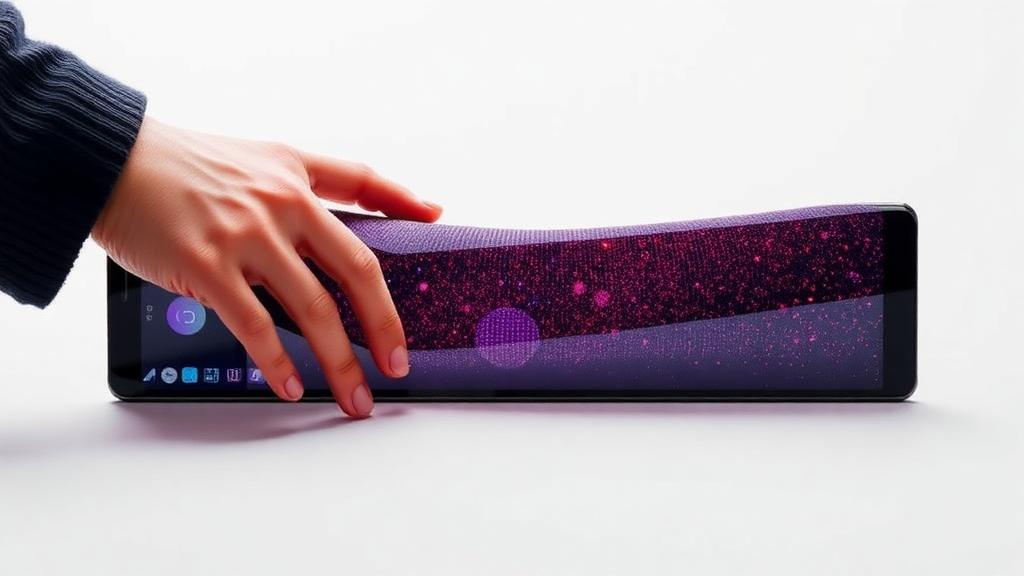
A display that stretches like a rubber band yet keeps every pixel razor sharp sounds like science fiction, but a research team in South Korea has turned the concept into working hardware. Scientists at DGIST (Daegu Gyeongbuk Institute of Science and Technology), working with collaborators at UNIST and the Institute for Basic Science, have unveiled what they describe as the world’s first foundational technology for an ultra-high-resolution stretchable quantum dot display, or QLED, that can deform freely like human skin while preserving image quality. The work, published online in September 2026 in Nature Nanotechnology, points toward a future in which wearable devices and electronic skin no longer force users to choose between flexibility and visual performance.
Stretchable displays have long been viewed as the next step beyond the foldable and rollable screens that now dominate headlines in consumer electronics. The appeal is obvious: a screen that can be pulled, twisted, and conformed to curved surfaces would open the door to wearable devices that wrap around wrists, arms, or even organs, and to electronic skin that could display information directly on the body. Yet the field has been haunted by a fundamental design compromise. In most conventional stretchable display architectures, only the electrical wiring, known as the interconnects, is engineered to stretch. The light-emitting regions themselves remain rigid and fixed in place. When the display is stretched, those emitting regions spread apart like islands on a widening sea, and the fraction of the display area that actually produces light shrinks dramatically. The result is a screen that looks increasingly sparse, dim, and washed out the moment it is deformed.
To escape this trap, researchers around the world have pursued a more ambitious approach called intrinsic stretchability, in which the light-emitting pixels themselves behave like rubber bands, elongating along with the rest of the device rather than merely drifting apart. In principle, this keeps the emitting area constant and the image intact under strain. In practice, the approach has proven notoriously difficult. Soft, rubber-like light-emitting layers resist the kind of precise patterning that high-resolution displays demand, and conventional organic composite materials used in such devices have suffered from significantly reduced color reproduction and brightness. A stretchable screen that cannot produce vivid colors or adequate luminance is of little practical value, no matter how elastic it may be.
The joint team, led by Professor Jiwoong Yang of the Department of Energy Science and Engineering at DGIST in collaboration with a team led by Professor Moon Kee Choi of UNIST and a team led by Associate Director Dae-Hyeong Kim of the IBS Center for Nanoparticle Research, addressed these challenges with a new fabrication process the researchers call LIFT. The technique rests on a clever marriage of chemistry and mechanics. Quantum dots, which are light-emitting nanoparticles prized for their tunable colors and high efficiency, are chemically bonded to an elastic polymer that can stretch like rubber. The resulting composite is then transferred onto a surface as fine patterns in a process the team likens to stamping a seal, pressing precisely defined structures into place rather than trying to pattern the soft material directly.
A critical refinement came in the treatment of the light-emitting layer’s surface. The researchers applied a specialized surface treatment designed to improve both the electrical conductivity and the adhesion of the layer. This dual function matters because the two properties tend to pull in opposite directions in stretchable electronics: materials that conduct electricity well are often stiff and brittle, while soft, adhesive materials frequently conduct poorly. By engineering the surface and interface properties of the quantum dot composite, the team enabled precise pattern formation and excellent light-emitting performance at the same time, without sacrificing the stretchability of the material itself.
The performance numbers reported by the team are striking. Using the LIFT process, the researchers created ultra-high-resolution patterns with a pixel density of up to 16,000 pixels per inch, a figure that places the technology among the finest display patterning achievements ever reported and far beyond what the human eye can resolve at normal viewing distances. They also produced high-quality multicolor pixels using stretchable red, green, and blue light-emitting layers, the essential building blocks of full-color imagery. The completed device achieved a maximum brightness of 53,300 nits, a luminance level that dwarfs the previous ceiling of roughly 15,000 nits for stretchable light-emitting devices and represents the highest brightness reported for any device in this class. For context, that level of brightness is bright enough to remain clearly visible even in demanding ambient lighting conditions.
Equally important is how the device behaves under mechanical stress. The team reports that the display operated stably without mechanical damage or any degradation in image quality even when stretched to approximately 65 percent beyond its original length. In other words, a user could pull the screen substantially out of shape and the picture would remain as crisp and luminous as before, with the pixels themselves elongating gracefully rather than cracking or dimming. This combination of record brightness, extreme pixel density, and genuine mechanical resilience is what distinguishes the work from earlier demonstrations that managed one or two of these attributes but never all of them together.
Professor Yang emphasized the broader significance of the achievement in remarks accompanying the release. He noted that the study is highly significant because the team simultaneously achieved fine pixel fabrication and improved light-emitting performance by precisely controlling surfaces and interfaces while maintaining the stretchability of the quantum dot composites. He added that by successfully combining the chemical design of materials with precision fabrication technologies, the research will significantly expand the potential for the commercialization of next-generation stretchable displays. The statement underscores a theme that runs through the entire project: progress came not from a single breakthrough material but from the careful co-design of chemistry, surface engineering, and manufacturing technique.
The implications reach well beyond the laboratory. Wearable devices are converging on forms that hug the body, and electronic skin concepts for robotics, health monitoring, and prosthetics all require displays that can survive continuous deformation while delivering readable, colorful output. A stretchable QLED platform built on intrinsically elastic pixels could allow future devices to integrate screens into sleeves, patches, bandages, or garments without the visual penalties that plague current approaches. The record brightness also matters for outdoor and medical applications, where displays must compete with sunlight or penetrate through layers of material. While the path from a laboratory prototype to mass production always involves additional engineering hurdles, the demonstration of a complete, reproducible fabrication process rather than a one-off device gives the work a distinctly commercial orientation.
The research was supported by programs of the National Research Foundation of Korea, including the Global Young Connect and Mid-Career Researcher programs, reflecting sustained public investment in next-generation display science. The findings were published in Nature Nanotechnology under the title describing high-resolution intrinsically stretchable quantum-dot displays achieved through thermally assisted intaglio transfer printing, a name that captures the stamp-like transfer method at the heart of the LIFT process. As foldable phones give way to ever more ambitious form factors, this work suggests that the displays of the coming decade may not merely bend at a hinge but stretch across the curved surfaces of the human body itself, glowing brightly and sharply the entire time.
Subject of Research: Intrinsically stretchable high-resolution quantum dot display technology
Article Title: “Image quality remains intact even when stretched like a rubber band”: DGIST develops world’s brightest “stretchable quantum dot display”
Article References: “Image quality remains intact even when stretched like a rubber band”: DGIST develops world’s brightest “stretchable quantum dot display”. (n.d.). Original publication
Image Credits: AI Generated
DOI: Not provided
Keywords: quantum dots, stretchable display, QLED, wearable devices, electronic skin, DGIST, Nature Nanotechnology, pixel density, luminance, transfer printing, flexible electronics, nanotechnology
Cite Scienmag News
Katie Riggs. (October 7, 2026). Stretchable Quantum Dot Display Hits Record 53,300 Nits While Stretching Like Skin. Scienmag. https://scienmag.com/stretchable-quantum-dot-display-hits-record-53300-nits-while-stretching-like-skin/
Katie Riggs. "Stretchable Quantum Dot Display Hits Record 53,300 Nits While Stretching Like Skin." Scienmag, 7 October 2026, https://scienmag.com/stretchable-quantum-dot-display-hits-record-53300-nits-while-stretching-like-skin/. Accessed 7 October 2026.
Katie Riggs. "Stretchable Quantum Dot Display Hits Record 53,300 Nits While Stretching Like Skin." Scienmag. October 7, 2026. https://scienmag.com/stretchable-quantum-dot-display-hits-record-53300-nits-while-stretching-like-skin/


