


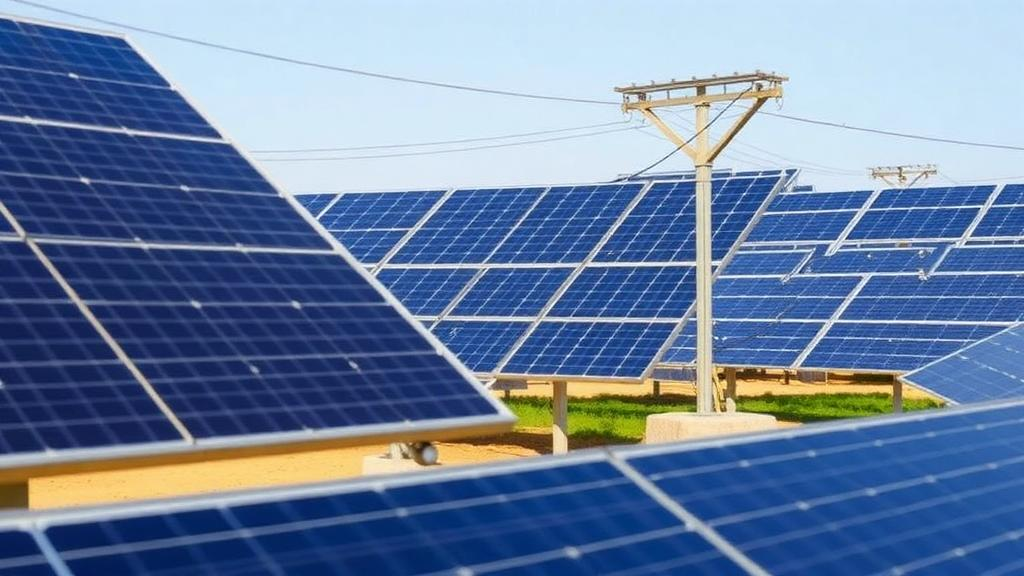
Across much of Asia, Africa, and Latin America, the electricity grid is not absent but unreliable. Power arrives for most of the day and then vanishes, repeatedly, for minutes or hours at a time, as utilities shed load to cope with generation shortfalls and distribution constraints. For households, clinics, and small businesses living with this chronic interruption, rooftop solar paired with battery storage is the obvious backup. Yet the standard methods for sizing such systems were built for two extremes that do not describe this reality: a fully reliable grid where the battery merely saves money, or a completely off-grid site where the system must survive alone. A new study published in Results in Engineering maps the neglected middle ground, and its findings overturn a common intuition about what makes a solar-battery system resilient.
The study, authored by Riad Mollik Babu, introduces the concept of a grid-unreliability regime, a statistical description of the interruption process captured by five independent quantities: the fraction of hours per year the grid is down, the mean duration of each outage, the variability of those durations, the predictability of outages in advance, and the timing bias of outages relative to solar availability. Rather than optimizing a single installation under one assumed condition, the analysis swept this five-dimensional space across 1,536 sampled regime points, sizing a distributed photovoltaic and battery system at each one against three objectives: net present cost, expected unserved critical energy, and life-cycle carbon intensity. The work is anchored to Dhaka, Bangladesh, where recurring load shedding exemplifies chronic grid unreliability.
To make results comparable across sites, the designs were expressed as two dimensionless ratios: a storage ratio, defined as battery energy per unit of daily critical load, and a PV ratio, defined as daily solar energy per unit of daily critical load. Outages were generated by an alternating-renewal process with durations drawn from a Gamma distribution, which allows the mean and the spread of outage durations to be set independently, a flexibility the conventional two-state Markov model lacks because it fixes the duration variability at one. A rule-based rolling-horizon controller operated each simulated year at hourly resolution, with predictability entering as the fraction of outage events revealed to the controller before they occur.
The variance decomposition, computed with second-order Sobol indices on the mean of five replicated optimizer runs, produced a striking hierarchy. The outage time fraction dominates both design ratios, with a total-order Sobol index of roughly 0.58 for each. Mean outage duration and duration variability follow. For the storage ratio, the response is almost purely additive: how much, how long, and how variably the grid is out together explain nearly all of the variance. Notably, the storage requirement grows fastest at low outage fractions, meaning the biggest design sensitivity sits in mildly unreliable grids rather than the most severe ones, a regime of diminishing structural return as outages intensify.
The most surprising result concerns predictability. Intuition would place advance knowledge of outages on the storage decision, since a controller that knows an outage is coming can pre-charge the battery. The evidence moves it almost entirely off that decision. Once residual stochastic variance from the optimizer and the synthetic outage years was removed, predictability’s total-order index on the storage ratio fell to about 0.02. What actually lowers the required PV capacity is not foresight but permission: the simple ability to charge the battery from the grid between outages. A blanket pre-charging policy holding no outage information whatsoever captured 87 to 109 percent of the PV reduction achieved by perfect foresight, and the paired difference between the two was not statistically resolved in any tested regime.
Predictability does matter, but through a different channel. At a fixed charging rule, moving from uninformed blanket pre-charging to full foresight cut annual imported grid energy by 67 percent in the severe regime and lowered life-cycle carbon intensity by 45 percent, from 145.6 to 79.6 grams of CO2-equivalent per kilowatt-hour. The advantage shrinks where outages fall after dark, because evening interruptions carry little solar overlap and the battery must be filled largely from the grid whether or not the controller anticipates them. Foresight, in other words, governs the efficiency of grid charging, not the size of the array.
The study also quantified the price of reliability. Median net present cost rose 51 percent from a 95 percent to a 99 percent critical-load availability target, and a further 32 percent to reach 99.9 percent. Every one of the 1,536 sampled regimes proved feasible even at 99.9 percent energy-based availability, demonstrating that chronic load shedding does not impose the survival limit of a rare multi-day outage. The framework was benchmarked against conventional sizing rules with sobering results: sizing the same Dhaka consumer as though the grid were absent inflated cost by 103 to 185 percent, while a days-of-autonomy rule overshot by 156 to 270 percent, because both ignore the energy the grid delivers between interruptions.
Robustness was tested extensively. The design rules transferred across a second solar year, an alternative double-peaked load profile, and two other cities, Karachi and Lagos, with the mean PV ratio moving by under 4 percent and the sensitivity structure statistically indistinguishable between sites. Correlated regime combinations, imperfect forecasts, and narrowed parameter ranges were also examined. When forecast skill degraded from perfect to useless, systems whose pre-charging depended on announced schedules saw PV requirements balloon by 68 to 196 percent, because the controller stopped importing and reverted to solar-only operation. The robust policy is to permit grid charging unconditionally and use any published schedule only to reduce imported energy.
The practical implications reach beyond engineering. Metering or tariff rules that block grid charging of home batteries quietly raise the capacity customers must install, while a reliable load-shedding schedule does not shrink that capacity but does cut the grid energy and emissions needed to hold a given reliability level. Both benefits remain invisible to design methods that treat predictability as a storage-side parameter. By reducing grid unreliability to five measurable quantities and showing how each shapes the cost-optimal design, the study offers a transferable playbook for the billions of people whose grids are present but perpetually imperfect.
Subject of Research: Optimal sizing of distributed PV and battery systems under chronic grid unreliability regimes
Article Title: Resilience value of distributed PV and battery systems under grid-unreliability regimes
Article References: Babu, R. M. (2026). Resilience value of distributed PV and battery systems under grid-unreliability regimes. Results in Engineering, 32, Article 113342. https://doi.org/10.1016/j.rineng.2026.113342
Image Credits: AI Generated
DOI: 10.1016/j.rineng.2026.113342
Keywords: distributed PV, battery storage, grid unreliability, load shedding, resilience, Sobol sensitivity analysis, multi-objective optimization, Dhaka, energy access, predictability, techno-economic sizing, life-cycle carbon
Cite Scienmag News
Faith Mcneil. (October 6, 2026). Solar and Battery Sizing Gets a Reality Check for Grids That Keep Failing. Scienmag. https://scienmag.com/solar-and-battery-sizing-gets-a-reality-check-for-grids-that-keep-failing/
Faith Mcneil. "Solar and Battery Sizing Gets a Reality Check for Grids That Keep Failing." Scienmag, 6 October 2026, https://scienmag.com/solar-and-battery-sizing-gets-a-reality-check-for-grids-that-keep-failing/. Accessed 6 October 2026.
Faith Mcneil. "Solar and Battery Sizing Gets a Reality Check for Grids That Keep Failing." Scienmag. October 6, 2026. https://scienmag.com/solar-and-battery-sizing-gets-a-reality-check-for-grids-that-keep-failing/


