


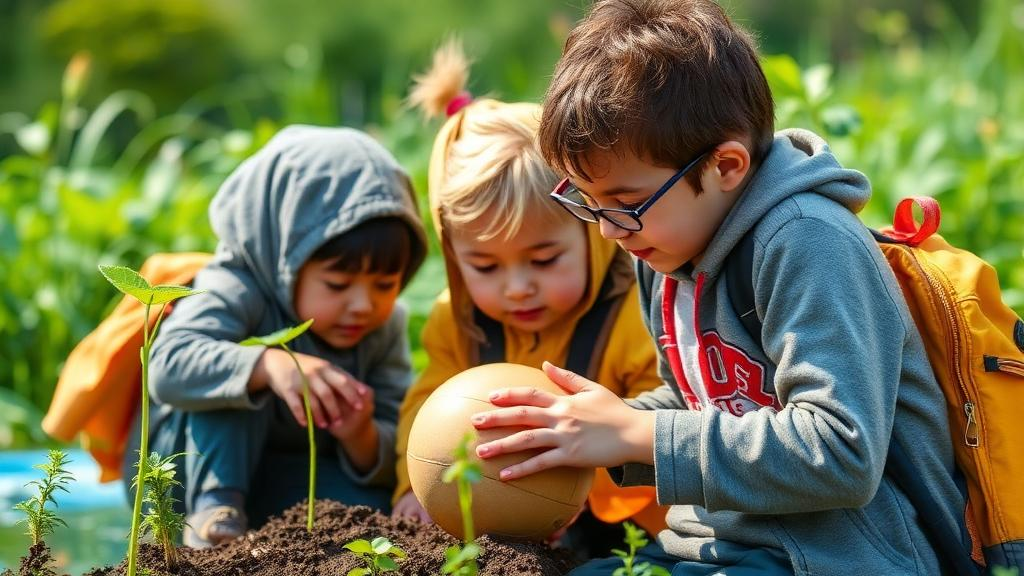
When a group of South African schoolchildren decided that the empty patch of ground beside their school should become a vegetable garden, they were doing far more than growing cabbages. They were tracing hunger back to unemployment, unemployment back to poverty, and poverty back to weak support structures — and then designing a practical response. That chain of reasoning, documented in their own project portfolio, is exactly what a new study identifies as evidence of sustainability competencies emerging in young learners through community-based civic action.
The research, published in Discover Education by Ashiya Osman, Athenkosi Sigenu and Charmaine du Plessis of the University of South Africa, analysed 31 completed projects from the Department of Basic Education’s Youth Citizen Action Programme (YCAP), a national initiative in which teams of four to five learners identify a community problem, investigate its causes, implement an intervention and reflect on the results. The portfolios, produced between 2021 and 2024 by primary and secondary school teams across several provinces, were treated by the researchers as socially produced texts — artefacts of learning shaped by interactions with peers, mentors, communities and the programme’s structured toolkit.
The theoretical backbone of the study is a pairing of two frameworks. The first is Wiek and colleagues’ influential model of sustainability competencies, which singles out systems thinking, normative thinking and strategic thinking as core capacities for anyone hoping to act on complex social and environmental problems. The second is variation theory, developed by Ference Marton and colleagues, which holds that learning happens not merely through experience but through discernment — through noticing how certain aspects of a situation vary against a stable background. Applied to civic education, the theory suggests that the sheer diversity of community challenges learners encounter is not a complicating variable but the very mechanism that makes deep learning possible.
The researchers adopted a qualitative design grounded in social constructivism, purposively sampling portfolios that had been recognised at provincial or national level and that documented the full project cycle from problem identification to reflection. Fourteen portfolios came from primary schools (Grades 5 to 7) and seventeen from secondary schools (Grades 8 to 11). Three researchers independently coded subsets of the data at a manifest level, compared decisions in a shared spreadsheet, resolved disagreements through discussion, and then applied a refined codebook across the full dataset before moving to a deductive, theory-informed interpretation.
Four interconnected themes emerged. The first, systems thinking as a sustainability competency, captured how learners stopped treating community problems as isolated events and began reading them as parts of wider social, institutional and environmental systems. Food insecurity was linked to unemployment, poverty and low academic performance; bullying and substance abuse were traced to family stress, social exclusion and weak support structures. One portfolio observed that mental health issues are both a cause and an effect of poor academic performance — a formulation the authors cite as a clear expression of learners recognising interdependence rather than linear cause-and-effect chains.
The second theme, problem-solving through solution design, revealed a striking pattern: similar problems produced different solutions in different contexts. Littering was met with clean-up campaigns in some schools, recycling schemes or environmental education in others; food insecurity prompted vegetable gardens in one community and donation or sponsorship drives in another. From a variation-theory perspective, this divergence is significant. It suggests learners were not mechanically applying a fixed template but had discerned which aspects of their particular situation mattered most — infrastructure failure, behavioural practices or municipal service delivery — and adjusted their strategies accordingly. Learners also reflected on barriers such as limited funding, low participation and time constraints, and revised their plans in response.
The third theme showed learning happening through real-world civic action itself. Learners investigated problems, spoke to stakeholders, implemented solutions and then reflected on how their own understanding had shifted. The portfolios record increased awareness, emotional maturity, empathy and insight after learners engaged directly with community members affected by poverty, gender-based violence, mental health struggles and environmental degradation. This aligns with the experiential learning tradition running from John Dewey through David Kolb’s cycle of concrete experience, reflective observation, abstract conceptualisation and active experimentation — a cycle the YCAP process, with its toolkit-guided structure and mentor support, enacts in full.
The fourth theme, civic responsibility and learner agency, is perhaps the most striking. Learners described themselves with the language of responsibility, leadership, ownership and hope, positioning themselves as capable actors who could mobilise others rather than waiting for adults or institutions to intervene. Statements such as “We want to be role models for our peers” reflect what the researchers identify as normative thinking: not just judging what is wrong, but making value-based claims about the kind of community they want to help create. The authors connect this to Gert Biesta’s concept of subjectification — education forming autonomous civic subjects rather than merely qualified graduates — and to Westheimer and Kahne’s distinction between participatory and justice-oriented citizenship, the latter targeting the structural roots of social problems rather than their visible symptoms.
Taken together, the four themes describe a progression from recognising problems, to designing responses, to learning through action, to acting as civic subjects. The authors argue that variation theory supplies the explanatory mechanism the sustainability education literature has been missing: the field is strong on describing competency outcomes but weak on explaining how they are produced, particularly at school level, where most evidence comes from higher education and engineering contexts in the Global North. In YCAP, variation arose through the different community challenges teams tackled, through mentors deliberately exposing learners to other teams’ projects, and through the diversity of solutions generated even for similar problems. The study is careful to note that it identifies patterns consistent with variation theory rather than proving causal relationships.
The practical implications are concrete. The authors suggest that mentors should embed exposure to variation deliberately rather than leaving it to chance, that school leaders should structure opportunities for learners to engage a wider range of stakeholders such as local government and health services — engagement that was inconsistently present across the dataset — and that policymakers consider toolkit-based, reflection-oriented models like YCAP as a viable way to extend sustainability education beyond universities. Future programme design, they add, could incorporate the two competencies absent from the data: anticipatory thinking, through activities requiring learners to forecast long-term consequences before implementation, and genuine collaborative competence, through shared decision-making with communities rather than purely informational liaison. The study’s limitations are acknowledged — the sample comprised only recognised, high-quality portfolios, and the analysis was confined to what learners documented — but the central message stands. When a structured process holds the pedagogical architecture constant while community context varies, young learners can discern the critical features of sustainability challenges in ways that decontextualised classroom instruction cannot produce. In this model, the community is the curriculum, variation is the mechanism, and the formation of autonomous civic subjects is the goal.
Subject of Research: Sustainability competencies and civic learning in school-based community projects analysed through variation theory
Article Title: Exploring civic learning and sustainability competencies in school community projects using variation theory
Article References: Osman, A., Sigenu, A., & du Plessis, C. (2026). Exploring civic learning and sustainability competencies in school community projects using variation theory. Discover Education, 5(1), Article 1131. https://doi.org/10.1007/s44217-026-02245-8
Image Credits: AI Generated
DOI: 10.1007/s44217-026-02245-8
Keywords: sustainability education, civic learning, variation theory, systems thinking, normative thinking, strategic thinking, experiential learning, Youth Citizen Action Programme, South Africa, school community projects, learner agency, qualitative research
Cite Scienmag News
Sloane Callahan. (October 6, 2026). School Kids Tackle Real-World Crises and Learn Sustainability Along the Way. Scienmag. https://scienmag.com/school-kids-tackle-real-world-crises-and-learn-sustainability-along-the-way/
Sloane Callahan. "School Kids Tackle Real-World Crises and Learn Sustainability Along the Way." Scienmag, 6 October 2026, https://scienmag.com/school-kids-tackle-real-world-crises-and-learn-sustainability-along-the-way/. Accessed 6 October 2026.
Sloane Callahan. "School Kids Tackle Real-World Crises and Learn Sustainability Along the Way." Scienmag. October 6, 2026. https://scienmag.com/school-kids-tackle-real-world-crises-and-learn-sustainability-along-the-way/


