


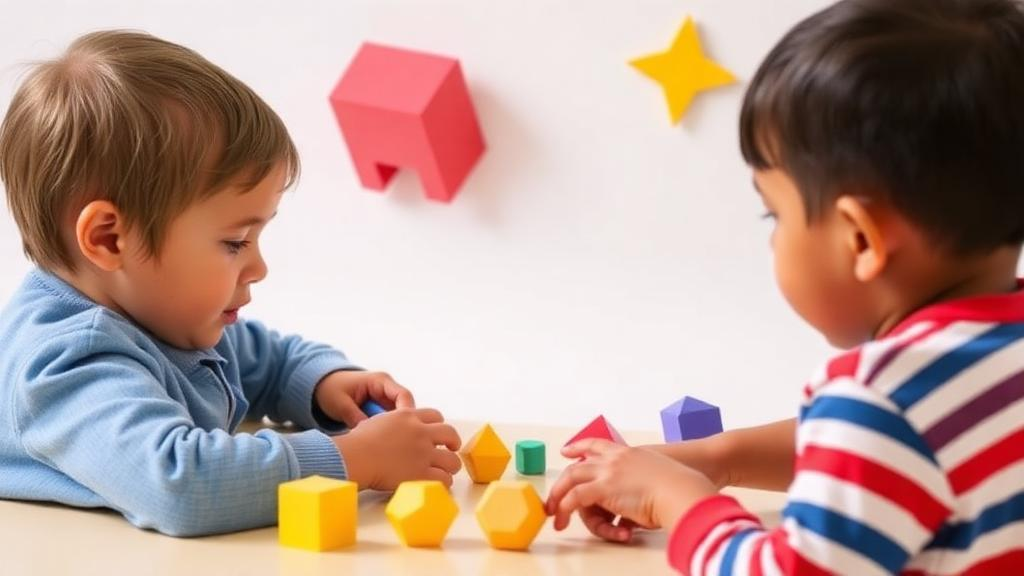
Geometry has long occupied a curious position in early childhood classrooms. Educators agree that spatial and geometric thinking form a foundation for later mathematics achievement, yet most preschool and kindergarten activities focus on flat, two-dimensional shapes: circles, squares, and triangles drawn on paper or cut from felt. Solid shapes, the cubes, cylinders, spheres, and cones that fill the physical world children navigate every day, receive far less systematic attention. A new study published in the Early Childhood Education Journal suggests that a hands-on program built around 3D modeling and printing may help close that gap, offering young children a way to think about three-dimensional form that flat worksheets cannot provide.
The research, conducted by İlkay Sel of Bozüyük TOKİ Primary School and Ümran Alan of Anadolu University, developed and implemented an educational program centered on 3D modeling and printing, abbreviated 3DMP, in a kindergarten classroom. Rather than treating the technology as a novelty, the researchers embedded it in a project theme of houses and buildings, a topic familiar to every five-year-old. Children did not simply watch a printer extrude plastic; they engaged with the full design cycle, moving from imagining structures to modeling them digitally and finally holding the physical results in their hands. The approach reflects a broader movement in early childhood education toward maker-centered learning, in which children construct knowledge through designing, building, and iterating.
Methodologically, the study took a mixed-methods approach, combining quantitative assessment with qualitative insight. Fifteen kindergarten children and their parents participated. The researchers collected data through pre- and post-assessment forms administered to the children, semi-structured interviews, and parent-child sharing notebooks that documented conversations and observations at home. For the quantitative analysis, the team used the Wilcoxon signed-rank test, a non-parametric statistical method suited to comparing matched pre- and post-intervention scores from a small sample. The qualitative data were examined through inductive analysis, allowing themes to emerge from the children’s own words and behaviors rather than testing predetermined categories.
The quantitative results pointed in a clear direction. After participating in the 3DMP program, children showed substantial gains in their ability to recognize and correctly name three-dimensional geometric shapes. In practical terms, a child who might previously have called every block-like object a box could distinguish a cube from a rectangular prism, or identify a cylinder as the shape underlying a can or a tower. Because the study involved a small sample and lacked the controls of a large randomized trial, the findings are best understood as evidence of promise rather than definitive proof. Still, the consistency between the statistical results and the qualitative observations strengthens the case that the program itself, rather than ordinary maturation, drove the improvement.
The qualitative strand of the study revealed something arguably more interesting than improved vocabulary. Children made meaningful progress in understanding the concept of dimension itself, the idea that distinguishes a flat square from a cube, or a drawn circle from a sphere. Dimensional understanding is notoriously difficult for young learners. Developmental research on children’s geometric concepts, including the influential work of Douglas Clements and Julie Sarama, has shown that children often treat shapes as holistic visual templates rather than as objects defined by properties. A shape is a door because it looks like a door, not because it has four sides and four corners. Moving beyond that visual prototype stage requires rich, varied experiences with shapes in multiple orientations, sizes, and contexts.
This is precisely where 3D modeling and printing may offer something distinctive. When a child designs a house in a child-friendly CAD environment such as Tinkercad, which carries kidSAFE certification and has been studied as a tool for enhancing children’s spatial thinking, the software forces a confrontation with three-dimensionality. A wall is not a line; it is a slab with thickness. A roof is not a triangle; it is a prism that must sit atop the structure. When the design is printed, the child holds the consequence of every geometric decision. Errors become visible and tangible: a tower topples because its base is too narrow, a roof does not fit because its dimensions were mismatched. The feedback loop between digital design and physical object gives geometric properties a functional meaning that flashcards never could.
The study’s suggestion that dimensional understanding may play a contributing role in 3D shape recognition carries implications for how early geometry is taught. If grasping the difference between two and three dimensions helps children correctly identify and name solid shapes, then curricula that defer three-dimensional geometry to later grades may be missing a developmental opportunity. The finding aligns with a growing body of research on the relationship between spatial thinking and mathematics achievement. Meta-analytic work by Zachary Hawes, Katie Gilligan-Lee, and Kelly Mix has documented that spatial training produces measurable gains in mathematics performance, and studies of preschoolers have linked spatial assembly skills to early numerical ability. Geometry, far from being a peripheral strand of the mathematics curriculum, appears to be woven into the cognitive architecture that supports mathematical thinking more broadly.
The choice of a houses-and-buildings theme deserves attention as well. Project-based approaches in early childhood education, drawing on traditions of emergent curriculum, hold that learning is deepest when it grows from children’s lived experience. Every child lives in a building, walks past buildings, and plays with building blocks. Anchoring the 3DMP program in this familiar domain meant that geometric concepts arrived attached to meaningful purposes: children were not abstractly learning what a cylinder is, they were figuring out what kind of shape would make a sturdy column for a house. The parent-child sharing notebooks extended this learning beyond the classroom, inviting families into the conversation and giving researchers a window into how children talked about shapes at home.
The study also contributes to a sparsely researched corner of educational technology. Reviews of 3D printing in education, including systematic surveys published in journals of computer-assisted learning and additive manufacturing, show that most empirical work has focused on primary, secondary, and higher education. Studies integrating 3D modeling and printing into early childhood geometry learning are, as the authors note, especially scarce. Concerns about complexity, cost, and developmental appropriateness have kept the technology out of most kindergarten classrooms. This study offers a counterexample: with a developmentally appropriate design, young children can engage meaningfully with digital fabrication tools, and the engagement can pay measurable learning dividends. The work was supported by the Scientific and Technological Research Council of Türkiye under a rapid support funding program, signaling institutional interest in bringing emerging technologies into early education research.
Cautions remain. Fifteen children in one classroom cannot establish how the program would fare at scale, across different teachers, curricula, and resource levels. The Wilcoxon test on a small sample is sensitive to the enthusiasm of implementation, and the researchers themselves frame the results as demonstrating what developmentally appropriate 3DMP experiences may support rather than what they inevitably will. Yet the convergence of quantitative gains, qualitative depth, and theoretical coherence makes this a study worth watching. If the ability to think in three dimensions can be nurtured in five-year-olds by letting them design, print, and hold their own ideas, then the humble desktop 3D printer may earn a permanent place alongside blocks and crayons in the early childhood toolkit, and the flat world of early geometry education may finally gain its missing dimension.
Subject of Research: The contribution of a 3D modeling and printing program to kindergarten children's learning of three-dimensional geometry
Article Title: Thinking in Three Dimensions: A Mixed-Methods Study on the Contribution of a 3D Modeling and Printing Program to Young Children’s Geometry Learning
Article References: Sel, İ., & Alan, Ü. (2026). Thinking in Three Dimensions: A Mixed-Methods Study on the Contribution of a 3D Modeling and Printing Program to Young Children’s Geometry Learning. Early Childhood Education Journal. https://doi.org/10.1007/s10643-026-02360-z
Image Credits: AI Generated
DOI: 10.1007/s10643-026-02360-z
Keywords: early childhood education, 3D modeling and printing, geometry, 3D geometric shapes, dimensional understanding, kindergarten, spatial thinking, mathematics education, Tinkercad, mixed methods, maker education, project-based learning
Cite Scienmag News
Courtney Benton. (October 6, 2026). Kindergartners Learn 3D Geometry Faster When They Design and Print Their Own Shapes. Scienmag. https://scienmag.com/kindergartners-learn-3d-geometry-faster-when-they-design-and-print-their-own-shapes/
Courtney Benton. "Kindergartners Learn 3D Geometry Faster When They Design and Print Their Own Shapes." Scienmag, 6 October 2026, https://scienmag.com/kindergartners-learn-3d-geometry-faster-when-they-design-and-print-their-own-shapes/. Accessed 6 October 2026.
Courtney Benton. "Kindergartners Learn 3D Geometry Faster When They Design and Print Their Own Shapes." Scienmag. October 6, 2026. https://scienmag.com/kindergartners-learn-3d-geometry-faster-when-they-design-and-print-their-own-shapes/


