


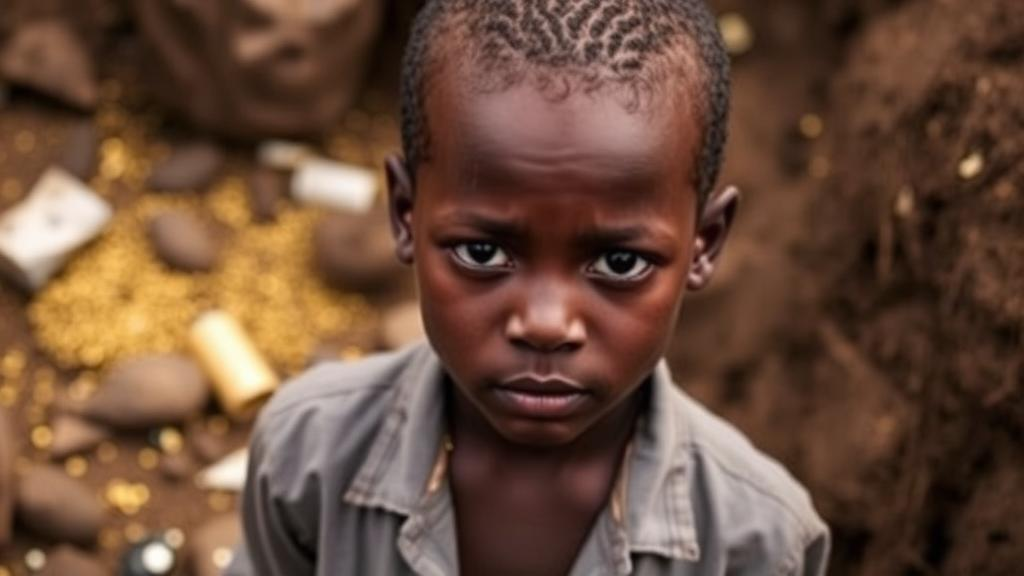
In the gold-bearing villages of Ghana’s Amansie South District, the promise of quick cash is drawing thousands of young people into illegal mining pits, and a new study suggests the price they pay is measured in broken bodies and abandoned classrooms. Researchers from Kwame Nkrumah University of Science and Technology and the London School of Economics surveyed 383 youth engaged in illicit gold mining, known locally as galamsey, across four communities: Manso Adubia, Manso Ayerebikrom, Manso Kensere, and Manso Agroyesum. Their findings, published in SN Social Sciences, paint a stark quantitative portrait of an occupational health crisis that has largely unfolded out of sight of regulators, combined with an educational toll that threatens to lock a generation out of formal economic life.
The headline number is hard to ignore: 82.8 percent of the surveyed miners reported at least one health problem attributable to their work. Musculoskeletal injuries topped the list at 39.4 percent, a figure that reflects the brutal mechanics of artisanal gold extraction. Unlike industrial mining, galamsey operates without engineered shafts, ventilation, or mechanical lifting aids. Young miners dig with hand tools into unstable ground, haul ore in head pans over long distances, crouch for hours in flooded pits, and operate rock crushers by hand. The biomechanical load on spines, knees, shoulders, and wrists is enormous, and the absence of any safety training or protective equipment means soft-tissue injuries, chronic back pain, and joint damage accumulate rapidly in workers who are often still in their teens or early twenties.
Skin diseases ranked second at 30.0 percent, a predictable consequence of constant immersion in muddy water laced with sediment, fuel residues, and potentially pathogenic microorganisms. Miners stand for hours in pits and sluice channels where stagnant water provides an ideal medium for fungal and bacterial infections. Respiratory problems affected 16.0 percent of respondents, driven by the inhalation of silica-rich dust generated during digging, crushing, and washing of gold-bearing ore. Prolonged exposure to respirable crystalline silica is a well-established cause of silicosis and increases the risk of tuberculosis, a combination that occupational health researchers have documented in formal mining sectors worldwide. In the unregulated galamsey economy, where no dust monitoring or mask distribution takes place, that exposure is essentially unmitigated from the first day a young person picks up a shovel.
Malaria accounted for 8.0 percent of reported health problems, an indirect but significant occupational hazard. Abandoned and active mining pits collect rainwater and create extensive networks of stagnant pools that serve as breeding habitat for Anopheles mosquitoes, the vectors of the malaria parasite. The transformation of landscapes around mining sites thus amplifies the disease ecology of an already malaria-endemic region, meaning miners face elevated infection risk both at work and at home. Mercury-related problems, reported by 7.0 percent of respondents, point to the most insidious chemical hazard in artisanal gold mining. Miners use elemental mercury to amalgamate fine gold particles, then typically burn off the mercury with open flames or blowtorches to recover the metal. This releases mercury vapor, which is readily absorbed through the lungs and attacks the central nervous system, causing tremors, memory loss, mood disturbances, and kidney damage. Chronic low-dose exposure can produce subtle neurological deficits long before overt symptoms appear, and mercury discharged into rivers enters the food chain, particularly fish, extending the hazard far beyond the mining camps themselves.
Perhaps the most alarming statistic in the study concerns injuries: 77.2 percent of respondents reported having experienced an injury while working at a mining site. That figure implies that physical harm is not an occasional accident in this economy but a near-universal rite of passage. Pit collapses are the most lethal hazard in artisanal mining, occurring when unsupported excavations in saturated soil give way without warning. Drowning in flooded shafts, being struck by falling rocks, lacerations from tools and machinery, and injuries from improvised explosives all contribute to the toll. Because galamsey is illegal, injured miners frequently avoid formal health facilities, fearing exposure or arrest, and instead rely on informal care that may leave them with untreated fractures, chronic wounds, or permanent disability. The study’s interviews with four health practitioners in the district corroborated the survey pattern, confirming that mining-related trauma and illness regularly reach local clinics even though the true burden is likely undercounted.
The damage extends beyond health into what the researchers call personal development, the accumulation of education, skills, and credentials that determine a young person’s long-term economic trajectory. Among surveyed miners who had formal education or vocational training, 52.7 percent had dropped out of school or training to mine. Among those with informal apprenticeship-style training, 44.0 percent had discontinued their training. In practical terms, more than half of the formally educated young miners in the sample had traded a diploma or certificate path for daily wages in a gold pit, and nearly half of the informally trained had abandoned their trades. The opportunity cost compounds over time: a nineteen-year-old who leaves junior high school for mining forfeits not only the credential but the literacy, numeracy, and social networks that formal education confers, making return to schooling or skilled employment progressively harder as the years pass.
Why do young people make this trade? The survey’s motivational data offer a clear answer rooted in economic desperation rather than recklessness. Lack of employment opportunities was the leading motivation, cited by 40 percent of respondents, and the need for quick income followed at 37 percent. Ghana is one of Africa’s largest gold producers, yet the rural districts that host the deposits often lack the formal jobs, credit, and infrastructure that might absorb young labor. Galamsey offers immediate, cash-in-hand payment in a way that farming, schooling, or apprenticeships do not. The researchers note that this dynamic is well documented across sub-Saharan Africa, where artisanal mining expands during periods of agricultural poverty and acts as a survival strategy for households excluded from formal economies. The irony is sharp: the same livelihood that feeds a family today undermines the health and human capital that would sustain it tomorrow.
The study employed an embedded case study design that integrated quantitative and qualitative methods, combining structured questionnaires administered to the 383 young miners with in-depth input from four health practitioners and four junior high school headmasters in the district. Quantitative responses were analyzed with descriptive statistics, while qualitative interviews were subjected to thematic analysis. The headmasters’ testimony reinforced the survey numbers, describing how school-age children in mining communities are increasingly drawn to the pits, a pattern consistent with earlier Ghanaian research linking galamsey to basic school dropout in Obuasi and other mining districts. Ethical approval for the study came from the Academic Committee of the Department of Land Economy at KNUST, and informed consent was obtained from all participants, with parental or guardian permission secured for those below the legal age of consent.
The researchers are careful about the limits of their design. The data are self-reported and cross-sectional, drawn from a single district, so they establish association rather than definitive causation, and they cannot capture miners who declined to participate or who work in other regions. Still, the consistency of the findings with prior occupational health studies of artisanal and small-scale gold mining in Ghana and elsewhere in West Africa lends them weight. Earlier integrated assessments of Ghanaian artisanal mining have documented the same hierarchy of hazards, from physical trauma to mercury exposure, and studies from the Democratic Republic of Congo have found similarly high injury rates among juvenile artisanal miners, including elevated blood lead levels. The Amansie South results thus fit a broader continental pattern in which the informal mining sector concentrates risk on the youngest and most economically vulnerable workers.
What emerges from the study is not a call for simple prohibition but for coordinated intervention. The authors argue that reducing the harm requires simultaneous action from health services, environmental health authorities, education institutions, local government, and youth livelihood programs. Occupational safety measures, even basic ones such as protective equipment, pit support training, and mercury-free processing technologies, could cut the injury and toxic exposure burden substantially. But safety measures alone will not pull young people from the pits while the underlying economic pull remains intact. Alternative livelihood programs have had a mixed record in Ghana, and the researchers’ data suggest why: any alternative must match the immediacy of mining income while offering a credible path to skills and credentials. Until the district’s youth can see a future in school, farming, or trade that pays off faster than a shovel in a gold pit can, the bodies and the classrooms of Amansie South will continue to pay the cost of the country’s gold.
Subject of Research: Occupational health and educational impacts of illegal gold mining among youth in Ghana
Article Title: Health and personal development impacts of illegal gold mining among youth in Amansie South District, Ghana
Article References: Sarpong, C. K., Agyei, C., & Kidido, J. K. (2026). Health and personal development impacts of illegal gold mining among youth in Amansie South District, Ghana. SN Social Sciences, 6(10), Article 454. https://doi.org/10.1007/s43545-026-01717-w
Image Credits: AI Generated
DOI: 10.1007/s43545-026-01717-w
Keywords: illegal gold mining, galamsey, Ghana, youth, occupational health, musculoskeletal injuries, mercury exposure, school dropout, artisanal mining, Amansie South District, public health, livelihoods
Cite Scienmag News
Courtney Benton. (October 6, 2026). Ghana’s Illegal Gold Rush Is Wrecking Young Miners’ Bodies and Futures. Scienmag. https://scienmag.com/ghanas-illegal-gold-rush-is-wrecking-young-miners-bodies-and-futures/
Courtney Benton. "Ghana’s Illegal Gold Rush Is Wrecking Young Miners’ Bodies and Futures." Scienmag, 6 October 2026, https://scienmag.com/ghanas-illegal-gold-rush-is-wrecking-young-miners-bodies-and-futures/. Accessed 6 October 2026.
Courtney Benton. "Ghana’s Illegal Gold Rush Is Wrecking Young Miners’ Bodies and Futures." Scienmag. October 6, 2026. https://scienmag.com/ghanas-illegal-gold-rush-is-wrecking-young-miners-bodies-and-futures/


