


Every programmer remembers the moment when a new way of thinking about code finally clicked, whether it was the first time recursion made sense or the day object-oriented design stopped feeling like an arbitrary set of rules. Yet despite decades of research on how people learn to program, remarkably little is known about how developers acquire proficiency across the fundamentally different paradigms that structure modern software. A new exploratory study published in Discover Education by Alfred Aminayanate Bob-Manuel of the University of Port Harcourt takes a rare empirical look at this question, surveying developers about their learning experiences across five major paradigms: procedural/imperative, object-oriented, functional, concurrent/parallel, and reactive/event-driven programming. The findings, though drawn from a small sample, sketch a striking picture of an education system that prepares learners well for traditional styles of programming while leaving them to fend for themselves when confronted with the abstract and concurrency-heavy approaches that increasingly dominate contemporary software engineering.
The study rests on a theoretical foundation drawn from three pillars of learning science. The first is cognitive load theory, developed by John Sweller, which describes how sensory memory, working memory, and long-term memory interact when learners process new information. According to this framework, the difficulty of learning a programming paradigm depends on the level of abstraction and the number of interacting elements a learner must juggle simultaneously. When a developer trained in object-oriented thinking encounters functional programming, the unfamiliar constructs must be integrated with existing mental schemas, a process that can easily overload working memory and slow early progress. The second pillar is transfer learning theory, which explains how skills acquired in one domain can either help or hinder learning in another. Prior experience with object-oriented interfaces may ease the adoption of similar constructs in Java, for example, while deeply ingrained imperative habits can actively interfere with understanding functional programming’s insistence on immutability. The third framework, expertise development theory, describes how knowledge accretes over years of practice, with rapid early gains followed by plateaus as learners refine their conceptual understanding, a pattern that maps directly onto the classic shape of a learning curve.
What makes programming paradigms such a compelling subject for cognitive research is that they are not merely syntactic conventions. Each paradigm encodes a distinct cognitive organization of the problem space. Object-oriented programming encourages learners to model systems as networks of classes and objects that communicate through message-passing, emphasizing encapsulation and modular design. Functional programming demands immutability, higher-order functions, and declarative reasoning that resembles mathematics more than step-by-step instruction. Logic and other declarative paradigms ask learners to specify desired outcomes rather than explicit control flows. Because these mental models differ so profoundly, switching paradigms forces developers to reorganize how they represent problems internally. The study highlights a phenomenon the literature calls paradigm adherence or transfer interference: developers anchored to their first-learned paradigm tend to reach for the wrong tools when working in another, searching for solutions based on residual knowledge from a previous approach. This not only impedes comprehension but can measurably slow the rate of learning, which is precisely why the author argues that paradigm acquisition is neither uniform nor linear and deserves empirical measurement in its own right.
To capture these trajectories, the researcher adopted a cross-sectional, survey-based design combining quantitative and qualitative methods. A structured online questionnaire collected data on years of experience per paradigm, self-rated proficiency at six time points from the start of learning through the present, perceived difficulty on a five-point scale, motivation, and hours of study. Seventeen developers responded, a small but diverse group that included students, researchers and academics, and professional developers, with bachelor’s degree holders making up roughly 52.9 percent of respondents. The questionnaire was content-validated by two academic researchers in computing education and piloted with two developers before distribution. Responses were anonymized, exported, and analyzed in Python, with descriptive statistics, Pearson correlations, and a paired t-test forming the quantitative core, while open-ended responses were subjected to a six-phase thematic analysis following the framework of Braun and Clarke. The author is candid about the limitations: with such a modest sample and retrospective self-reports, the results are descriptive and hypothesis-generating rather than generalizable, but they offer a structured operationalization of paradigm learning that larger studies can build upon.
The experience data revealed a pronounced hierarchy among the paradigms. Object-oriented programming showed the highest mean prior experience at approximately 3.15 years, followed by functional programming at about 2.32 years and procedural programming at roughly 2.21 years. At the bottom sat the reactive/event-driven and concurrent/parallel paradigms, with mean experience of only about 1.82 and 1.47 years respectively. This distribution suggests that object-oriented and procedural styles remain the default foundation of most developers’ education, while reactive and concurrent approaches are treated as specialized or advanced domains that many practitioners simply never encounter in depth. The pattern, the study argues, reflects curricular biases and structural barriers in computing education rather than any inherent order in which paradigms should be learned, and it hints at a potential misalignment between what universities teach and what the modern software industry increasingly demands.
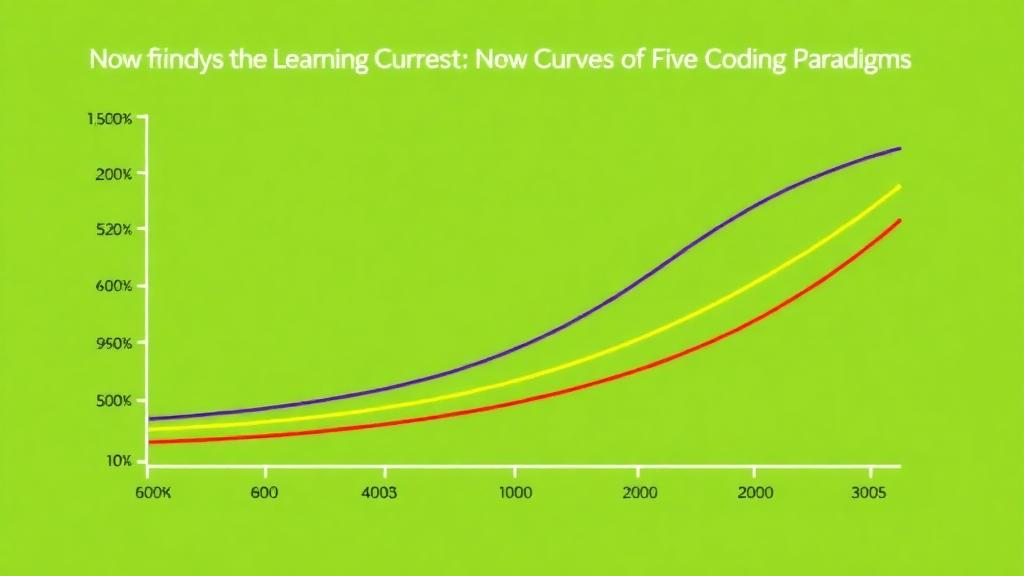
The learning curves themselves told a story of steady, if effortful, progress. Average self-rated proficiency began at a baseline of roughly 3.71, climbed to about 4.0 by the three-month mark, and reached approximately 5.18 by the time of the survey. A paired t-test comparing starting and current proficiency produced a statistically significant result, with t equal to negative 4.47 and p below 0.05, indicating a measurable learning gain across the group. Difficulty ratings, however, skewed heavily toward the difficult end of the scale, with only a minority of participants describing the learning process as easy or moderate. The author attributes this to two non-exclusive factors: the intrinsic complexity and abstraction of the paradigms themselves, and the particular demographic composition of the sample, which included many learners still embedded in academic settings. Correlation analysis added further texture, showing a positive relationship of about 0.45 between general experience and current proficiency, positive correlations between experience in related paradigms such as functional and object-oriented programming that suggest foundational knowledge transfer, and a positive link between total hours invested and final proficiency.
Perhaps the most vivid findings came from the qualitative strand. Thematic analysis of the open-ended responses surfaced three dominant motivators for learning a new paradigm: academic and curricular drivers such as university courses and degree requirements, employment and project needs including job requirements and freelance work, and intrinsic motivation rooted in personal interest and self-growth. Participants who learned with a definitive practical goal in mind, such as capacity building or project demands, reported the highest average proficiency levels, reaching up to 7.0 on the self-rating scale. One participant observed that most paradigms are intertwined, noting that understanding the basics of procedural and object-oriented programming makes learning other paradigms easier. Another described a slow learning trajectory attributed to self-directed study, while a third reported learning far more after joining a team, underscoring the value of collaborative and structured support. A word cloud of recurring terms placed academic and course above all others, with job, project, and personal appearing as secondary drivers.
Taken together, the results paint a picture of developers leaning heavily on self-directed learning, including documentation, tutorials, and hands-on experimentation, to acquire the more advanced paradigms that formal instruction leaves uncovered. The study frames this as a quiet failure of the traditional educational model: learners are well prepared for conventional tasks built on procedural and object-oriented foundations, but the cognitive strain of abstract or concurrency-focused paradigms, combined with limited early exposure and weak pedagogical scaffolding, slows their progression precisely where industry needs them to be fluent. The author recommends diversifying paradigm exposure at early learning stages, providing more robust scaffolding for abstract concepts, and integrating real-world, project-driven learning into curricula. The findings also connect to broader educational research suggesting that structured bridging activities, critical thinking exercises, and algorithmic problem-solving approaches can shorten learning curves in programming and related domains.
The study’s limitations are acknowledged plainly and are worth keeping in view. Seventeen respondents cannot represent the global developer population, retrospective self-assessments capture perceived rather than actual learning trajectories, and the cross-sectional design rules out causal inference about how proficiency develops over time. Recall bias and subjective interpretations of proficiency are inherent risks of the method. The author calls for longitudinal designs that track real proficiency changes, larger and more diverse samples spanning multiple institutions and regions, and experimental studies evaluating specific interventions such as visualization tools, AI-assisted learning systems, and project-based modules. Even so, the work makes a genuine contribution by treating paradigm acquisition as a measurable cognitive process with comparable learning curves, rather than a vague matter of pedagogical taste. As software systems grow more concurrent, reactive, and distributed, the gap between what computing curricula emphasize and what developers must master is only likely to widen, and studies like this one provide the empirical footing needed to close it.
Subject of Research: Empirical study of learning curves and how developers acquire proficiency across five programming paradigms
Article Title: Learning curves and programming paradigm acquisition in developer education
Article References: Learning curves and programming paradigm acquisition in developer education. (n.d.). https://doi.org/10.1007/s44217-026-02124-2
Image Credits: AI Generated
DOI: 10.1007/s44217-026-02124-2
Keywords: programming paradigms, learning curves, developer education, cognitive load theory, object-oriented programming, functional programming, concurrent programming, computing curricula, self-directed learning, transfer of learning, thematic analysis, software engineering education
Cite Scienmag News
Courtney Benton. (October 6, 2026). How Developers Really Learn to Program: New Study Maps the Learning Curves of Five Coding Paradigms. Scienmag. https://scienmag.com/how-developers-really-learn-to-program-new-study-maps-the-learning-curves-of-five-coding-paradigms/
Courtney Benton. "How Developers Really Learn to Program: New Study Maps the Learning Curves of Five Coding Paradigms." Scienmag, 6 October 2026, https://scienmag.com/how-developers-really-learn-to-program-new-study-maps-the-learning-curves-of-five-coding-paradigms/. Accessed 6 October 2026.
Courtney Benton. "How Developers Really Learn to Program: New Study Maps the Learning Curves of Five Coding Paradigms." Scienmag. October 6, 2026. https://scienmag.com/how-developers-really-learn-to-program-new-study-maps-the-learning-curves-of-five-coding-paradigms/


