


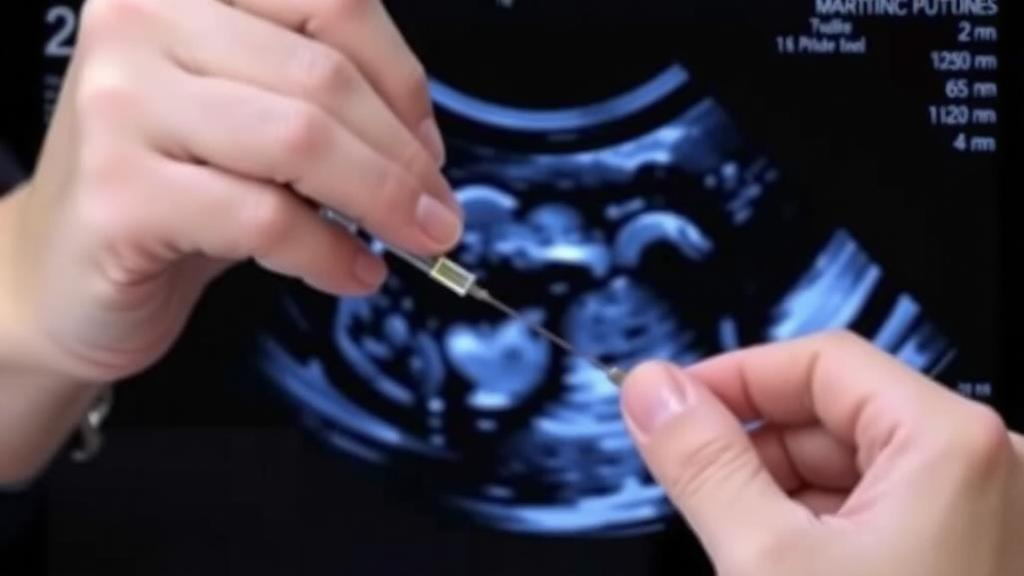
Point-of-care ultrasound has quietly reshaped how physicians across many specialties approach the bedside. What began as a compact imaging tool for emergency medicine and critical care has evolved into a core competency, one that the Accreditation Council for Graduate Medical Education now lists as an official milestone for graduation in several training programs. The device itself is deceptively simple: a portable ultrasound unit that allows a clinician to visualize anatomy in real time, at the bedside, when fast and accurate decisions matter most. Yet in neurology, adoption of this technology has lagged behind other fields, and a new editorial from researchers at Boston University Chobanian & Avedisian School of Medicine argues that this gap deserves urgent attention, particularly when it comes to one of the specialty’s most fundamental procedures.
That procedure is the lumbar puncture, a technique neurologists perform routinely to sample cerebrospinal fluid for the diagnosis of infections, inflammatory diseases, and a host of other neurological conditions. In an editorial published online in the journal Neurology Education, corresponding author Daniel Harrison, MD, assistant professor of neurology at the school and a neurointensivist at Boston Medical Center, together with his colleague, makes the case that empowering neurologists and neurology trainees to perform ultrasound-assisted lumbar punctures at the bedside is a worthwhile goal. The editorial reviews a study by Grubman et al. that evaluated the possible benefits of the technique in neurology, analyzed previous work in other fields, and described future steps toward more widespread adoption.
The technical logic behind ultrasound guidance for lumbar puncture is straightforward. Traditionally, the procedure relies on anatomical landmarks: the clinician palpates the patient’s spine, identifies the spaces between vertebrae by touch, and inserts a needle into the dural sac to collect fluid. This blind approach works well in many patients, but it can fail in those whose anatomy makes landmarks difficult to identify, including patients with obesity, spinal deformities, or severe degenerative back disease. Failed attempts mean repeated needle insertions, prolonged discomfort, referrals for fluoroscopic or computed tomography guidance, and, critically, delays in diagnosis. Ultrasound changes the equation by allowing the operator to visualize the spinous processes, interspinous spaces, and depth to the dural sac before the needle ever breaks the skin.
Evidence from other specialties suggests the payoff is real. Harrison notes that when studied in other fields, ultrasound-assisted lumbar puncture has resulted in increases in overall and first-pass success rates, with reductions in patient-reported pain scores and possible rates of complications. Anesthesiologists and emergency physicians, who regularly perform neuraxial procedures such as epidural injections and spinal anesthesia, have accumulated much of this evidence. The editorial is candid, however, about a key limitation: data supporting the use of this technique specifically by neurologists and neurology trainees remain limited. Training in point-of-care ultrasound for head, eye, and nerve conditions is improving, but the technology is only moderately used by neurologists managing some neurological conditions, and procedure guidance has not yet become a standard part of the specialty’s toolkit.
The stakes of delay are not abstract. Harrison points to meningitis as a prime example, noting that there is an established association between time to treatment and patient outcomes in that condition. When a patient presents with suspected bacterial meningitis, cerebrospinal fluid analysis is often essential to confirm the diagnosis and guide antimicrobial therapy. Every failed lumbar puncture attempt, every transfer to another service for image-guided sampling, adds time to a clock that is directly linked to morbidity and mortality. The ability of a neurologist or trainee to complete the procedure successfully at the bedside, on the first attempt, with ultrasound assistance, could therefore translate into measurably better outcomes for the sickest patients.
Harrison and his colleague argue that the benefits of ultrasound assistance may be even more pronounced in patients who are overweight or have difficult anatomy. Considering the available data, they suggest that patients who seem most likely to benefit, for example those with the highest body mass indices or severe back disease, should always have lumbar punctures performed with ultrasound assistance, regardless of the discipline of the specialist performing the procedure. This recommendation effectively reframes ultrasound guidance not as an optional refinement but as a standard of care for a defined, high-risk subgroup, a position that, if adopted widely, would have significant implications for training programs and hospital equipment allocation alike.
The editorial also emphasizes that the educational infrastructure for implementation already exists. As Harrison explains, the field knows which competency-based educational tools can be leveraged to maximize the chances of successful implementation in neurology. Point-of-care ultrasound education in other specialties has matured into a well-defined pedagogy, with milestone-based progression, hands-on simulation, supervised scanning, and formal competency assessment. The ACGME’s designation of point-of-care ultrasound as an official graduation milestone in multiple specialties provides a ready-made template that neurology residency programs could adapt, integrating probe skills, image interpretation, and procedure guidance into existing curricula rather than building an educational framework from scratch.
What is missing, according to the researchers, is the kind of evidence that would convince specialty leaders and hospital administrators to invest. The editorial calls for controlled multicenter studies focusing on higher-level outcomes such as trainee performance, patient outcomes, and health care or implementation costs. Such studies would test whether the successes documented in other specialties genuinely translate to neurology, where patient populations, procedure settings, and trainee experience differ. Cost-effectiveness data would be particularly persuasive, since portable ultrasound units represent a capital expense, and departments will want evidence that reduced procedure times, fewer failed attempts, and fewer referrals for image-guided puncture offset the investment.
The editorial’s appearance in Neurology Education is itself meaningful, because it places the argument before the audience best positioned to act: the educators who design residency and fellowship curricula. The Grubman et al. study that the editorial reviews represents an early step in building the neurology-specific evidence base, evaluating the possible benefits of ultrasound-assisted lumbar puncture in the specialty and mapping the path toward broader adoption. If subsequent multicenter trials confirm the pattern seen in other fields, the combination of existing educational tools, clear clinical rationale, and a defined high-benefit patient subgroup could accelerate adoption faster than is typical for new procedural techniques.
For now, the editorial stands as a call to action grounded in cautious optimism. The technique is not new, the supporting evidence from adjacent specialties is substantial, and the clinical scenarios where it matters most, from suspected meningitis to the patient whose body habitus defeats landmark-based approaches, are familiar to every practicing neurologist. What remains is the deliberate work of training, assessment, and study that would turn bedside ultrasound-guided lumbar puncture from an emerging idea into an expected skill. As Harrison and his colleague conclude, empowering neurologists and neurology trainees to perform lumbar punctures at the bedside in the interest of swift diagnosis and treatment is a goal worth pursuing, and the tools to achieve it are already within reach.
Subject of Research: Ultrasound-assisted lumbar puncture training and adoption in neurology
Article Title: Editorial deems empowering neurologists and neurology trainees to perform lumbar punctures at bedside a worthwhile goal
Article References: Editorial deems empowering neurologists and neurology trainees to perform lumbar punctures at bedside a worthwhile goal. (n.d.). Original publication
Image Credits: AI Generated
DOI: Not provided
Keywords: point-of-care ultrasound, lumbar puncture, neurology education, medical training, bedside procedures, meningitis, ACGME milestones, neurology trainees, ultrasound guidance, Boston University School of Medicine, patient outcomes, Editorial
Cite Scienmag News
Cassandra Pierce. (October 6, 2026). Ultrasound-Guided Lumbar Puncture Training Could Transform Bedside Neurology Care. Scienmag. https://scienmag.com/ultrasound-guided-lumbar-puncture-training-could-transform-bedside-neurology-care/
Cassandra Pierce. "Ultrasound-Guided Lumbar Puncture Training Could Transform Bedside Neurology Care." Scienmag, 6 October 2026, https://scienmag.com/ultrasound-guided-lumbar-puncture-training-could-transform-bedside-neurology-care/. Accessed 6 October 2026.
Cassandra Pierce. "Ultrasound-Guided Lumbar Puncture Training Could Transform Bedside Neurology Care." Scienmag. October 6, 2026. https://scienmag.com/ultrasound-guided-lumbar-puncture-training-could-transform-bedside-neurology-care/


