


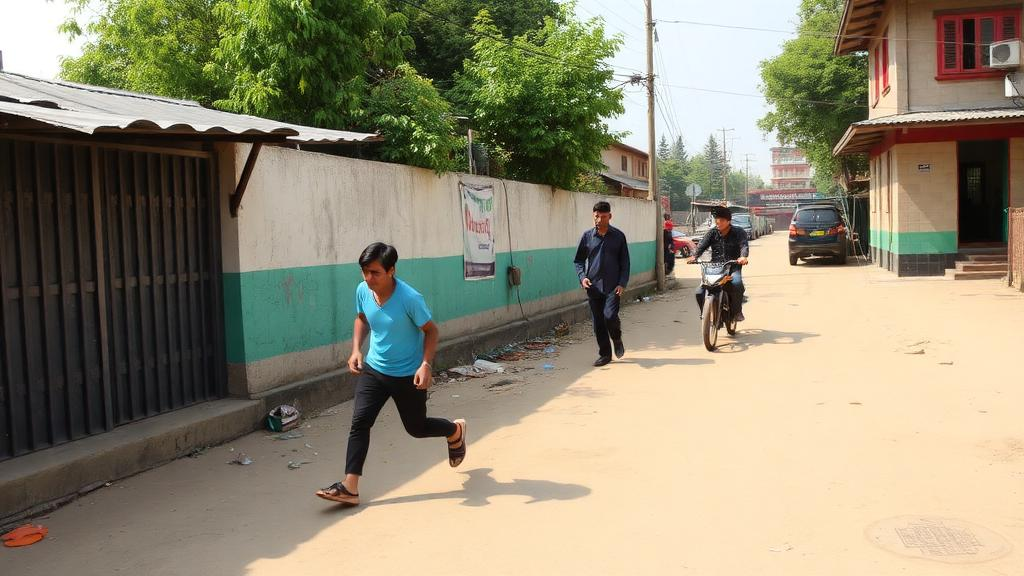
In the foothills of the Himalayas, a quiet revolution in public health research is underway. A team of Danish, Nepali, Australian and American scientists has strapped wrist-worn motion sensors onto hundreds of adults living in Pokhara, Nepal’s fastest-growing city, to answer a deceptively simple question: what actually makes people in rapidly urbanising low-income settings move, and what keeps them sitting still? The findings, published in BMC Public Health, challenge assumptions imported from wealthy Western cities and suggest that the daily grind of productive life, not purpose-built recreation, may be the engine of physical activity in places like semi-urban Nepal.
The study, led by Rajan Shrestha of Aarhus University and the Nepal Development Society, forms part of a growing effort to correct a stubborn imbalance in global health evidence. Physical inactivity and prolonged sedentary behaviour are rising public health concerns across low- and middle-income countries, where non-communicable diseases such as diabetes, cardiovascular disease and cancer are climbing steeply. Yet most of what researchers know about the environmental and psychological drivers of activity comes from high-income countries, and much of it rests on questionnaires that ask people to recall and report their own behaviour, a method notoriously prone to bias and error.
To sidestep those limitations, the researchers turned to objective measurement. They analysed data from 421 adults who had taken part in the Community-Based Promotion of Physical Activity trial in Pokhara Metropolitan City. Each participant wore an Axivity AX3 accelerometer on the wrist continuously for seven days, providing minute-by-minute records of movement and stillness. The device captures acceleration in three dimensions, from which researchers derive measures such as the Euclidean Norm Minus One, a standard metric for quantifying overall body movement intensity. From these raw signals, the team calculated daily moderate-to-vigorous physical activity, the intensity level most strongly linked to health benefits, as well as total sedentary time.
Alongside the sensor data, participants completed structured questionnaires covering two distinct categories of environmental opportunity. The first, described as recreational or built opportunities, captures features familiar from urban planning literature in wealthy countries: parks, playgrounds, walking paths, gyms and other purpose-built facilities for leisure-time exercise. The second, productive or utilitarian opportunities, reflects a different reality: whether the surrounding environment supports movement as a by-product of daily life, such as walking to markets, shops, workplaces or services. The team also measured psychosocial factors drawn from the Theory of Planned Behaviour, a widely used psychological framework, including intention to be active and perceived behavioural control, the confidence a person feels in their own ability to act.
Because participants were recruited through community clusters, the researchers used multilevel linear mixed-effects models with random intercepts for clusters, a statistical approach that accounts for the fact that people living in the same neighbourhood share characteristics and cannot be treated as fully independent observations. This matters enormously in studies of built environments: ignoring clustering can produce misleadingly confident estimates. The models estimated associations between environmental and psychosocial factors and two outcomes, daily moderate-to-vigorous physical activity and sedentary time, and the team added interaction terms to test whether perceived behavioural control modified the environmental effects.
The headline result is striking for what it reveals about the geography of movement. Productive and utilitarian environmental opportunities, the everyday infrastructure that lets people accomplish necessary tasks on foot, showed stronger associations with device-measured moderate-to-vigorous activity than recreational or built features did. In the model that considered the environment alone, higher productive or utilitarian opportunity was linked to more daily moderate-to-vigorous activity. However, when the researchers added psychosocial factors into a combined model, these environmental associations were attenuated, suggesting that part of the apparent environmental effect travels through, or overlaps with, psychological and motivational characteristics of individuals.
One psychological factor refused to fade. Perceived behavioural control remained positively and robustly associated with moderate-to-vigorous physical activity even after adjustment, with an estimated coefficient of 34.35 and a 95 percent confidence interval running from 6.98 to 61.72. In practical terms, adults who felt more capable of being active accumulated meaningfully more device-measured activity each day. Intention, by contrast, showed no clear association with measured behaviour, a finding that will resonate with anyone who has resolved to exercise and then not done so. The gap between intending and acting is a central puzzle of behavioural science, and this dataset from Nepal adds a low- and middle-income country data point to a debate dominated by Western samples.
Sedentary time told a subtler story. Environmental associations with sitting and stillness were weaker and less consistent than those with activity, but the interaction analysis produced one notable result: among people in the highest tertile of productive or utilitarian environmental opportunity, higher perceived behavioural control was associated with less sedentary time, with an interaction coefficient of −35.26 minutes and a confidence interval from −64.92 to −5.61. The interpretation is intriguing. Environments rich in utilitarian movement opportunities may only translate into less sitting for people who feel confident in their ability to act on those opportunities, hinting that environmental and psychological levers work together rather than independently.
The authors caution, appropriately, that this is a cross-sectional analysis. It captures a single moment in time and cannot establish whether environments shape behaviour, whether active people choose more supportive environments, or whether some third factor drives both. Reverse causation is a live possibility: someone who already enjoys walking may perceive their neighbourhood as more walkable. The sample, drawn from participants in an existing physical activity promotion trial in one metropolitan area, may also not represent all of semi-urban Nepal. Still, the use of objective accelerometry over a full week, the multilevel design and the explicit separation of recreational from productive environmental opportunity make this one of the more methodologically careful studies of its kind in South Asia.
The implications stretch well beyond Pokhara. Cities across Asia and Africa are urbanising at unprecedented speed, and the design choices made in the next two decades will lock in patterns of movement or stillness for generations. If the findings hold, they suggest that in rapidly urbanising low- and middle-income countries, promoting physical activity may depend less on importing the gym-and-park model of wealthy nations and more on preserving and strengthening the everyday, utilitarian movement woven into daily life, while simultaneously building residents’ confidence that they can act. Interventions that pair walkable markets, services and workplaces with behavioural support targeting perceived control could do double duty. As non-communicable diseases rise across the Global South, this study offers a timely reminder that the most powerful exercise prescription may already be written into the streets people walk every day, provided they believe they can follow it.
Subject of Research: Environmental and psychosocial determinants of device-measured physical activity and sedentary behaviour among adults in semi-urban Nepal
Article Title: Environmental and psychosocial contexts of device-measured physical activity and sedentary behaviour in semi-urban Nepal: a multilevel analysis
Article References: Shrestha, R., Paudel, S., Rijal, A., Adhikari, T. B., Khatri, B., Neupane, D., Vaidya, A., Nielsen, R. Ø., & Kallestrup, P. (2026). Environmental and psychosocial contexts of device-measured physical activity and sedentary behaviour in semi-urban Nepal: a multilevel analysis. BMC Public Health. https://doi.org/10.1186/s12889-026-29793-w
Image Credits: AI Generated
DOI: 10.1186/s12889-026-29793-w
Keywords: physical activity, sedentary behaviour, accelerometry, Nepal, low- and middle-income countries, built environment, perceived behavioural control, Theory of Planned Behaviour, multilevel analysis, public health, urbanisation, non-communicable diseases
Cite Scienmag News
Ophelia Keating. (October 6, 2026). In Semi-Urban Nepal, Everyday Chores Beat Gyms for Getting People Moving. Scienmag. https://scienmag.com/in-semi-urban-nepal-everyday-chores-beat-gyms-for-getting-people-moving/
Ophelia Keating. "In Semi-Urban Nepal, Everyday Chores Beat Gyms for Getting People Moving." Scienmag, 6 October 2026, https://scienmag.com/in-semi-urban-nepal-everyday-chores-beat-gyms-for-getting-people-moving/. Accessed 6 October 2026.
Ophelia Keating. "In Semi-Urban Nepal, Everyday Chores Beat Gyms for Getting People Moving." Scienmag. October 6, 2026. https://scienmag.com/in-semi-urban-nepal-everyday-chores-beat-gyms-for-getting-people-moving/


