


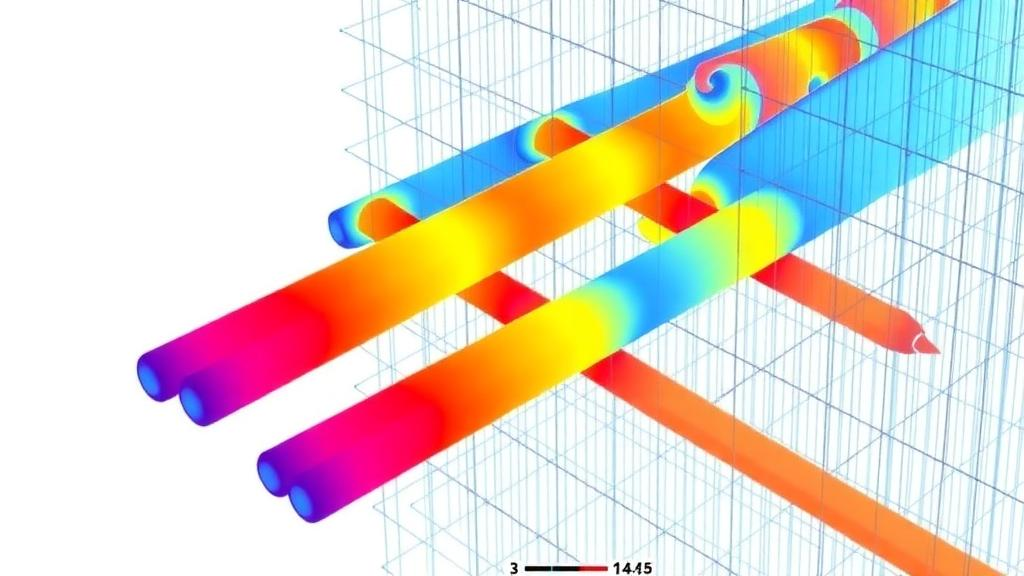
Heat is one of those everyday phenomena that hides an astonishing depth of mathematics beneath its surface. When a metal rod is heated at one end, the way warmth spreads along its length follows a precise mathematical law, one that scientists and engineers have understood for well over a century. But the moment you place several rods side by side and heat them all at once, the problem changes character entirely. Each rod no longer behaves independently: the temperature of one influences the temperature of its neighbors, and the neighbors influence it back, creating a tangled web of interactions that is notoriously difficult to compute. A research team led by Professor Amir Sadeghi of Islamic Azad University and Professor Shinya Miyajima of Tohoku University has now developed a mathematical technique that makes this kind of simulation dramatically faster, and their work could change how engineers predict and manage heat flow in practical settings.
The mathematical foundation of heat flow is the heat equation, a partial differential equation that describes how temperature evolves in space and time. For a single rod with a known heating condition, the solution can be written in terms of a well-known special function called the complementary error function. This function, which takes a real number as its input and returns a value between 0 and 2, encodes how heat from a concentrated source diffuses outward over time. It is one of the workhorses of applied mathematics, appearing not only in heat conduction but also in probability theory, diffusion processes, and statistical analysis. When a computer evaluates the complementary error function for the right inputs, it can effectively reproduce the temperature profile of a heated rod at any moment in time.
The difficulty arises when multiple rods are heated simultaneously. Because the rods interact thermally, the simple one-dimensional solution no longer applies on its own. What the researchers realized is that the coupled system can be captured if the ordinary, single-number inputs to the complementary error function are replaced by an entire matrix of numbers. A matrix is an array of real numbers arranged in rows and columns, and it provides a natural bookkeeping device for systems with many interacting components. In this setting, the entries of the matrix encode the geometry and thermal coupling of the rods, so that a single matrix-valued calculation carries information about all of the rods at once. The resulting object is called the complementary error matrix function, a matrix-valued extension of the classical complementary error function.
Professor Miyajima describes the central challenge in simple terms: a matrix is a way of organizing numbers so that we can better understand how certain systems work, and the hard part is figuring out how to arrange the numbers. That arrangement is not arbitrary. For the matrix-based simulation to be valid, the input matrix must satisfy a specific mathematical assumption. If that assumption fails, the elegant correspondence between the matrix function and the physical heat-flow problem breaks down. Even when the assumption does hold, the simulation is not guaranteed to succeed, because computing the value of a matrix function is itself a formidable numerical task. Before this work, no method for computing the complementary error matrix function had ever been reported in the scientific literature, which meant the team had to build the entire computational framework from the ground up.
The first hurdle was theoretical. The researchers had to clarify the mathematical properties of the complementary error matrix function: what it means, how it behaves, and under what conditions it is well defined. Establishing these properties was essential, because numerical computation without a solid theoretical footing can produce answers that look plausible but are quietly wrong. By pinning down the function’s properties, the team ensured that any value computed on a computer genuinely corresponds to the physical heat-propagation scenario the matrix is meant to represent. This careful groundwork is what separates a reliable simulation tool from a mathematical curiosity, and it is the kind of unglamorous but critical work that underpins much of computational science.
The second hurdle was speed. Evaluating a matrix version of the complementary error function directly would require an enormous amount of computational time, because the standard definitions of matrix functions involve operations whose cost grows rapidly with the size of the matrix. For a simulation of multiple interacting rods, where the matrix can be large and the function must be evaluated many times to trace the heat over time, a naive approach would be impractical. Professor Sadeghi explains that to avoid this bottleneck, the team derived a new representation of the function, describing it as being like shorthand. This reformulation preserves the mathematical meaning of the function while restructuring the calculation so that it can be carried out far more efficiently, allowing the simulation to be completed much, much faster than a direct evaluation would allow.
The payoff of this shorthand representation is substantial. With an efficient way to compute the complementary error matrix function, the researchers can rapidly simulate how heat propagates through each rod when multiple rods are heated at the same time, including the mutual influence that makes the problem so hard. What might previously have demanded prohibitive amounts of computational time can now be obtained in a fraction of the effort. Speed matters in this field for reasons that go beyond convenience. Fast simulations allow engineers to explore many design variations, to run what-if analyses in real time, and to build the kind of predictive models that can be consulted before a physical system is ever built or a hazardous situation arises.
The potential practical implications reach into everyday life. Being able to predict accurately how heat spreads through coupled conductive components means being able to anticipate where hot spots will form, how long surfaces will remain dangerous to touch, and how thermal energy migrates through assemblies of materials. As the researchers note, this capability may allow us to better predict how heat might spread in real life, and how to avoid getting burned. That framing is not merely rhetorical: thermal safety is a genuine design constraint in everything from consumer electronics to industrial machinery, and tools that make coupled heat-flow predictions faster and more accessible give designers a clearer window into risks that were previously expensive to quantify.
The research also represents a notable milestone in pure and applied mathematics. The complementary error matrix function had, until now, been an unexplored object: its properties had not been clarified and no computational method for it existed. By defining the function rigorously, establishing its mathematical behavior, and deriving an efficient numerical scheme for evaluating it, Sadeghi and Miyajima have added a new tool to the mathematical toolbox, one that connects the classical theory of special functions to the modern needs of coupled-system simulation. Their work illustrates a recurring pattern in applied mathematics, in which extending a familiar scalar function to matrices unlocks entirely new classes of physical problems that can be solved with the same conceptual machinery.
The findings were published in the journal Linear Algebra and Its Applications on August 18, 2026, in a paper titled Complementary error matrix function and its numerical computation. The choice of venue is fitting, since the entire contribution rests on the disciplined use of matrices, the arrays of rows and columns that sit at the heart of linear algebra. For a problem as seemingly mundane as heat traveling through rods, the solution draws on deep mathematical structure, and the result is a simulation technique that is both theoretically sound and computationally swift. As researchers and engineers begin to work with this new function, the ability to model interacting heated components quickly and accurately could find uses well beyond the rods that inspired it, wherever coupled diffusion processes demand fast, reliable answers.
Subject of Research: Numerical computation of the complementary error matrix function for simulating heat propagation through multiple coupled rods
Article Title: Rapid simulation of heat propagation through multiple rods
Article References: Rapid simulation of heat propagation through multiple rods. (n.d.). Original publication
Image Credits: AI Generated
DOI: Not provided
Keywords: heat propagation, matrix functions, complementary error function, numerical computation, linear algebra, heat equation, simulation, Tohoku University, Islamic Azad University, coupled systems, thermal analysis, applied mathematics
Cite Scienmag News
Reid Dalton. (October 6, 2026). New Matrix Method Speeds Up Simulations of Heat Flow Through Multiple Rods. Scienmag. https://scienmag.com/new-matrix-method-speeds-up-simulations-of-heat-flow-through-multiple-rods/
Reid Dalton. "New Matrix Method Speeds Up Simulations of Heat Flow Through Multiple Rods." Scienmag, 6 October 2026, https://scienmag.com/new-matrix-method-speeds-up-simulations-of-heat-flow-through-multiple-rods/. Accessed 6 October 2026.
Reid Dalton. "New Matrix Method Speeds Up Simulations of Heat Flow Through Multiple Rods." Scienmag. October 6, 2026. https://scienmag.com/new-matrix-method-speeds-up-simulations-of-heat-flow-through-multiple-rods/


