


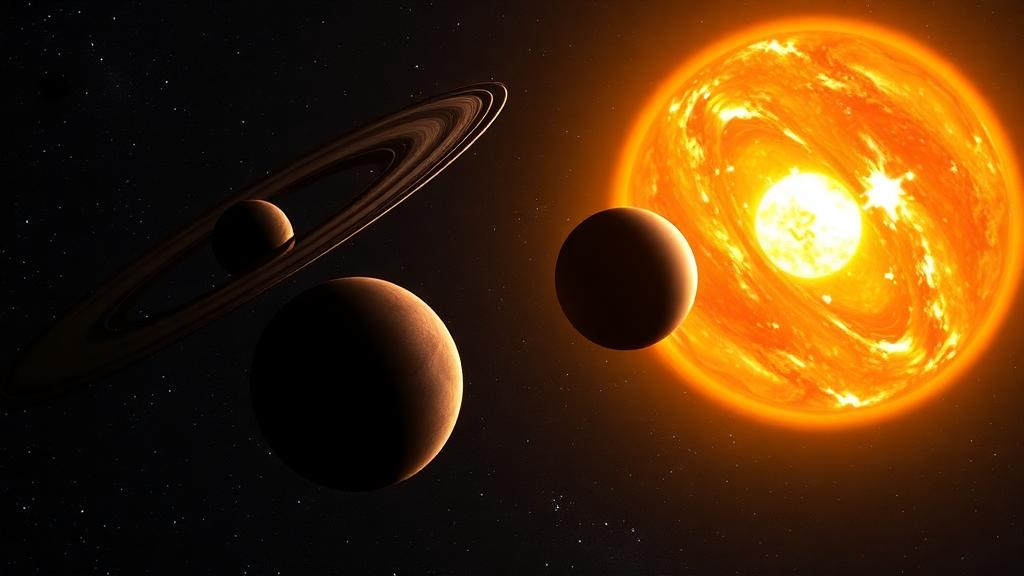
In a quiet corner of the Milky Way, roughly 300 light years from Earth, astronomers have caught a star in the act of slowly eating its companion — and the meal is expected to last for billions of years. The system, catalogued as ZTF J0440+2325, consists of a small red dwarf star and a brown dwarf, a planet-like object more massive than any planet but too lightweight to ignite hydrogen fusion. The pair orbit each other every 86.65 minutes, an interval so short that their entire orbit could fit within the diameter of our sun. In a paper published in Nature Astronomy, researchers at MIT and their collaborators report that this is the first time anyone has observed a low-mass object slowly and steadily consuming material from another low-mass object, rather than engulfing it in a single catastrophic event.
The discovery fills a curious gap in astronomers’ understanding of how stars and their companions interact. Across the galaxy, most planetary bodies circle their host stars in stable, detached orbits, like Earth around the sun. At the other extreme, astronomers have documented a handful of instances in which a star pulls a planet too close and swallows it whole — a fate that awaits Earth itself when the sun eventually swells into a red giant. ZTF J0440+2325 sits strikingly between these two extremes. Instead of a sudden engulfment or a peaceful coexistence, the system shows a star gradually feeding on its companion at a measured, sustainable pace. “When we think of stars interacting with planets or brown dwarfs, the picture is always that the star eventually swallows the other thing,” said Kevin Burdge, assistant professor of physics at MIT. “But here, we’ve found an alternative: Instead of swallowing the thing up, the star can gradually eat it, for billions of years.”
The story of the discovery began several years ago, when Burdge was combing through data from the Zwicky Transient Facility, or ZTF, a survey that uses a camera on a telescope at Palomar Observatory in California to scan the sky for rapid changes in brightness. Such flickers can signal supernovae, gamma-ray bursts, or colliding neutron stars. Light curves from supernovae typically resemble a bell curve, charting the gradual brightening and fading of an explosion. What Burdge noticed instead was something far stranger: a triangular waveform, rising and falling in a sharp, repeating pattern that no known stellar process seemed to produce. “I remember first looking at this and thinking, stars don’t make triangular waveforms like this,” he recalled.
At the time, Burdge and his colleagues were investigating a different class of objects known as black widow binaries, in which an extremely dense, rapidly spinning neutron star slowly consumes a much smaller companion star, much like the spider that gives the systems their name. Burdge wondered whether the triangular signal might come from a similar system. But the light from the source refused to cooperate. In black widow binaries, the light appears to wobble because a very light object whips around a much heavier one, and the amplitude of that wobble encodes the extreme imbalance of masses. “We weren’t seeing that whipping back and forth here,” Burdge said. “It didn’t make any sense. We couldn’t explain what this was.” The signal sat unresolved for years, a persistent puzzle in the team’s files.
The breakthrough came when Burdge and Aaron Householder, a graduate student in MIT’s Department of Earth, Atmospheric, and Planetary Sciences, decided to revisit the mystery. From the original ZTF signal, they pinpointed the source’s location within the Milky Way, about 300 light years away, and trained multiple telescopes on the object. Their measurements revealed a wobble — but a far smaller one than any black widow binary would produce. “That was the real clincher for this system,” Householder said. “When we measured that wobble, we found we were not seeing a black widow. This was a low-mass star that’s orbited by a brown dwarf. The wobble was too small in amplitude to be anything else.” The insight that unlocked the puzzle was that a system with less total mass allows two objects to orbit each other gently, without the dramatic back-and-forth whipping seen in David-and-Goliath pairings.
The measurements established that the two objects are extraordinarily close, with the brown dwarf completing an orbit every 87 minutes. Both bodies are small by stellar standards: the star weighs roughly 85 times the mass of Jupiter, while the brown dwarf comes in at about 25 Jupiter masses. With two low-mass objects circling at such intimate range, the team suspected that one might be pulling material from the other — a process known as accretion. Accretion is most often observed around objects that are extremely massive yet physically tiny, such as black holes and neutron stars. When a black hole draws material from a nearby companion, the matter spirals inward through a disk. “The difference here is, the thing absorbing matter is not a tiny black hole but a star, which is relatively big in size,” Burdge explained. “So matter just pummels directly onto the surface, at very high speeds, like an asteroid hitting the moon.”
To test whether accretion was actually occurring, the researchers ran simulations of the system. Using the measured properties of the star and the brown dwarf, they modeled particles of matter on the brown dwarf’s surface and tracked how those particles would behave over time under the laws of physics and the equations of motion. The result was unambiguous: the test particles fell directly onto the surface of the star. “When we track those test particles, we see they indeed fall right onto the surface of the star,” Householder said. “This is the first time we’ve caught a low-mass star actively accreting from another low-mass object.” The finding establishes a new category of interacting binary, one in which the accretor is a full-fledged star rather than a compact remnant.
The team also calculated the rate of the transfer, and the numbers are remarkable in both directions. The brown dwarf is losing material at about one one-hundred-thousandth of an Earth mass per year — the equivalent of roughly 40 million dump trucks’ worth of material, or about 1.3 trillion one-pound burritos, every second. Yet even at that staggering everyday scale, the loss represents only a tiny fraction of the brown dwarf’s total mass. The transfer is slow and steady enough that, given the size of the system, the star could continue its leisurely snacking for hundreds of thousands of years, and possibly for billions. What would be a cataclysmic feast on human timescales is, cosmically speaking, a grazing meal.
The slow accretion also solved the mystery of the triangular light curve. The stream of material from the brown dwarf strikes the surface of the red dwarf, heating a large, glowing hot spot at the point of impact. Viewed from afar, the system’s brightness rises and falls as the brown dwarf and its stream circle the star, carrying the blazing impact zone in and out of view. “It’s like you’ve got this continuous fireball onto one of the objects, and as one orbits the other, that hotspot comes in and out of view, and the peak of the triangle signal is when you’re looking right at the fireball,” Burdge explained. The triangular waveform, once an inexplicable anomaly, is now a diagnostic signature of a star being pummeled by a steady stream of stolen matter.
With the puzzle resolved, the team is now turning its attention to finding similar systems elsewhere in the galaxy. Because the triangular light curve is so distinctive, it offers a ready-made search template for future surveys. “It’s inspiring a lot of new searches on our part,” Householder said. “I think we’re going to learn a lot about a different kind of way that planets and brown dwarfs interact with their host stars.” The research, supported in part by the National Science Foundation, included MIT co-authors Aaron Householder, Kaitlyn Shin, Saul Rappaport, Joheen Chakraborty, and Emma Chickles, along with collaborators from Caltech, the University of Hawaii, the Instituto de Astrofísica de Canarias, the Universidad de La Laguna in Spain, and the Harvard-Smithsonian Center for Astrophysics. For now, ZTF J0440+2325 stands as proof that the drama between stars and their companions is not always a story of sudden destruction — sometimes, it is a meal savored over eons.
Subject of Research: Stable mass transfer from a brown dwarf onto a low-mass star in a close binary system
Article Title: Astronomers catch a star slowly snacking on a brown dwarf, 300 light years away
Article References: Astronomers catch a star slowly snacking on a brown dwarf, 300 light years away. (n.d.). Original publication
Image Credits: AI Generated
DOI: Not provided
Keywords: brown dwarf, red dwarf, accretion, binary star system, ZTF J0440+2325, Zwicky Transient Facility, light curve, stellar evolution, mass transfer, MIT, Nature Astronomy, black widow binary
Cite Scienmag News
Grant Pearson. (October 5, 2026). Star Caught Slowly Devouring Its Brown Dwarf Companion in Cosmic First. Scienmag. https://scienmag.com/star-caught-slowly-devouring-its-brown-dwarf-companion-in-cosmic-first/
Grant Pearson. "Star Caught Slowly Devouring Its Brown Dwarf Companion in Cosmic First." Scienmag, 5 October 2026, https://scienmag.com/star-caught-slowly-devouring-its-brown-dwarf-companion-in-cosmic-first/. Accessed 5 October 2026.
Grant Pearson. "Star Caught Slowly Devouring Its Brown Dwarf Companion in Cosmic First." Scienmag. October 5, 2026. https://scienmag.com/star-caught-slowly-devouring-its-brown-dwarf-companion-in-cosmic-first/


