


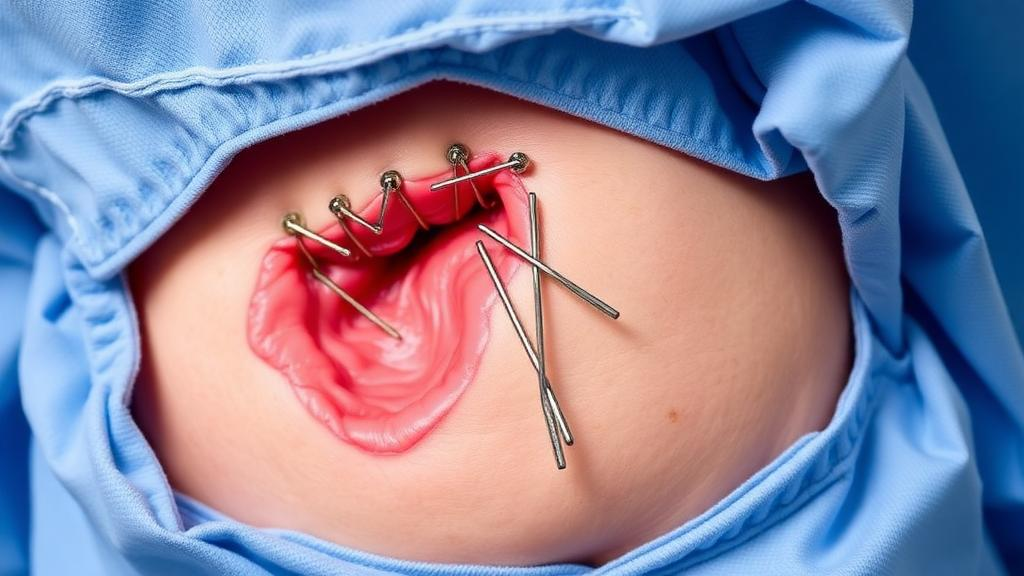
One of the most stubborn complications of abdominal surgery may have a surprisingly simple fix: the thread itself. A new study from Kobe City Medical Center West Hospital in Japan suggests that closing the abdominal wall with barbed sutures—threads studded with tiny backward-facing anchors—can nearly halve the risk of incisional hernia after minimally invasive gastroenterological surgery, compared with the smooth, slowly absorbable monofilament sutures that current guidelines typically recommend. The findings, published in Annals of Gastroenterological Surgery, offer a potential upgrade to one of the most routine steps in modern operations.
Incisional hernias occur when tissue pushes through a weakness in the abdominal wall at the site of a surgical scar. They are among the most frequent postoperative complications, causing pain and cosmetic concerns and, more seriously, carrying the risk of small bowel incarceration—a situation in which a loop of intestine becomes trapped in the defect and requires emergency surgery. Even without such emergencies, definitive repair usually demands another operation, imposing additional physical and economic burdens on patients. While minimally invasive approaches such as conventional multiport, robot-assisted, or single-incision laparoscopic surgery reduce hernia risk compared with open surgery, the problem persists. In minimally invasive colorectal surgery, particularly when the specimen extraction site sits on the midline, previous reports put the incidence at roughly 16 percent.
Barbed sutures were developed as an advancement in wound-closure surgery, and they bring several mechanical advantages. Because the barbs anchor tissue directly, surgeons do not need to tie knots or rely on an assistant to hold tension, which shortens closure time. More importantly, the barbs distribute tension more evenly along the wound rather than concentrating it at knot points. Earlier studies have linked barbed sutures to a lower risk of evisceration after abdominal fascial closure in emergency surgery, and other research found reduced hernia rates compared with interrupted slowly absorbable sutures after minimally invasive colorectal operations. What remained unclear was whether barbed sutures could outperform the continuous non-barbed slowly absorbable sutures that guidelines currently favor.
To answer that question, the research team reviewed the records of patients who underwent elective minimally invasive gastroenterological surgery requiring a midline incision, including the umbilical region for specimen extraction, between January 2021 and January 2025. After applying exclusion criteria—such as preoperative hernia, conversion to open surgery, or missing imaging data—255 patients entered the analysis: 142 whose extraction sites were closed with continuous triclosan-coated polydioxanone suture, a standard slowly absorbable monofilament, and 113 closed with a triclosan-coated barbed suture of the same absorbable material. The choice of suture was left to the operating surgeon’s discretion, but the fascial closure technique itself was standardized across the institution.
Because surgeons did not assign sutures randomly, the researchers used a statistical technique called inverse probability of treatment weighting, built on propensity scores that accounted for known hernia risk factors. These included age, sex, body mass index, smoking status, nutritional status measured by the prognostic nutritional index, comorbidities such as diabetes and chronic obstructive pulmonary disease, prior midline abdominal surgery, rectus diastasis—a separation of the abdominal muscles of two centimeters or more—and primary umbilical hernia. After weighting, the two groups were well balanced, with standardized mean differences below 0.1 for nearly all baseline characteristics. Hernia status one year after surgery was assessed uniformly by abdominal computed tomography, and four surgeons blinded to the closure method made the diagnoses according to European Hernia Society criteria.
The results were striking. One year after surgery, incisional hernia was detected in 20.6 percent of the weighted conventional suture group but only 10.7 percent of the barbed suture group. Weighted logistic regression showed that barbed sutures were associated with a reduced risk of hernia, with an odds ratio of 0.46 and a 95 percent confidence interval of 0.22 to 0.99, a statistically significant result. Short-term outcomes were comparable between the groups: operative time, serious postoperative complications graded by the Clavien–Dindo classification, and surgical site infection rates showed no significant differences. Subgroup analyses across age, diabetes, rectus diastasis, body mass index, prior abdominal surgery, and surgical approach showed a generally consistent benefit, with no significant interactions.
The mechanical explanation may lie in how barbs interact with healing tissue. The authors propose three mechanisms. First, barbed sutures distribute tension homogeneously along the suture line, which may reduce segmental ischemia and tissue necrosis, promoting more stable fascial healing. Second, the barbs create multiple fixation points that keep tissue edges securely approximated even under increased intra-abdominal pressure, preventing the suture line from loosening. Third, previous work has shown that barbed sutures induce greater fibrous tissue formation around the barbs than smooth sutures, potentially reinforcing the strength of the repair. Because both groups used continuous antimicrobial-coated absorbable sutures, the presence or absence of barbs stands out as the most plausible driver of the difference.
The study also carries important caveats. When the surgical approach—robot-assisted versus laparoscopic—was added to the statistical model, the association remained in favor of barbed sutures but was attenuated and no longer statistically significant, with an odds ratio of 0.53. The researchers note that robotic surgery and barbed suture adoption both increased during the later study period, making the two strongly correlated with calendar time, so the surgical approach may have partly captured secular changes rather than a true causal factor. The retrospective, single-center design limits generalizability, particularly for hepato-biliary-pancreatic procedures, which made up only a small fraction of cases. Surgeon-specific technical details such as the suture-to-wound length ratio and bite width were unavailable, and follow-up beyond one year was limited, even though hernia rates are known to keep rising between one and three years after surgery.
An additional competing-risks analysis using all available follow-up data, with death without prior hernia treated as a competing event, reinforced the primary finding: the cumulative incidence of hernia remained lower in the barbed suture group, with a subdistribution hazard ratio of 0.48. At 12, 24, and 36 months, weighted cumulative incidence was 19.6, 24.6, and 26.8 percent in the conventional group versus 9.0, 15.7, and 15.7 percent in the barbed group. Notably, among patients who developed hernias, all eight symptomatic cases—and all seven who underwent elective repair—occurred in the conventional suture group, although defect sizes did not differ significantly between groups, suggesting symptoms may not track directly with defect dimensions.
The authors caution that even with barbed sutures, additional preventive strategies remain important for high-risk patients, including the small-bite technique—tissue bites of five to nine millimeters with stitches placed roughly five millimeters apart—a suture-to-wound length ratio of at least four to one, and avoiding midline incisions for specimen extraction where possible. As barbed sutures such as STRATAFIX become more widely adopted, the findings suggest that the choice of closure material, combined with careful technique and attention to patient risk factors, could meaningfully reduce the burden of incisional hernia. Larger, longer-term studies will be needed to confirm the benefit and establish whether this simple change in thread can deliver lasting protection.
Subject of Research: Barbed versus non-barbed suture closure for preventing incisional hernia after minimally invasive gastroenterological surgery
Article Title: Barbed Sutures Are Associated With a Lower Incidence of Incisional Hernia Compared With Continuous Non‐Barbed Monofilament Sutures After Minimally Invasive Gastroenterological Surgery
Article References: Honma, S., Takashima, T., Ushikubo, T., Ishikawa, K., Kumode, T., Suzuki, T., Murakami, T., Hosokawa, S., & Nakajima, S. (2026). Barbed Sutures Are Associated With a Lower Incidence of Incisional Hernia Compared With Continuous Non‐Barbed Monofilament Sutures After Minimally Invasive Gastroenterological Surgery. Annals of Gastroenterological Surgery, Article ags3.70294. https://doi.org/10.1002/ags3.70294
Image Credits: AI Generated
DOI: 10.1002/ags3.70294
Keywords: barbed sutures, incisional hernia, minimally invasive surgery, fascial closure, laparoscopic surgery, robot-assisted surgery, surgical site infection, rectus diastasis, propensity score analysis, abdominal wall closure, gastroenterological surgery, STRATAFIX
Cite Scienmag News
Ophelia Keating. (October 5, 2026). Barbed Sutures Cut Hernia Risk After Keyhole Abdominal Surgery, Study Finds. Scienmag. https://scienmag.com/barbed-sutures-cut-hernia-risk-after-keyhole-abdominal-surgery-study-finds/
Ophelia Keating. "Barbed Sutures Cut Hernia Risk After Keyhole Abdominal Surgery, Study Finds." Scienmag, 5 October 2026, https://scienmag.com/barbed-sutures-cut-hernia-risk-after-keyhole-abdominal-surgery-study-finds/. Accessed 5 October 2026.
Ophelia Keating. "Barbed Sutures Cut Hernia Risk After Keyhole Abdominal Surgery, Study Finds." Scienmag. October 5, 2026. https://scienmag.com/barbed-sutures-cut-hernia-risk-after-keyhole-abdominal-surgery-study-finds/


