


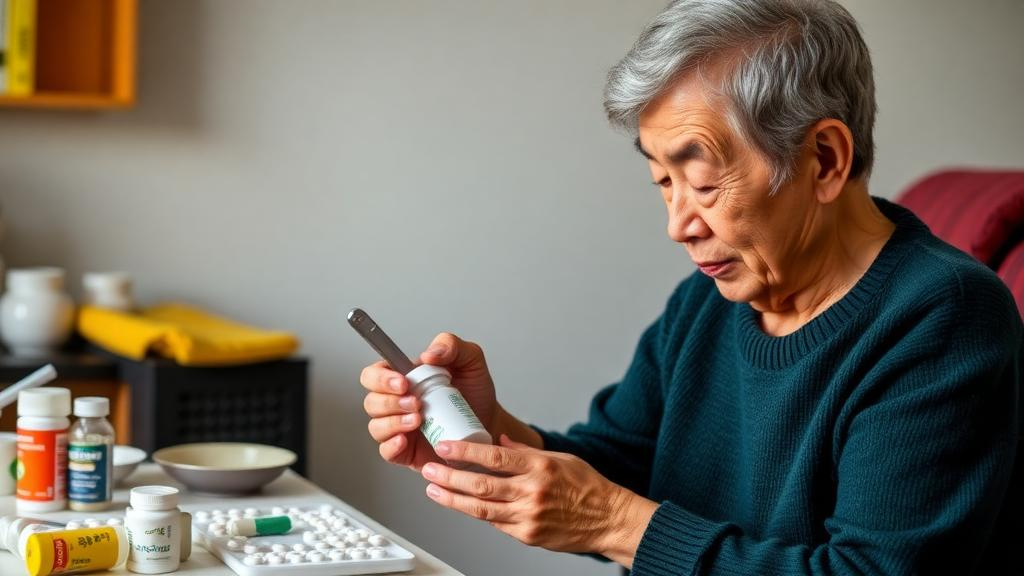
For millions of older adults in China, the simple act of swallowing a pill at the right time has become a quiet daily struggle, and new research suggests that struggle is far more than a minor inconvenience. A large cross-sectional analysis of the 2023 China Longitudinal Aging Social Survey, published in BMC Health Services Research, has found that living with multiple chronic diseases nearly triples the odds that an older person cannot take medications independently, and that this risk is shaped in unexpected ways by physical functional limitation. The study, led by Wanxin Mao, Zhiying Chen, Zheng Shao and Wenjun Jiang, with Lina Gao and Kan Tian as corresponding authors at Nanjing University of Chinese Medicine, offers one of the most detailed portraits yet of how disease burden, disability and medication-taking ability intersect in the world’s most rapidly aging society.
The research team drew on data from the 2023 wave of the China Longitudinal Aging Social Survey, a nationwide survey conducted by Renmin University of China. The descriptive sample comprised 11,670 adults aged 60 years or older, of whom 11,655 had usable data on chronic conditions. Multimorbidity was defined in a deliberately strict and clinically meaningful way: a participant was considered to have multimorbidity only if they reported two or more chronic conditions that had each been diagnosed by a physician. This physician-confirmed definition matters, because self-reported disease labels can be unreliable, and anchoring the definition to clinical diagnosis reduces the risk of inflating disease burden estimates.
The headline numbers are striking. Among the 11,655 participants with available chronic-condition data, 5,311 people, or 45.6 percent, met the definition of multimorbidity. In other words, nearly one in two older Chinese adults in the survey was living with at least two diagnosed chronic diseases. Against that backdrop, 573 participants, or 4.9 percent of the sample, reported difficulty taking medications independently. That figure was derived from a single functional item asking respondents whether they could take medications by themselves, a deceptively simple question that captures a complex chain of abilities: opening containers, reading labels, remembering schedules, and physically manipulating pills.
To test whether multimorbidity was genuinely associated with medication-taking difficulty rather than merely correlated with it, the researchers used multivariable logistic regression, a statistical technique that estimates the odds of an outcome while adjusting for other characteristics that could confound the relationship. The primary model produced an adjusted odds ratio of 2.682, with a 95 percent confidence interval of 2.163 to 3.324. Because that confidence interval sits entirely above 1, the finding is statistically robust: older adults with multimorbidity had roughly 2.7 times the odds of reporting difficulty taking medications independently compared with those without multimorbidity, after accounting for other measured factors.
Yet the single most powerful predictor in the analysis was not disease count but functional limitation. Participants with functional limitation showed an adjusted odds ratio of 16.495 for difficulty taking medications independently, with a 95 percent confidence interval of 13.140 to 20.708. That is an enormous effect by epidemiological standards, and it makes intuitive sense: taking medication is itself a physical and cognitive task, so impairments in mobility, dexterity, vision or memory translate directly into difficulty managing a pill regimen. The finding reframes medication-taking not as a purely medical behavior but as a functional one, sitting squarely within the domain of daily living activities.
The most technically intriguing result concerns the interaction between multimorbidity and functional limitation. The multiplicative interaction term was statistically significant, with an interaction odds ratio of 0.219 and a 95 percent confidence interval of 0.120 to 0.398. On its face, an interaction odds ratio below 1 might suggest that functional limitation weakens the association between multimorbidity and medication difficulty. But the authors caution against a naive reading of that number. When the team calculated adjusted probabilities of medication-taking difficulty across the combined-status profiles, the highest probability was found among participants who had both multimorbidity and functional limitation. The statistical interaction reflects the way odds ratios behave on a multiplicative scale, where ceiling effects can compress ratios even as absolute risk continues to climb. In practical terms, the two vulnerabilities compound rather than cancel each other out.
This distinction between multiplicative interaction and absolute risk is more than a statistical footnote; it carries real consequences for how screening tools should be built. If analysts looked only at the interaction odds ratio, they might conclude that multimorbidity matters less for people who are already functionally limited. The adjusted probabilities tell the opposite story: the combined-vulnerability group represents the highest-risk profile in the population. For clinicians and policymakers, the lesson is that disease burden and functional status must be assessed together, because each amplifies the practical impact of the other on a person’s ability to manage treatment at home.
The study then took a second analytical step that distinguishes it from much of the existing multimorbidity literature: it connected these health profiles to the use of community healthcare services. Among participants who reported at least one community healthcare service need, the researchers examined whether combined-status profiles predicted unmet need. The result was clear. Older adults with both multimorbidity and difficulty taking medications independently had significantly higher odds of unmet community healthcare service needs, with an adjusted odds ratio of 2.197 and a 95 percent confidence interval of 1.604 to 3.008. The people least able to manage their own medications were also the people most likely to fall through the cracks of the community care system.
This service-gap finding lands at a delicate moment for China’s health system. The country is aging at a pace unmatched in modern history, and its policy response has emphasized strengthening primary and community-level care so that chronic disease management can happen close to home rather than in overcrowded tertiary hospitals. Medication adherence and safe self-administration are central to that vision, because most chronic disease treatment is delivered through daily pharmaceutical regimens. If nearly half of older adults carry multiple chronic conditions and a meaningful minority cannot manage their medications without help, then community health services become the load-bearing infrastructure of the entire chronic disease strategy. The study’s evidence that the combined-vulnerability group faces doubled odds of unmet need suggests that current service planning may not be reaching precisely the people who depend on it most.
The authors argue that their findings support integrating disease burden, functional status and medication-taking ability into a unified assessment of service-related vulnerability, and into needs-based planning for community health services. In practice, that could mean screening for medication-taking difficulty during routine community health visits, flagging older adults who combine multimorbidity with functional limitation for enhanced support such as medication management services, home visits or caregiver training. As with all cross-sectional research, the study captures a single moment in time and cannot establish whether multimorbidity causes medication difficulty or vice versa; the single-item measure of medication-taking ability also leaves room for more granular measurement in future work. But the scale of the dataset, the physician-anchored definition of multimorbidity and the careful layered analysis make a compelling case that the intersection of chronic disease, disability and medication management is where community healthcare in aging societies will be won or lost. For the hundreds of millions of older adults navigating multiple prescriptions across Asia and beyond, the pill bottle, it turns out, is a frontline of healthcare.
Subject of Research: Multimorbidity, functional limitation and medication-taking difficulty among older adults in China
Article Title: Multimorbidity, functional limitation, difficulty taking medications independently, and unmet community healthcare service needs among older adults in China: a cross-sectional analysis of the 2023 CLASS wave
Article References: Mao, W., Chen, Z., Shao, Z., Jiang, W., Gao, L., & Tian, K. (2026). Multimorbidity, functional limitation, difficulty taking medications independently, and unmet community healthcare service needs among older adults in China: a cross-sectional analysis of the 2023 CLASS wave. BMC Health Services Research. https://doi.org/10.1186/s12913-026-15736-z
Image Credits: AI Generated
DOI: 10.1186/s12913-026-15736-z
Keywords: multimorbidity, older adults, medication management, functional limitation, community health services, China, CLASS survey, unmet healthcare needs, cross-sectional study, logistic regression, aging, health services research
Cite Scienmag News
Ophelia Keating. (October 5, 2026). Millions of Older Chinese Adults Struggle to Take Their Own Medicines, Study Finds. Scienmag. https://scienmag.com/millions-of-older-chinese-adults-struggle-to-take-their-own-medicines-study-finds/
Ophelia Keating. "Millions of Older Chinese Adults Struggle to Take Their Own Medicines, Study Finds." Scienmag, 5 October 2026, https://scienmag.com/millions-of-older-chinese-adults-struggle-to-take-their-own-medicines-study-finds/. Accessed 5 October 2026.
Ophelia Keating. "Millions of Older Chinese Adults Struggle to Take Their Own Medicines, Study Finds." Scienmag. October 5, 2026. https://scienmag.com/millions-of-older-chinese-adults-struggle-to-take-their-own-medicines-study-finds/


