


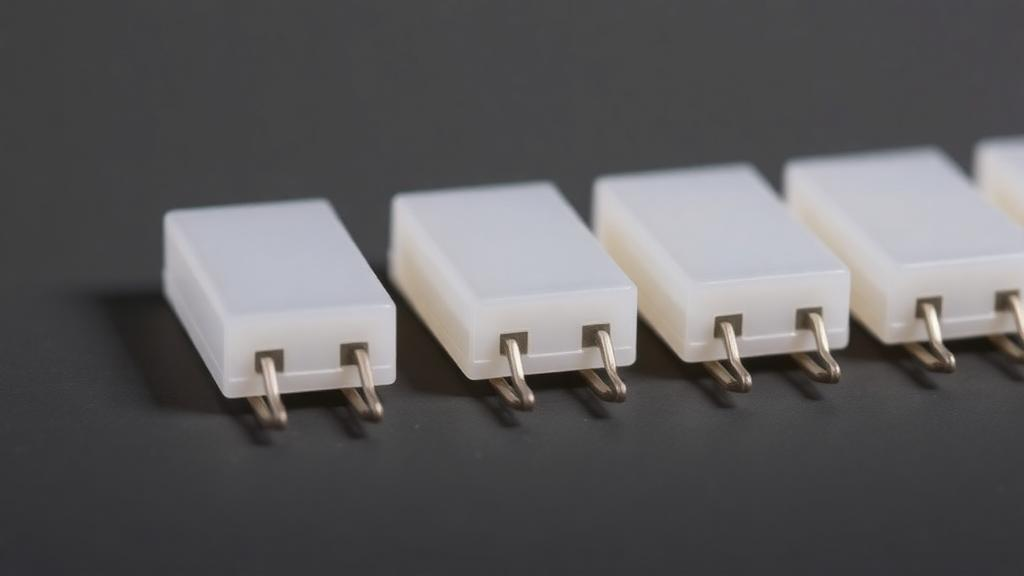
Every electric vehicle, wind turbine, and high-speed train depends on power electronics that must store and release electrical energy in fractions of a second, and the humble dielectric capacitor sits at the heart of that challenge. Now a team of Chinese materials scientists has shown that a surprisingly simple trick, adding a small dose of low-melting-point glass to a ceramic powder before firing, can dramatically improve how these energy-storage materials densify, how their grains grow, and how much energy they can pack into every cubic centimeter. The work, published in the Journal of Materials Science, offers a practical route to denser, better-performing glass-ceramics that could matter for everything from pulsed-power systems to advanced multilayer capacitors.
The material at the center of the study is a glass-ceramic based on the PSBNT system, a lead-containing niobate-titanate composition that crystallizes into what researchers call tetragonal tungsten bronze niobate, a crystal structure prized in dielectric applications. Glass-ceramics like this are made by preparing a glass, crystallizing it into a ceramic phase, and then sintering the resulting powder into a dense solid. The problem has always been that sintering these niobate-based powders requires high temperatures, and high temperatures bring unwanted consequences: exaggerated grain growth, evaporation of volatile components such as lead, and porosity that undermines both dielectric performance and electrical breakdown strength. The team, led by Yunhe Yi of Northeastern University in Shenyang together with colleagues from the GRINM Group, GRIMAT Engineering Institute, the General Research Institute for Nonferrous Metals, and the Shanghai Institute of Ceramics, attacked this problem with a sintering aid called PZABS glass, a low-melting additive designed to soften and flow well below the temperature at which the main ceramic phase would normally densify.
The manufacturing route is as important as the chemistry. Rather than pressing dry powder into pellets, the researchers used tape casting, a scalable industrial process in which the powder is mixed with solvents, binders, and plasticizers into a slurry and spread into thin, uniform sheets. Tape casting is the same technique used to fabricate multilayer ceramic capacitors, where hundreds of thin dielectric layers are stacked and co-fired together. That connection matters because any improvement demonstrated in a tape-cast system translates more directly to real capacitor manufacturing than results obtained on conventionally pressed bulk ceramics. Prior work in the field, including studies on binder burnout shrinkage and compaction in multilayer capacitor fabrication, has shown how sensitive the final microstructure is to the details of this processing chain, which is precisely why the authors chose to investigate densification behavior in a tape-cast format.
The central variable in the experiments was the amount of PZABS glass added to the PSBNT powder, and the results traced a classic goldilocks curve. With no additive or too little of it, the ceramic particles sintered sluggishly, leaving pores scattered through the microstructure. As the glass content rose, the liquid phase formed during firing filled the gaps between particles, lubricated their rearrangement, and accelerated mass transport, driving the density up and the porosity down. At an addition of just 2 weight percent PZABS, the glass-ceramic reached its best state: a density of approximately 4.84 grams per cubic centimeter and a porosity of only about 0.30 percent, remarkably low numbers for a sintered niobate glass-ceramic. The liquid glass essentially acted as a transient glue, wetting the particle surfaces and pulling the compact together before it crystallized or vaporized away.
But the story turns when the glass dose climbs further. At 6 weight percent PZABS and above, the researchers observed the precipitation of a secondary phase, lead niobate-titanate with the formula Pb2(Nb0.67Ti0.33)2O6.67, alongside the dominant tetragonal tungsten bronze phase and minor silica. Excess glass also worsened densification rather than helping it, a counterintuitive result that the authors attribute to the way too much liquid phase disrupts the sintering balance, promoting secondary crystallization and degrading the microstructural uniformity that dense ceramics require. In other words, the sintering aid is a tool with a narrow effective window: enough to flow and fill pores, but not so much that it changes the phase chemistry of the material. This densification-versus-phase-stability tradeoff is a recurring theme in glass-assisted sintering, and the study quantifies it cleanly for this system.
The dielectric measurements tell the practical story. The optimally doped 2 weight percent sample achieved a relative dielectric permittivity of about 949, a high value that reflects both the intrinsic polarizability of the tungsten bronze niobate crystals and the near-absence of porosity, since air-filled pores dilute permittivity and concentrate electric fields. Just as importantly for energy storage, the sample withstood a breakdown strength of roughly 220 kilovolts per centimeter. Breakdown strength is the ceiling on how much voltage a capacitor can take before it fails, and dense, pore-free microstructures are the key to raising it, because pores and defects act as failure initiation sites. Combining high permittivity with high breakdown strength is the central balancing act of dielectric energy storage research, since the stored energy density scales with the square of the breakdown field.
Those two quantities together delivered the headline numbers of the study: a maximum energy density of 1.03 joules per cubic centimeter and a recoverable energy density of 0.82 joules per cubic centimeter. The gap between the two reflects hysteresis losses in the ferroelectric response, energy that is dissipated as heat rather than returned during discharge, and minimizing that gap is what efficiency means in this context. The researchers also tracked how the additive changed the character of the polarization response. Increasing PZABS content enhanced the relaxor behavior of the glass-ceramic, with the diffuseness exponent gamma rising from 1.81 to 1.96. Relaxor ferroelectrics have smeared-out, frequency-dependent transitions and slim polarization loops, which generally means lower hysteresis loss and better energy-storage efficiency, so the shift toward stronger relaxor character is a meaningful microstructural lever, not just a curiosity.
Placed in context, the work connects to a broad and active effort across the ceramics community to use glass additives as sintering accelerants and property modifiers. Previous studies have employed calcium-aluminosilicate glasses in strontium barium niobate ceramics, phosphorus pentoxide doping to enhance densification of SrO-BaO-Nb2O5-SiO2 tungsten bronze glass-ceramics, and zinc-bismuth-silicate glasses in barium titanate systems, while low-temperature co-fired ceramic technology has long relied on glass phases to bond ceramic layers at reduced temperatures. What distinguishes the new study is the combination of a deliberately low-melting PZABS glass, a tape-casting route compatible with multilayer device fabrication, and a systematic mapping of how additive content controls the full chain from thermal behavior and phase evolution to microstructure and final dielectric and ferroelectric performance. The authors also situate their findings within recent work on defect engineering and crystallization control in glass-ceramics, where managing the defects formed during crystallization has emerged as a parallel strategy for boosting energy storage.
There are honest caveats. The material contains lead, which raises environmental and regulatory questions in commercial electronics, even as much of the field pushes toward lead-free alternatives such as sodium niobate and bismuth-based systems. And an energy density of about one joule per cubic centimeter, while respectable for a sintered glass-ceramic, remains below the targets for the most demanding pulsed-power applications, where researchers pursue several joules per cubic centimeter through strategies like configurational entropy tuning and viscous polymer processing. The value of this study lies less in a record number and more in the demonstration of a controllable, industrially relevant processing knob: a two-weight-percent glass addition that simultaneously maximizes density, preserves the desired crystal phase, and tunes the relaxor response. The work was supported by the Beijing Natural Science Foundation, and the corresponding authors are Qingmeng Zhang and Zheng Lu.
For engineers designing the next generation of capacitors, the message is that sintering aids deserve the same careful optimization as the ceramic chemistry itself. The difference between the best and worst formulations in this study was only a few weight percent of glass, yet it separated a dense, high-permittivity, high-breakdown material from a porous one littered with secondary phases. As demand grows for compact, efficient energy storage in electrified transport and renewable power systems, such processing-level insights, validated in tape-cast form factors that mirror real device fabrication, are exactly the kind of incremental but transferable knowledge that moves dielectric materials from laboratory promise toward manufacturing reality.
Subject of Research: Low-melting glass-assisted sintering of PSBNT niobate glass-ceramics for dielectric energy storage
Article Title: Low-melting glass-assisted sintering of PSBNT glass-ceramics: densification, microstructure evolution and dielectric properties
Article References: Yi, Y., Chen, J., Zhao, Y., Zhou, M., Zhang, Q., & Lu, Z. (2026). Low-melting glass-assisted sintering of PSBNT glass-ceramics: densification, microstructure evolution and dielectric properties. Journal of Materials Science. https://doi.org/10.1007/s10853-026-13841-2
Image Credits: AI Generated
DOI: 10.1007/s10853-026-13841-2
Keywords: glass-ceramics, sintering, tape casting, dielectric materials, energy storage, tungsten bronze, relaxor ferroelectrics, sintering aids, porosity, breakdown strength, capacitors, materials science
Cite Scienmag News
Denise Maddox. (October 5, 2026). A Dash of Low-Melting Glass Makes Ceramic Capacitors Denser and Stronger. Scienmag. https://scienmag.com/a-dash-of-low-melting-glass-makes-ceramic-capacitors-denser-and-stronger/
Denise Maddox. "A Dash of Low-Melting Glass Makes Ceramic Capacitors Denser and Stronger." Scienmag, 5 October 2026, https://scienmag.com/a-dash-of-low-melting-glass-makes-ceramic-capacitors-denser-and-stronger/. Accessed 5 October 2026.
Denise Maddox. "A Dash of Low-Melting Glass Makes Ceramic Capacitors Denser and Stronger." Scienmag. October 5, 2026. https://scienmag.com/a-dash-of-low-melting-glass-makes-ceramic-capacitors-denser-and-stronger/


