


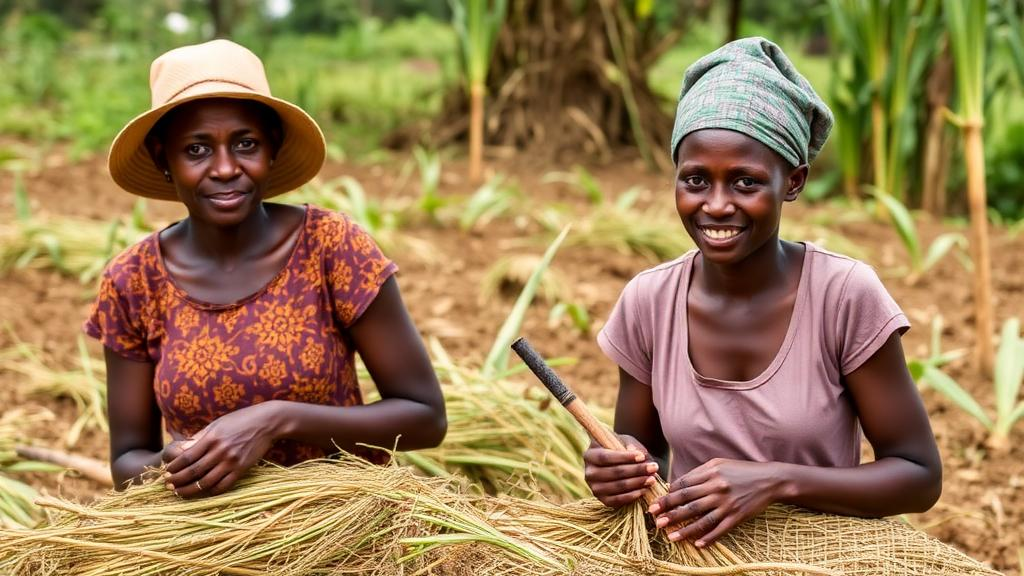
In the flat, swampy plains of eastern Uganda, smallholder farmers are living on the front line of a changing climate. Prolonged dry spells, rising temperatures and increasingly erratic rainfall are eroding harvests of cassava, sweet potatoes and other staples across the Kyoga Agro-ecological zone, one of the country’s most important agricultural regions. A new study published in BMC Environmental Science has now mapped, in unusually fine detail, how unevenly farmers in this zone are responding to those pressures, revealing stark divides along lines of gender, income, education and geography.
The research, led by Chombo Oketcho of Gulu University together with colleagues at Makerere University, surveyed 384 smallholder households in the districts of Pallisa and Tororo using a cross-sectional design. The sample was calculated with the Krejcie and Morgan formula from a population of roughly 168,000 households and split equally between the two districts, with 192 face-to-face interviews conducted in each. Farmers were interviewed in their own languages, Dhopadhola in Tororo and Lugwere and Ateso in Pallisa, by trained graduate research assistants, and the team used GPS coordinates and inverse distance weighting in ArcGIS to map adaptation levels spatially across the zone’s two sub-regions.
Those sub-regions matter. The Kyoga zone is divided into the southern Banana Cotton Millet System (BCMS) subzone, which receives 1215 to 1556 millimetres of rain across two wet seasons, and the northern Teso System (TS) subzone, which receives 1215 to 1465 millimetres in a single long season. Temperatures across the zone range from 24 to 36 degrees Celsius, and the soils are of low to moderate fertility. The region is also among the poorest in Uganda: the Bukedi sub-region, which includes the study districts, records multidimensional poverty affecting 78 percent of its population, compared with a national average of 21.4 percent. That combination of climatic exposure and economic deprivation makes the zone a critical test case for adaptation policy.
The study’s first finding is that farmers overwhelmingly recognise the problem. Some 85.9 percent of respondents in the BCMS subzone and 93.8 percent in the TS subzone said climate change is occurring. More specifically, 55.7 percent of farmers in the BCMS subzone reported rising temperatures over the past decade and 61.5 percent reported declining rainfall, while in the TS subzone the figures were 57.8 percent and 59.9 percent respectively. Only small minorities believed conditions had stayed constant or fluctuated. This near-consensus on perceived climate change is a crucial precondition for adaptation, since farmers using traditional techniques must first recognise that the climate has shifted before they will seek out new strategies.
To measure how far that recognition had translated into action, the researchers asked farmers which of a validated list of strategies they employed, including fast-yielding crop varieties, adjusted planting dates, mulching, soil conservation, tree planting, diversification, irrigation and intercropping. Responses were grouped into three levels: one to two strategies as low adaptation, three to four as moderate, and five to seven as high. The descriptive results revealed clear patterns. In both subzones, farmers in older age brackets were more likely to sit in the highest adaptation category, and adaptation rose with farming experience only up to about 30 years, after which it declined, perhaps because long-experienced farmers become risk-averse or less receptive to new advice.
Gender emerged as one of the starkest determinants. In the BCMS subzone, 68.2 percent of farmers at the highest adaptation level were male, while women dominated the lower categories. The pattern was even sharper in the TS subzone, where 91.2 percent of farmers practising five to seven strategies were men. The multinomial logistic regression confirmed the pattern statistically: female farmers in the TS subzone were significantly less likely to adopt three to four or five to seven strategies compared with the baseline of one to two strategies, with p-values below 0.01, while in the BCMS subzone the relationship was negative but not significant. The authors attribute this to the gender-biased distribution of resources in society, which leaves women with less land, capital and decision-making power.
Money and schooling also mattered. Annual income was positively and significantly associated with adopting both moderate and high levels of adaptation in the BCMS subzone, and education showed a positive, significant link with the highest adaptation level in both subzones: primary education reached significance at p-values of 0.018 in the TS subzone and 0.03 in the BCMS subzone, with secondary education similarly significant. Most farmers at every adaptation level had only primary schooling, suggesting that even basic education helps farmers value innovation, though the researchers note that beyond a certain point educated farmers often shift to non-farm income. Landholding showed a similar ceiling effect, with adaptation rising with farm size only up to two to four acres, the size held by the majority of farmers at every level.
Social networks and information access rounded out the picture. About 68 percent of respondents belonged to a social group, and group membership was significantly and positively associated with moderate adaptation levels in both subzones, a relationship the authors link to peer-to-peer farmer education. Meanwhile 91 percent of farmers accessed weather information, mostly through radio news broadcasts, and access to climate information and credit both tracked positively with adaptation levels. Interestingly, in the BCMS subzone the absence of access to information services was positively associated with moderate adaptation, a counterintuitive result that challenges the assumption that extension services uniformly boost adaptive readiness.
The study was grounded in the Theory of Planned Behavior, which holds that behavioural beliefs, normative beliefs and control beliefs shape intentions and, in turn, actions. Applied here, the framework helps explain why awareness alone has not produced uniform adaptation: farmers may recognise climate change yet lack the perceived control, resources or social encouragement to respond with multiple strategies. The regression results, showing that income, education, group membership and gender independently predict adaptation levels, map closely onto that triad of attitude, social pressure and perceived control.
The authors argue that their findings should inform Uganda’s ongoing reforms of its National Adaptation Plans, including the National Adaptation Plan for Agriculture, and international development frameworks, by embedding socioeconomic disparities into adaptation planning. They recommend targeted support for farmers working fewer than two acres, explicit measures to close the gender gap, stronger and better-delivered information services, and location-specific strategies tailored to each subzone rather than a one-size-fits-all approach. They also call for future modelling of climate scenarios for the Kyoga plains so that farmers can prepare for conditions that may worsen, persist or improve. With poverty in the study region running at several times the national average and rain-fed agriculture the sole livelihood for most households, the message is clear: closing the adaptation gap between who can respond and who cannot may determine whether climate change becomes a hardship or a catastrophe for millions of rural Ugandans.
Subject of Research: Determinants of variation in climate change adaptation levels among smallholder farmers in the Kyoga Agro-ecological zone of Uganda
Article Title: Exploring variation in adaptation levels to climate extremes among farmers of the Kyoga Agro ecological zone in Uganda using a cross sectional design
Article References: Oketcho, C., Mukwaya, P. I., Oriangi, G., & Kisira, Y. (2024). Exploring variation in adaptation levels to climate extremes among farmers of the Kyoga Agro ecological zone in Uganda using a cross sectional design. BMC Environmental Science, 1(1), Article 14. https://doi.org/10.1186/s44329-024-00014-2
Image Credits: AI Generated
DOI: 10.1186/s44329-024-00014-2
Keywords: climate change adaptation, smallholder farmers, Uganda, Kyoga plains, gender disparities, multinomial logistic regression, agro-ecological zones, food security, rural livelihoods, cross-sectional survey, climate extremes, adaptation strategies
Cite Scienmag News
Sloane Callahan. (October 4, 2026). Gender, Income and Education Divide How Ugandan Farmers Adapt to Climate Extremes. Scienmag. https://scienmag.com/gender-income-and-education-divide-how-ugandan-farmers-adapt-to-climate-extremes/
Sloane Callahan. "Gender, Income and Education Divide How Ugandan Farmers Adapt to Climate Extremes." Scienmag, 4 October 2026, https://scienmag.com/gender-income-and-education-divide-how-ugandan-farmers-adapt-to-climate-extremes/. Accessed 4 October 2026.
Sloane Callahan. "Gender, Income and Education Divide How Ugandan Farmers Adapt to Climate Extremes." Scienmag. October 4, 2026. https://scienmag.com/gender-income-and-education-divide-how-ugandan-farmers-adapt-to-climate-extremes/


