


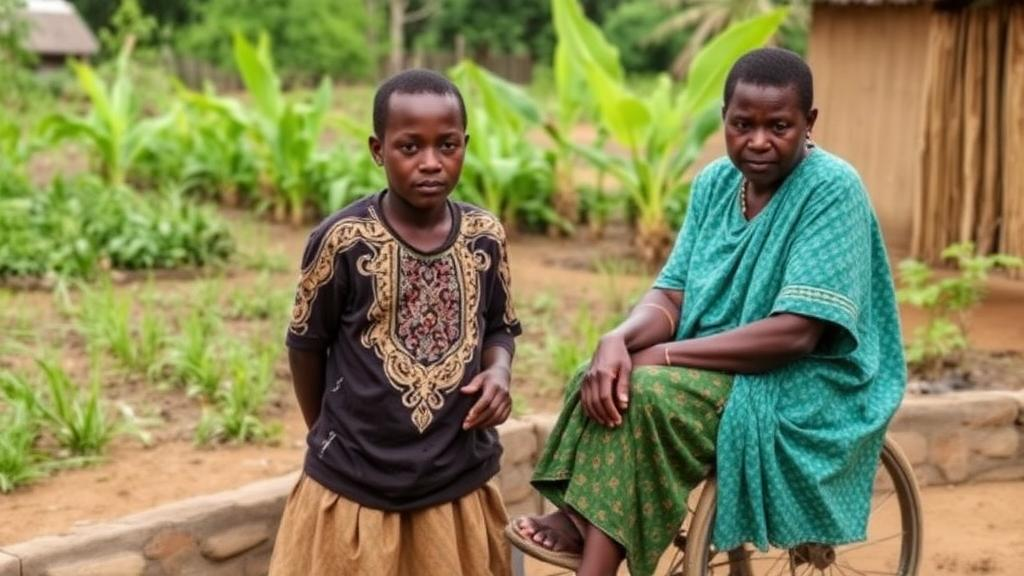
In the savannah districts of northwest Ghana, where a single rainy season decides whether families eat, climate change is not an abstract threat but a daily arithmetic of hunger, heat, and illness. A new study from the University for Development Studies and its collaborators reveals that within this already precarious landscape, one group carries a burden that has long been invisible in climate science: persons with disabilities. Drawing on surveys of 105 people with physical, sensory, and cognitive or intellectual disabilities, alongside interviews with officials in social welfare, disaster management, and district planning, the research offers one of the most detailed empirical portraits to date of how disability shapes the lived experience of a changing climate in sub-Saharan Africa.
The setting could hardly be more climatically exposed. Ghana’s Upper West Region, which borders Burkina Faso and Côte d’Ivoire, sits in the Guinea Savannah zone, where unimodal rainfall averaging around 115 centimetres falls between April and September, and the dry season brings dust-laden harmattan winds from the Sahara. Ghana has already warmed by roughly one degree Celsius since 1960, and projections suggest mean annual temperatures could rise by a further one to three degrees by 2050, with the frequency of hot days and nights increasing by 16 to 57 percent by mid-century. For a region where nearly all households depend on rain-fed cultivation of millet, maize, groundnuts, and guinea corn, these shifts translate directly into failed harvests, water scarcity, and hunger.
What the new research makes clear is that these hazards do not land evenly. Of the region’s roughly 900,000 inhabitants, about six percent live with some form of disability, and in the Nadowli Kaleo District, where the study was conducted, prevalence reaches 4.8 percent. The socio-economic profile of the survey respondents is stark: eighty percent were unemployed, a quarter had no formal education, and roughly ninety percent lived in households earning less than 500 Ghanaian cedis per month, equivalent to about 42 US dollars. This is the economic terrain on which drought, extreme heat, and flooding arrive, and it is a terrain that leaves almost no margin for recovery.
The reported impacts were sweeping. Ninety-four percent of respondents said that drought, extreme heat, and flooding affected their daily activities, and every single participant reported some form of emotional distress, worry, or sadness tied to environmental change. In the longer term, 96.2 percent reported water- and food-related illnesses, 90.5 percent reported increased hunger and poor nutrition, 89.5 percent reported pest-related diseases, and 84.8 percent reported displacement. Heat-related illness or discomfort was the most commonly cited immediate health effect, reported by roughly four in five respondents across all disability categories. One participant with a physical disability described the mechanism plainly: when the weather turns very hot, moving around, working, and getting help all become harder, precisely when survival demands them most.
Crucially, the study shows that vulnerability is not uniform within the disabled population, challenging the tendency of climate research to treat marginalised groups as undifferentiated blocks. Perceptions of who suffers most differed significantly across disability categories. Among respondents with cognitive or intellectual disabilities, 84 percent said persons with disabilities were more affected by climate change than others, as did 82.6 percent of those with physical disabilities, but only 30.8 percent of those with sensory or other disabilities, who more often identified low-income households as the hardest hit. Self-reported climate knowledge also varied significantly, with respondents who have sensory disabilities reporting lower levels of knowledge, a gap the researchers link to communication barriers in how warnings and weather information are disseminated.
This information gap is where the study’s environmental justice framework becomes sharpest. The authors analyse their findings through four dimensions of justice: distributive, concerning who bears the burdens; procedural, concerning who participates in decisions; recognitional, concerning whose needs and identities are acknowledged; and capabilities-based, concerning whether people possess the substantive freedoms to act. When climate information arrives only through written notices, public announcements, or other non-inclusive formats, people with visual, hearing, or cognitive impairments are systematically excluded from the knowledge that determines preparedness. A key informant from the community development department confirmed that access to climate information is not the same for all disability groups, with communication and sensory limitations creating additional barriers to receiving warnings about weather conditions and risks.
Yet the research also documents agency, not just victimhood. Between 81 and 95 percent of respondents across disability categories reported taking some form of adaptive action. The most common strategies were reliance on family and friends, cited by 39.1 percent, livelihood diversification, cited by 21 percent, support from government and external organisations, also 21 percent, and crop diversification, cited by 10.5 percent. Respondents described pivoting from farming alone into petty trading and casual work so that a failed harvest would not mean total destitution. These patterns, the authors argue, dismantle assumptions of passivity: people with disabilities are actively managing climatic uncertainty, even under conditions of poverty that would overwhelm most households.
But agency has limits when the structures around it remain exclusionary. The most striking statistic in the study may be this: 98.2 percent of respondents expressed dissatisfaction or uncertainty about the adequacy of government and societal efforts to address the needs of persons with disabilities in relation to climate change, and only 1.8 percent were satisfied. Respondents acknowledged that their needs were nominally reflected in disaster preparedness plans, yet 98.1 percent said those plans still required substantial improvement to respond to their circumstances. Ghana’s National Climate Change Policy formally commits to inclusive participation, but the gap between paper commitments and accessible implementation, the researchers find, encompasses failures of procedural and recognitional justice as much as distributive ones.
The theoretical weight of the study rests on the social model of disability, which holds that disability is constructed not by impairment itself but by institutional barriers, inaccessible infrastructure, and exclusionary practices. Read through this lens, the climate vulnerability of the respondents is not an inevitable consequence of their bodies or minds; it is manufactured by social systems that fail to accommodate diverse needs in transportation, healthcare, disaster preparedness, and livelihood support. Nearly seventy percent of respondents with physical disabilities reported challenges accessing infrastructural facilities during climatic stress, compared with 46.2 percent of those with sensory or other disabilities and 41.1 percent of those with cognitive or intellectual disabilities, illustrating how mobility and the built environment mediate who can reach water, food, markets, and medical care when conditions deteriorate.
The study’s authors are careful about the limits of their evidence. The sampling frame came from an official register of 1,006 people maintained by the Department of Social Welfare, meaning unregistered individuals, who may be still more vulnerable, were not captured. Some disability categories contained small numbers, so the statistical associations are presented as exploratory patterns rather than causal proof, and the findings reflect self-reported perceptions rather than objectively verified climate impacts. Even with these caveats, the message for policy is unambiguous. Climate adaptation that treats persons with disabilities as a homogeneous, passive block of vulnerability will fail both the science and the people. What is required, the researchers conclude, is disability-inclusive climate governance: accessible and multi-format climate information, meaningful participation of persons with disabilities in adaptation planning, disability-responsive infrastructure, and livelihood support that recognises them not merely as victims of a warming world, but as active agents whose knowledge and adaptive capacities are essential to building a climate future that works for everyone.
Subject of Research: Climate vulnerability and environmental justice among persons with disabilities in Northwest Ghana
Article Title: Climate vulnerability and environmental justice among persons with disabilities in Northwest Ghana
Article References: Aniah, P., Doke, E. T. A., Chrysogonus, A., Amoah, G. A., & Nayaga, P. (2026). Climate vulnerability and environmental justice among persons with disabilities in Northwest Ghana. Discover Global Society, 4(1), Article 213. https://doi.org/10.1007/s44282-026-00568-3
Image Credits: AI Generated
DOI: 10.1007/s44282-026-00568-3
Keywords: climate change, disability, environmental justice, climate vulnerability, adaptation, Ghana, sub-Saharan Africa, social model of disability, food insecurity, adaptive capacity, disaster risk management, inclusive policy
Cite Scienmag News
Sloane Callahan. (October 4, 2026). In Rural Ghana, Climate Change Hits People With Disabilities Hardest, Study Finds. Scienmag. https://scienmag.com/in-rural-ghana-climate-change-hits-people-with-disabilities-hardest-study-finds/
Sloane Callahan. "In Rural Ghana, Climate Change Hits People With Disabilities Hardest, Study Finds." Scienmag, 4 October 2026, https://scienmag.com/in-rural-ghana-climate-change-hits-people-with-disabilities-hardest-study-finds/. Accessed 4 October 2026.
Sloane Callahan. "In Rural Ghana, Climate Change Hits People With Disabilities Hardest, Study Finds." Scienmag. October 4, 2026. https://scienmag.com/in-rural-ghana-climate-change-hits-people-with-disabilities-hardest-study-finds/


