


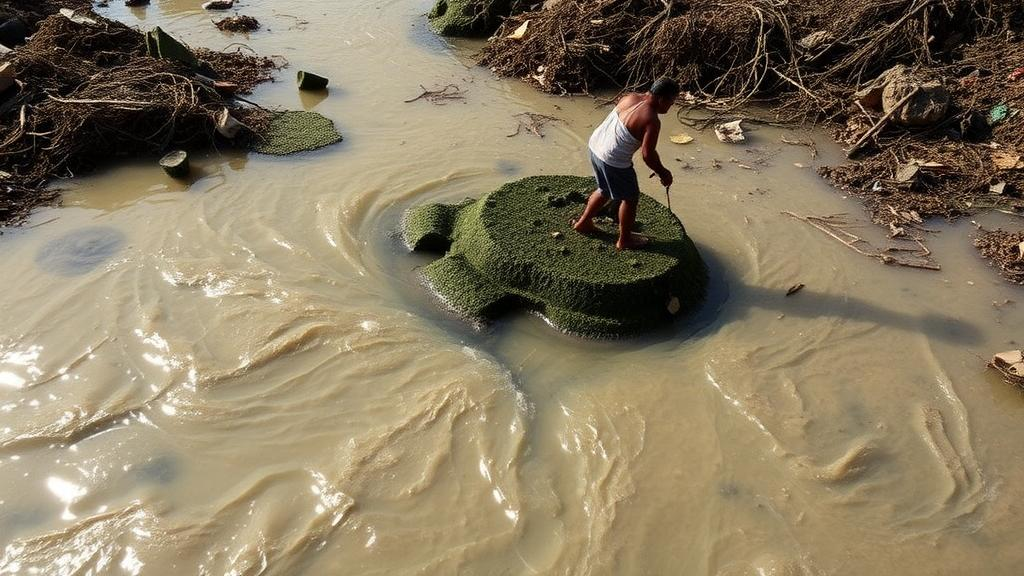
A new study of the Dhaleshwari River in Bangladesh has revealed one of the most extreme chromium contamination footprints ever documented in river sediments, and it carries a sobering lesson for pollution policy worldwide: moving a polluting industry does not eliminate its pollution, it simply relocates it. When Bangladesh’s tannery sector was shifted from the notorious Hazaribagh district of Dhaka to a new industrial estate at Hemayetpur in Savar, the promise was that a modern Central Effluent Treatment Plant would protect the receiving river. Instead, researchers measuring sediments along the Dhaleshwari found chromium concentrations at the discharge point averaging 24,514 micrograms per gram, roughly 260 times the average value in the Earth’s crust, with individual samples reaching nearly 38,000 micrograms per gram. The findings, published in Environmental Geochemistry and Health, show that a single industrial outfall can carve a sharply confined geochemical anomaly into a riverbed while leaving the wider basin comparatively untouched.
The research team, led by Rahat Khan of the Bangladesh Atomic Energy Commission with collaborators in Bangladesh, Saudi Arabia and Australia, collected sixty sediment samples from eighteen sites arranged around the tannery outfall. The design was deliberately three-dimensional: transverse transects crossed the river from the discharge point to the opposite bank at fifty-metre intervals, lateral transects ran along both banks at forty-five-degree angles, and longitudinal sites extended 1,500 to 2,500 metres upstream and downstream. At six key stations the team also extracted sediment cores about twenty-five centimetres long, slicing them into five-centimetre layers to trace how contamination varies with depth. All samples were analysed for fifteen major and trace elements using instrumental neutron activation analysis, a nuclear technique validated against certified reference materials from the International Atomic Energy Agency.
Chromium stood out immediately as the dominant anomaly. Across all sixty samples its concentrations ranged from 63 to 37,846 micrograms per gram, with a coefficient of variation near 280 percent, a statistical signature of a dataset dominated by one extreme location. Chromium exceeded the average upper continental crustal value in 92 percent of samples, while antimony, cobalt and arsenic also surpassed crustal benchmarks in many samples. Yet the spatial structure told the real story. Chromium concentrations declined significantly with distance from the outfall along the river’s flow axis, and a non-parametric comparison across four analytical zones, discharge, opposite bank, upstream and downstream, confirmed that the discharge zone carried far higher levels than all others. The pattern points to a geochemical background that is spatially stable, with tannery influence fading rapidly beyond the immediate discharge area.
The depth profiles added a subtler dimension. Across the six sites with full twenty-five-centimetre cores, including the discharge point itself, chromium showed no systematic trend with depth, suggesting episodic and uneven deposition rather than a clean historical record. Within the nine near-field cores flanking the outfall, however, a significant depth effect emerged, and a paired comparison across all fifteen core sites found surface layers significantly enriched relative to the deepest layers, with a median surface concentration of 1,056 micrograms per gram against 237 micrograms per gram at depth. Near the source, within-core variability reached 50 to 117 percent, reflecting chaotic, source-proximal deposition, while distal cores varied by only 5 to 24 percent, consistent with mixing and depositional averaging. Lateral proximity to the outfall, in other words, exerts stronger control on the sediment burden than vertical stratification.
To separate industrial signals from natural geology, the team applied a battery of geo-environmental indices, including the geo-accumulation index, aluminium-normalised enrichment factors, contamination factors and the pollution load index. Every metric converged on the same conclusion: contamination is strongly element-specific and spatially concentrated, with chromium dominating the discharge zone where the geo-accumulation index climbed as high as 7.2 and mean enrichment factors reached 37.3. The authors caution that aluminium normalisation may be biased at the discharge point itself, because aluminium there is diluted to 1.5 to 1.7 percent by tannery waste compared with roughly 7.5 percent at background sites, so they relied on normalisation-free indices to corroborate the extreme enrichment. Elsewhere in the river, elements such as aluminium, potassium, titanium, rubidium, caesium, thorium and uranium showed low enrichment, reflecting mineralogical composition and Himalayan sediment provenance rather than industrial loading.
The centrepiece of the study was source apportionment using Positive Matrix Factorisation, an Environmental Protection Agency receptor model that decomposes measured concentrations into source fingerprints and their contributions. Guided by principal component analysis, the team settled on a three-factor solution whose stability was confirmed through twenty base runs and twenty bootstrap runs, with all elements classified as strong variables and predicted-observed correlations above 0.75. The first factor, carrying caesium, cobalt, titanium, rubidium, aluminium, arsenic, uranium, thorium and potassium, accounted for 65.5 percent of elemental variance and was attributed to natural weathering of parent rock. The second factor, dominated by chromium at 46.06 percent with supporting contributions from barium and zinc, explained 15.5 percent and was interpreted as the anthropogenic tannery signature. The third, led by antimony and sodium, contributed 19.0 percent and was conservatively labelled a mixed natural-industrial source.
That arithmetic delivers the study’s most striking insight: a comparatively small anthropogenic fraction of the total elemental budget governs the river’s principal ecological concern. Screening against consensus-based sediment quality guidelines showed that half of all sixty samples exceeded the chromium Effects Range Median threshold, the concentration above which adverse biological effects are frequently expected, and 46.7 percent fell between the Effects Range Low and Medium values. Manganese averaged 613 micrograms per gram, above its Lowest Effect Level but below the Severe Effect Level, while zinc sat marginally above its LEL and arsenic remained below it. Station-level toxic unit sums ranged from 1.07 to 154.23, and mean ERM quotients reached 22.3 at the discharge station, corresponding to a 76 percent probability of toxicity under published interpretation frameworks, compared with probabilities of 21 to 49 percent at most other sites.
The authors are careful to frame these results as screening-level evidence rather than proof of biological harm. The measurements capture total chromium, not its speciation, and the difference matters enormously: trivalent chromium, Cr(III), is comparatively immobile, whereas hexavalent chromium, Cr(VI), is far more toxic and bioavailable. Sediment binding phases, redox conditions and organic matter content, all of which control whether chromium can actually enter food webs, were not measured here. Elevated total chromium has been linked elsewhere to biological effects such as bacterial DNA damage, but confirming such consequences in the Dhaleshwari would require dedicated speciation work, sediment bioassays and benthic community surveys. The Th/U ratio of 4.52, above the crustal value of 3.89, does suggest oxidising sediments, a condition under which uranium is mobilised while thorium stays put, but the redox chemistry of chromium itself remains unresolved.
The mechanistic picture that emerges is one of particle-reactive chromium being rapidly scavenged into bed sediments near its release point, producing a hotspot rather than basin-wide dispersion. Chromium released from leather processing travels largely in particulate and reactive phases that settle quickly, while zinc associates with multiple sediment fractions, clays, iron-manganese oxides, organic matter and carbonates, allowing broader redistribution, and sodium disperses with solution chemistry. Hydrodynamic sorting compounds these differences, as fine contaminated particles stay in suspension longer and travel farther than coarse grains. For managers, the implication is direct and potentially cost-saving: targeted intervention at the discharge zone, backed by rigorous enforcement of treatment performance, will do more good than basin-wide remediation. That message is urgent because the treatment plant’s capacity of roughly 14,000 cubic metres per day falls far short of peak effluent generation exceeding 35,000 cubic metres per day. The team calls for chromium speciation, seasonal monitoring, bioaccumulation studies in locally consumed fish and mineralogical characterisation to convert this spatial and source-apportionment framework into a fully management-relevant risk assessment for tannery-impacted rivers everywhere.
Subject of Research: Chromium contamination and source apportionment in river sediments near a relocated tannery discharge in Bangladesh
Article Title: Chromium as a severe anthropogenic geochemical anomaly in river sediments near a tannery outfall: spatial attenuation, source apportionment and ecological risk screening
Article References: Khan, R., Das Shuvo, S., Basir, M. S., Siddique, M. A. B., Mallick, J., Hang, H. T., Khan, M. H. R., Aldawood, S., Roy, D. K., & Saha, N. (2026). Chromium as a severe anthropogenic geochemical anomaly in river sediments near a tannery outfall: spatial attenuation, source apportionment and ecological risk screening. Environmental Geochemistry and Health, 48(14), Article 570. https://doi.org/10.1007/s10653-026-03457-5
Image Credits: AI Generated
DOI: 10.1007/s10653-026-03457-5
Keywords: chromium, river sediments, tannery effluent, Dhaleshwari River, Bangladesh, source apportionment, positive matrix factorisation, ecological risk, sediment quality guidelines, heavy metal contamination, industrial pollution, neutron activation analysis
Cite Scienmag News
Sloane Callahan. (October 4, 2026). Tannery Outfall Leaves Chromium Hotspot 260 Times Crustal Levels in Bangladesh River Sediments. Scienmag. https://scienmag.com/tannery-outfall-leaves-chromium-hotspot-260-times-crustal-levels-in-bangladesh-river-sediments/
Sloane Callahan. "Tannery Outfall Leaves Chromium Hotspot 260 Times Crustal Levels in Bangladesh River Sediments." Scienmag, 4 October 2026, https://scienmag.com/tannery-outfall-leaves-chromium-hotspot-260-times-crustal-levels-in-bangladesh-river-sediments/. Accessed 4 October 2026.
Sloane Callahan. "Tannery Outfall Leaves Chromium Hotspot 260 Times Crustal Levels in Bangladesh River Sediments." Scienmag. October 4, 2026. https://scienmag.com/tannery-outfall-leaves-chromium-hotspot-260-times-crustal-levels-in-bangladesh-river-sediments/


