


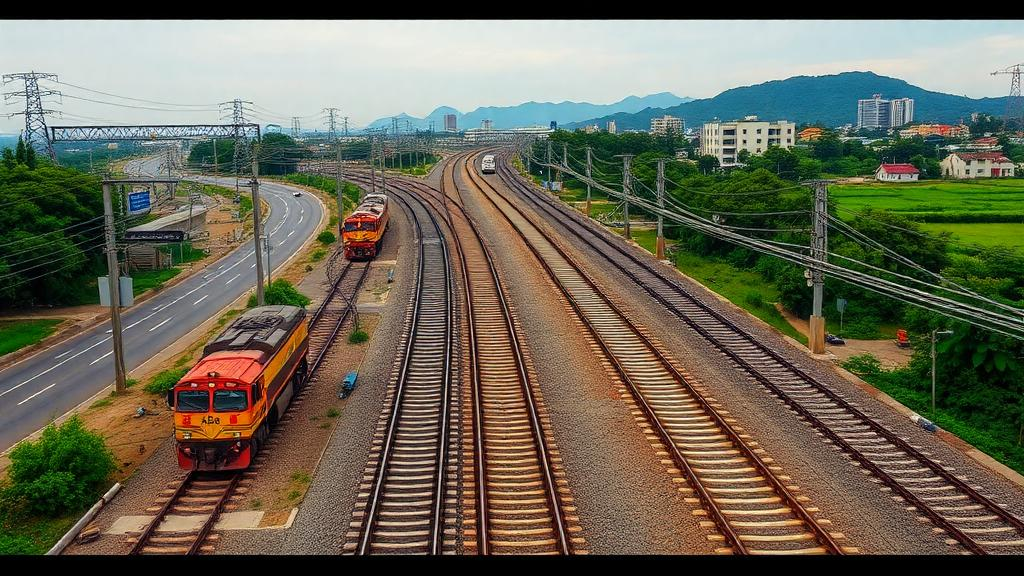
The world’s roads, railways, bridges and tunnels are about to undergo the largest construction boom in human history, and according to a new study in the Journal of Industrial Ecology, the carbon consequences have been almost entirely overlooked. Researchers led by André Baumgart of BOKU University Vienna and Dominik Wiedenhofer, working with colleagues at the International Institute for Applied Systems Analysis (IIASA), have built the first global model that links projected mobility demand to the physical infrastructure it requires, and then traces the steel, concrete, asphalt and aggregates needed to build and maintain it. Their conclusion is stark: without deliberate intervention, the material stock locked up in global mobility infrastructure could double or even triple by 2060, and the emissions from producing those materials could consume a meaningful slice of humanity’s remaining carbon budget.
The scale of the existing system is staggering. The team estimates that in 2024 the world’s mobility infrastructure contained roughly 355 billion metric tons of materials, with an uncertainty range of 255 to 455 billion tons. Aggregates such as sand and gravel account for 74 percent of that mass, followed by concrete and asphalt. Lower-class roads, the local and rural routes that rarely attract attention, hold nearly half of all the material, while high-class roads such as motorways hold another 37 percent. Rail-based infrastructure, including subways, trams, bridges and station buildings, represents only 6 percent of the total mass but consumes a remarkable 68 percent of all the steel embedded in mobility networks. Parking, fueling stations and airport runways contribute less than 3 percent.
What makes the study politically explosive is its mapping of inequality. Per-capita infrastructure stocks range from about 5 metric tons in densely populated, low-income regions such as Sub-Saharan Africa and South Asia to nearly 500 tons in affluent, low-density regions of North America and Western Europe. In length terms, that spans from less than one meter of infrastructure per person to more than 230 meters. The researchers point to earlier work suggesting that well-being gains from mobility infrastructure saturate at around 100 tons per capita, a threshold already exceeded by roughly 20 percent of countries. If the rest of the world converged on that decent-mobility level, global stocks would triple to about 1,037 billion tons by 2060, with South Asia seeing an eightfold increase and Sub-Saharan Africa a sevenfold increase.
Methodologically, the study is a marriage of two modelling traditions that rarely speak to each other. The team first mapped global infrastructure at a resolution of 10 by 10 meters using OpenStreetMap data, which earlier research has shown to be more than 80 percent complete for roads, and harmonized the features into 37 infrastructure classes. They converted lines and points into areas using region-specific average widths validated against satellite imagery, then multiplied each class’s area by material intensity factors covering ten materials from steel and copper to timber and plastics. This produced the baseline stock for 2024. Future stocks were projected by matching each country’s infrastructure to vehicle-kilometer trajectories from the MESSAGEix-Transport integrated assessment model across 12 world regions and seven transport modes, under the Shared Socioeconomic Pathway ‘middle of the road’ scenario.
The second half of the workflow is what gives the study its carbon teeth. Annual material inflows were calculated from the net change in stocks plus maintenance flows derived from class-specific lifetimes, using a ‘leaching’ approach in which infrastructure gradually wears out rather than disappearing at a single end-of-life date. These flows then feed into MESSAGEix-Materials, an economy-wide model that tracks materials from extraction through industrial processing to recycling and waste, and computes the embodied carbon dioxide of producing concrete, asphalt, iron and steel, and aluminum. In the reference scenario, annual material flows reach 23 billion tons by 2060, split roughly equally between expansion and the maintenance and replacement of existing networks, with about 69 percent of maintenance concentrated in higher-income countries whose stocks are already saturated.
The headline numbers on carbon are sobering. Cumulative embodied emissions from 2024 to 2060 amount to about 11 gigatons of carbon dioxide in the reference scenario, equivalent to roughly 1.0 to 6.2 percent of the remaining carbon budget for holding warming to 2 degrees or 1.5 degrees respectively. Under the global convergence scenario, emissions climb 76 percent to 19 gigatons. Most striking is the rail paradox: a worldwide modal shift from road to rail, often promoted as a climate solution, would push embodied emissions up 241 percent to 37 gigatons of carbon dioxide, because railways are extraordinarily hungry for steel, concrete, aluminum and copper. In that scenario, rail infrastructure stocks grow fourteenfold to 300 billion tons, with copper stocks increasing 21-fold and timber, largely for railway sleepers, growing 14-fold.
Not every demand-side measure moves the needle. Halving the vehicle fleet through car sharing, and fully electrifying the passenger fleet, change total stocks by less than 1 percent, because parking and charging infrastructure are a trivial share of total mass. The single most powerful lever is reducing mobility demand itself, particularly in high-income countries. An income-tiered global mobility reduction holds 2060 stocks to 520 billion tons, well below the reference trajectory, and cuts cumulative embodied emissions by 44 percent to 6 gigatons. The researchers are careful to frame their projections as exploratory ‘what-if’ scenarios rather than forecasts, noting that the relationship between demand and infrastructure is non-linear; sensitivity tests in which high-intensity regions utilize infrastructure more intensively before expanding yield stocks 10 to 35 percent below reference levels.
Supply-side measures alone disappoint. Bundles of circular economy and decarbonization options, including material substitution, higher recycling rates, fuel switching in heavy industry and carbon capture and storage, reduce embodied emissions by only 4 to 8 percent when deployed without broader climate policy. But the picture changes dramatically when they are combined with economy-wide climate policy consistent with a 67 percent chance of staying below 2 degrees. Pairing that policy package with the reference or convergence scenarios cuts cumulative emissions by 40 to 47 percent. Most importantly, the fully integrated scenario, combining mobility reduction, rail expansion, enhanced recycling and industrial decarbonization, delivers a 63 percent reduction in embodied emissions while still providing adequate infrastructure for a growing and urbanizing world, helping to offset the carbon cost of building the public transport systems needed to slash operational emissions.
The study’s authors argue that the decisive question is not how much infrastructure gets built but what kind and where, and that urban form is the hidden variable. Decentralized, car-oriented development entrenches automobile dependence, while dense, well-planned cities enable efficient public and active transport with far lower infrastructure requirements per person served. Urban mobility already accounts for 40 percent of global passenger transport carbon emissions, and the urban fabric laid down in South Asia and Sub-Saharan Africa over the coming decades will lock in mobility patterns for a century. The researchers point to empirical evidence from Vienna and scenario analyses for Indian cities showing that shifts toward public and non-motorized transport can substantially reduce resource use and emissions, and to concepts such as Barcelona-style ‘superblocks’ and transit-oriented development as spatial strategies that make car-free life convenient rather than coercive.
There is also a deeper tension the study forces into the open. Operational emissions from vehicles, estimated at roughly 260 to 300 gigatons of carbon dioxide cumulatively through 2060, dwarf infrastructure’s embodied emissions by nearly thirty times, which is why the latter has been ignored. Yet infrastructure and operations are coupled: every new kilometer of road stimulates the very traffic that makes decarbonization harder, a dynamic known as induced demand, vividly illustrated by the Belt and Road initiative opening new freight corridors across Eurasia. The authors stress that replacing motorized trips with walking and cycling in dense urban settings requires comparatively little material investment and delivers public health co-benefits through cleaner air and more physical activity. Their bottom line is that neither demand reduction nor cleaner production alone can reconcile the coming infrastructure boom with climate goals; only an integrated strategy, planned jointly with land use, can deliver mobility for all without mortgaging the carbon budget.
Subject of Research: Global material stocks and embodied carbon emissions of future road and rail mobility infrastructure expansion
Article Title: Material and carbon implications of future mobility infrastructure expansion around the world
Article References: Baumgart, A., Ünlü, G., Grammer, B., Javaid, A., Maczek, F., Krausmann, F., Krey, V., & Wiedenhofer, D. (2026). Material and carbon implications of future mobility infrastructure expansion around the world. Journal of Industrial Ecology, 30(4), 1935-1949. https://doi.org/10.1007/s44498-026-00132-x
Image Credits: AI Generated
DOI: 10.1007/s44498-026-00132-x
Keywords: mobility infrastructure, material stocks, embodied emissions, carbon budget, railways, roads, circular economy, decarbonization, urban form, OpenStreetMap, integrated assessment modelling, Global South
Cite Scienmag News
Sloane Callahan. (October 4, 2026). Roads, Rails and Carbon: The Hidden Material Cost of the World’s Mobility Boom. Scienmag. https://scienmag.com/roads-rails-and-carbon-the-hidden-material-cost-of-the-worlds-mobility-boom/
Sloane Callahan. "Roads, Rails and Carbon: The Hidden Material Cost of the World’s Mobility Boom." Scienmag, 4 October 2026, https://scienmag.com/roads-rails-and-carbon-the-hidden-material-cost-of-the-worlds-mobility-boom/. Accessed 4 October 2026.
Sloane Callahan. "Roads, Rails and Carbon: The Hidden Material Cost of the World’s Mobility Boom." Scienmag. October 4, 2026. https://scienmag.com/roads-rails-and-carbon-the-hidden-material-cost-of-the-worlds-mobility-boom/


