


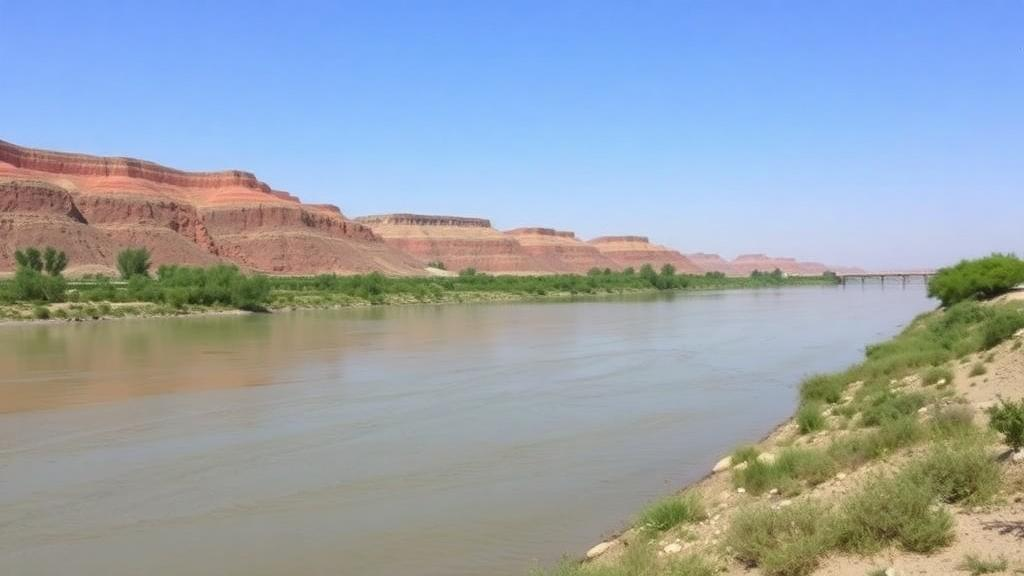
Along the banks of the Zayandeh Rud, the largest river of Iran’s central plateau, the green corridors that once defined one of the country’s most beloved ecotourism destinations are quietly disappearing. A new study published in Discover Conservation has quantified, with unusual spatial precision, how decades of tourism growth have reshaped the river’s ecological fabric. Combining large-scale surveys of residents and tourists with geostatistical modeling, researchers led by Hojatollah Sadeghi of the University of Isfahan, Kamran Jafarpour Ghalehteimouri of Kharazmi University, and Ali Shamsoddini of Islamic Azad University in Shiraz found that tourism development has driven a measurable conversion of agricultural land into service-oriented functions, triggering deforestation, garden loss, unauthorized well drilling, and the degradation of native plant species along the 400-kilometer waterway.
The Zayandeh Rud is no ordinary river. Rising in the central Zagros mountains near Zardkoh in Chaharmahal and Bakhtiari province, it flows eastward across the arid heart of Iran before terminating at the Gavakhuni wetland. Its basin spans roughly 41,500 square kilometers, with an estimated flow of 38 cubic meters per second under favorable conditions. In 2009, Iran’s Cultural Heritage and Tourism Organization designated the river a natural heritage site, cementing its status as both a recreational magnet and a cultural symbol. Yet the river has also endured severe water scarcity driven by climate change and drought, making the green infrastructure along its banks—trees, gardens, riparian vegetation, and the ecosystem services they provide—precious and fragile in equal measure.
Green infrastructure, in the ecological sense, refers to the interconnected network of natural and semi-natural areas that deliver what scientists call ecosystem services: provisioning benefits such as food, clean air, and water; regulating functions like climate moderation, pollination, and nutrient cycling; and cultural values including recreation and aesthetic inspiration. Healthy riparian ecosystems offer cost-effective alternatives to conventional grey infrastructure, purifying air, cooling microclimates, and buffering floods. When tourism development proceeds without systematic planning, the study’s authors argue, these multi-functional assets are precisely the ones that erode first, because land adjacent to scenic water is the most valuable for restaurants, guesthouses, and other tourism services.
To capture these dynamics, the research team designed a quantitative survey targeting twelve sites—six urban and six rural—all located within 500 meters of the riverbank. The rural settlements contained 4,816 residents, while the urban sites held a population of more than 2.26 million. Using stratified sampling to ensure proportional representation, the team distributed 240 questionnaires in urban areas and 150 in rural ones, ultimately collecting 390 valid responses. The instrument, reviewed by specialists in environmental planning and tourism studies, achieved a Cronbach’s alpha above the conventional 0.70 reliability threshold. The sample itself was diverse: 71.8 percent male and 28.2 percent female, with 65.9 percent local residents and 34.1 percent tourists, and educational attainment ranging from sub-diploma to doctoral level.
The statistical results were unambiguous. A one-sample t-test placed the current state of the river’s green infrastructure at an average score of 3.294 on a five-point scale—mediocre, but statistically significant. More striking was the finding that the river’s greenery during the rainy season scored 4.3974 as a driver of tourist attraction, confirming a painful paradox: the very vegetation that draws visitors is being consumed by the tourism it attracts. Across fifteen variables measuring tourism’s environmental role, all proved significant at p < 0.05. The strongest single impact was land-use change, with a mean score of 4.207, followed by increased waste accumulation in green spaces at 4.089, declining tree cover at 3.912, vegetation destruction along riverbanks at 3.864, unauthorized well construction at 3.700, and the loss of traditional gardens at 3.633.
Respondents were also asked to identify who bears responsibility for the damage. Tourists themselves ranked first, cited by 47.7 percent of the sample, a finding the researchers attribute to the absence of any comprehensive plan for sustainable tourism development in the region. Residents of smaller cities outside Isfahan ranked second at 21 percent, and villagers third at 10.8 percent. Interestingly, an independent-samples t-test revealed a significant difference of 0.049 between residents and tourists in their perceptions: tourists scored slightly higher (3.807 versus 3.772) in believing that tourism harms the river’s greenery, suggesting that visitors, perhaps comparing the river to other destinations, perceive the degradation more acutely than the people who live with it daily.
The study’s most technically innovative contribution lies in its spatial analysis. Using Geographically Weighted Regression in ArcGIS—a method that allows relationships between variables to vary across space rather than assuming uniform effects—the team modeled how settlement distance influences riparian vegetation. The model achieved an R-squared of 0.5442, meaning roughly 54 percent of the variation in green infrastructure can be explained by proximity to settlements, with an adjusted R-squared of 0.3680 and an Akaike Information Criterion value of −11.279 confirming the model’s comparative strength. The results revealed a clear distance-decay pattern: settlements within 300 meters of the river consistently exerted the strongest impacts, with coefficients between 3.815 and 3.835. Zayandeh Rud City, just 150 meters from the water, registered the highest coefficient at 3.835, while Isfahan, at 500 meters, showed the weakest among major urban centers at 3.612. Varnamkhast City, 1,500 meters away, dropped to 3.773, and Khoshuiye Village at 400 meters registered 3.817.
Complementary analyses sharpened the picture further. An ANOVA test confirmed that urban and rural settlements differ significantly in their impact on the river’s greenery (p < 0.001), and Duncan’s post hoc test isolated Cham-e Taq Village as the settlement with the highest perceived impact (mean 3.963), followed by Zayandeh Rud City (3.913) and Sedeh City (3.905), while Isfahan City showed the lowest (3.505). The authors suggest that Isfahan’s well-developed infrastructure and systematic green-space management may buffer degradation pressures that smaller settlements, lacking such institutional capacity, absorb in full. Meanwhile, Moran’s Index of −0.277, with a z-score of −0.753 and a p-value of 0.451, indicated a random spatial distribution of green infrastructure—no significant clustering or dispersion. This randomness implies that localized factors such as microclimate variability and historical land-use practices, rather than systematic spatial drivers, shape where greenery survives, meaning conservation efforts must be site-specific rather than uniform.
When asked what could restore the river’s ecological vitality, respondents pointed first to stakeholder performance in green-space development, which earned the highest mean score of 4.174 in a binomial test of twelve proposed factors. The application of new restoration techniques (4.013), governmental action on drought (4.000), and tourism-oriented green-space planning (3.951) followed closely. Building on these signals, the study proposes an ecosystem-based zoning framework: a Core Zone within 0 to 100 meters of the river with strict development restrictions, a Buffer Zone from 100 to 300 meters permitting only low-impact tourism, and a Sustainable Use Zone beyond 300 meters allowing controlled development supported by green infrastructure. The authors also recommend a multi-stakeholder Zayandeh Rud River Stewardship Alliance—with local communities holding 40 percent of seats, tourism operators 30 percent, environmental agencies 20 percent, and academic institutions 10 percent—supported by AI-driven satellite monitoring, automated water-quality stations, and regenerative tourism measures such as visitor footprint offsets and floating wetlands.
The broader significance of the research extends well beyond one Iranian river. In semi-arid, climate-vulnerable basins worldwide, tourism is often promoted as a sustainable alternative to extractive industry, yet this study demonstrates that unregulated tourism can replicate the same destructive land-use dynamics as urban sprawl. By fusing resident perceptions, spatial proximity data, and geostatistical modeling into a single replicable framework, the researchers offer planners a template for identifying critical distance thresholds and tailoring interventions to specific settlements. The message for the Zayandeh Rud is stark but hopeful: the degradation documented here is not inevitable. With spatially informed zoning, inclusive governance, and economic incentives aligned with conservation, tourism could shift from being the river’s stressor to becoming its restoration catalyst—preserving the green corridors that make the Zayandeh Rud worth visiting in the first place.
Subject of Research: Impacts of tourism development on the green infrastructure and ecosystem services of the Zayandeh Rud River in Iran
Article Title: Impact of tourism development on green infrastructures of ecosystem in Zayandeh Rud River tourism destinations: a spatial and temporal analysis
Article References: Sadeghi, H., Jafarpour Ghalehteimouri, K., & Shamsoddini, A. (2025). Impact of tourism development on green infrastructures of ecosystem in Zayandeh Rud River tourism destinations: a spatial and temporal analysis. Discover Conservation, 2(1), Article 37. https://doi.org/10.1007/s44353-025-00059-7
Image Credits: AI Generated
DOI: 10.1007/s44353-025-00059-7
Keywords: tourism development, green infrastructure, ecosystem services, Zayandeh Rud River, land-use change, Geographically Weighted Regression, spatial analysis, riparian vegetation, sustainable tourism, Iran, environmental degradation, river management
Cite Scienmag News
Sloane Callahan. (October 4, 2026). Tourism Is Quietly Stripping the Green Life from Iran’s Zayandeh Rud River. Scienmag. https://scienmag.com/tourism-is-quietly-stripping-the-green-life-from-irans-zayandeh-rud-river/
Sloane Callahan. "Tourism Is Quietly Stripping the Green Life from Iran’s Zayandeh Rud River." Scienmag, 4 October 2026, https://scienmag.com/tourism-is-quietly-stripping-the-green-life-from-irans-zayandeh-rud-river/. Accessed 4 October 2026.
Sloane Callahan. "Tourism Is Quietly Stripping the Green Life from Iran’s Zayandeh Rud River." Scienmag. October 4, 2026. https://scienmag.com/tourism-is-quietly-stripping-the-green-life-from-irans-zayandeh-rud-river/


