


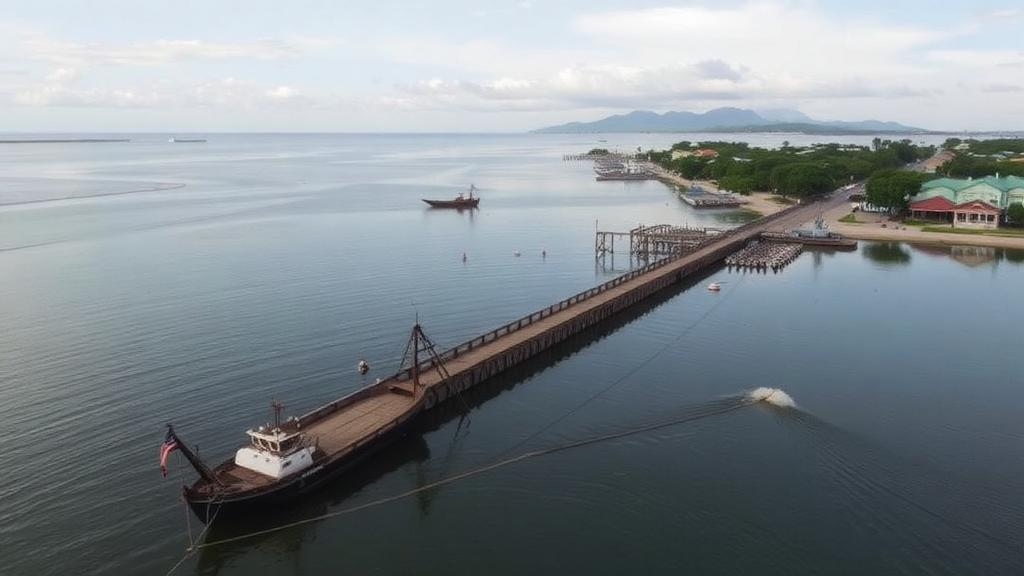
More than a decade after Typhoon Yolanda, internationally known as Haiyan, devastated the central Philippines in November 2013, the question of how Tacloban City should live alongside its water remains unresolved. A new study published in the journal Ambio by Antonio D. Salazar Jr. of the University of the Philippines Tacloban and Giles Jan L. Viojan of the University of the Philippines Cebu examines that question through a single, sharply contested piece of coastal infrastructure: the Cancabato Causeway. Their analysis, published on 4 October 2026, argues that post-disaster recovery is not merely a matter of rebuilding what the storm destroyed, but of deciding whose vision of the future gets materialized in concrete, documents, and daily practice along the shoreline of Cancabato Bay.
The researchers approach the bay not as a passive object to be engineered but as the center of what they call policy assemblages: temporary alignments of actors, infrastructures, legal instruments, documents, and practices that each assemble a different future for the same body of water. Drawing on public sector design scholarship and assemblage thinking, a tradition in critical policy research associated with scholars such as Thomas Baker and Pauline McGuirk, the study treats design as something that happens continuously in governance, not only in the drawings of architects and engineers. Policy design, in this framing, is the deliberate arrangement of instruments and capacities to shape outcomes, and it always embeds assumptions about what water is, what people need, and what counts as resilience.
The empirical work combined three qualitative methods: in-depth interviews, document analysis, and participant observation. The authors spent time in and around the Paraiso Mangrove Eco-Learning Park and Marine and Wildlife Sanctuary, a community-run site on the bay, and they acknowledge in their paper the community members and, notably, the more-than-human beings of the mangrove park who made the research possible. This fieldwork allowed them to trace how different groups mobilize different materials, from seawalls and causeway plans to environmental laws, scientific evidence, fishing boats, and mangrove seedlings, in order to make competing futures for the bay feel real and achievable.
Out of this material, the researchers identified three distinct policy assemblages competing to define Cancabato Bay. The first is a technocratic assemblage, in which government actors and allied institutions organize the bay primarily as a corridor for mobility and investment. In this vision, resilience is equated with new hard infrastructure: causeways, roads, and engineered defenses that promise to move people and capital efficiently while holding the water at bay. Participation by affected communities is proceduralized, reduced to formal consultation steps that satisfy legal requirements rather than genuinely reshaping the plans. The study’s findings echo a broader concern in recent disaster scholarship, including work by J. See and colleagues published in 2025, that hard infrastructure retains an enduring allure in adaptation policy even when it may reinforce, rather than resolve, underlying vulnerabilities.
The second assemblage is an environmental advocacy coalition that challenges the technocratic vision through law, scientific evidence, and the language of environmental justice. These actors invoke legal protections for the bay, document ecological harm, and argue that the causeway and related developments threaten fisheries, mangroves, and the livelihoods of coastal residents. Yet the authors find that this advocacy assemblage remains partly constrained by anthropocentric ways of knowing: it tends to value the bay instrumentally, as a resource and service provider for humans, rather than recognizing the bay itself as an actor with which people are entangled. The study draws here on posthumanist and feminist scholarship, including the work of Val Plumwood and of Nick Fox and Pam Alldred, which questions the assumption that only humans hold agency in environmental politics.
The third assemblage is the most intimate and, in the authors’ account, the most easily overlooked: a fisherfolk-bay assemblage. Here, the bay is not a corridor or a resource but a partner in everyday life. Fisherfolk practices of reading tides, harvesting in season, and rebuilding after storms embody what the researchers call living-with-water, a set of vernacular skills and hopes for futures shared with the bay rather than secured against it. This assemblage does not usually speak in the language of policy documents or environmental impact assessments, which is precisely why, the authors argue, conventional participation processes so often fail to register it. Its knowledge is carried in practice, memory, and aspiration rather than in technical reports.
From these three assemblages, the study derives three lessons for public design. First, design is inherently relational: any intervention in the bay reconfigures relationships among water, people, infrastructure, and governance, whether or not designers acknowledge this. Second, public design must work with multiplicity rather than seeking a single authoritative plan; the coexistence of technocratic, advocacy, and fisherfolk visions is not an obstacle to be eliminated but the raw material of legitimate design. Third, participation must be treated as future-making rather than as an end in itself. The point of involving communities is not to check a procedural box but to open the design process to futures that marginalized actors actually want to inhabit, including futures in which the bay retains room to be a living system rather than a fixed asset.
The concept of a relational public design that the authors propose connects their Tacloban findings to a wider international debate. Design theorists from Herbert Simon’s foundational work on the sciences of the artificial to Christian Bason’s studies of human-centered governance have treated design as a disciplined way of shaping the made world. More recently, scholars such as Arturo Escobar have argued for designs for the pluriverse, in which multiple worlds and ways of relating to nature are allowed to coexist. The Tacloban study operationalizes these ideas in a post-disaster setting, showing how assemblage thinking can serve as a methodology for mapping who assembles what, with which materials, toward which futures. In this sense, the paper contributes both to urban policy scholarship and to the sociology of architecture and landscape planning.
The stakes of the analysis are considerable for the Philippines, where water governance has long been identified as fragmented. Earlier national studies, including work by Agnes Rola and colleagues on water governance structures and capacities, have documented the institutional complexity that complicates coherent coastal management. Post-Yolanda reconstruction added another layer: research by D.K.P. Yee published in 2021 documented powers of exclusion operating in Tacloban’s recovery, in which disaster rebuilding became a vehicle for reordering land and waterfront access. The new Ambio study extends this line of critique by showing that exclusion operates not only through land markets and relocation but through the very design of infrastructure and participation, which can render fisherfolk futures illegible to planners.
What makes the study resonate beyond Leyte is its reframing of resilience itself. Where the technocratic assemblage equates resilience with engineered protection, and the advocacy assemblage equates it with legal and ecological defense, the fisherfolk-bay assemblage suggests a third possibility: resilience as an ongoing, negotiated practice of coexistence with a dynamic coastal environment. The authors do not claim that hard infrastructure is always wrong or that advocacy is misguided; rather, they show that each assemblage captures part of the truth while foreclosing other possibilities. A relational public design, on their account, would hold these visions in productive tension, treating the bay as a partner in recovery rather than a problem to be solved. As coastal cities worldwide confront rising seas and intensifying storms, the contested causeway of Tacloban offers a compact case study in the politics of designing with, rather than over, the water.
Subject of Research: Post-disaster coastal governance and public design in post-Yolanda Tacloban City
Article Title: Designing with, not over, the bay: Towards a relational public design in post-Yolanda Tacloban
Article References: Salazar, A. D., Jr., & Viojan, G. J. L. (2026). Designing with, not over, the bay: Towards a relational public design in post-Yolanda Tacloban. Ambio. https://doi.org/10.1007/s13280-026-02492-x
Image Credits: AI Generated
DOI: 10.1007/s13280-026-02492-x
Keywords: Typhoon Yolanda, Haiyan, Tacloban, Cancabato Bay, policy assemblage, public design, post-disaster recovery, urban coastal governance, fisherfolk, mangroves, resilience, Philippines
Cite Scienmag News
Violet Maxwell. (October 4, 2026). After Typhoon Yolanda, Who Gets to Design the Bay? Lessons from Tacloban’s Contested Waterfront. Scienmag. https://scienmag.com/after-typhoon-yolanda-who-gets-to-design-the-bay-lessons-from-taclobans-contested-waterfront/
Violet Maxwell. "After Typhoon Yolanda, Who Gets to Design the Bay? Lessons from Tacloban’s Contested Waterfront." Scienmag, 4 October 2026, https://scienmag.com/after-typhoon-yolanda-who-gets-to-design-the-bay-lessons-from-taclobans-contested-waterfront/. Accessed 4 October 2026.
Violet Maxwell. "After Typhoon Yolanda, Who Gets to Design the Bay? Lessons from Tacloban’s Contested Waterfront." Scienmag. October 4, 2026. https://scienmag.com/after-typhoon-yolanda-who-gets-to-design-the-bay-lessons-from-taclobans-contested-waterfront/


