


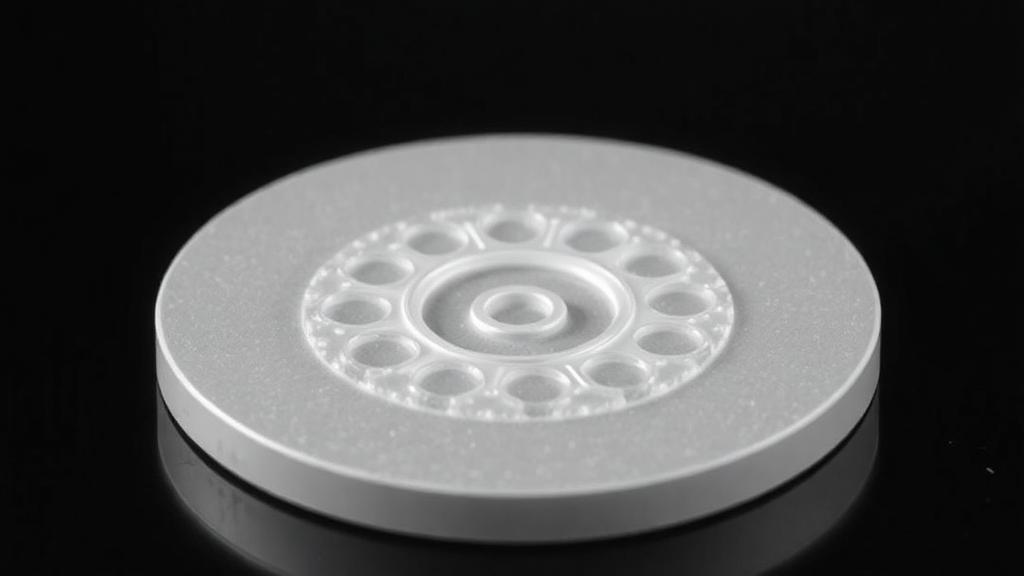
Calcium oxide may look like the least glamorous material in chemistry, but in the race to build practical quantum computers it has quietly become one of the most intriguing. The wide-bandgap ionic insulator, with a bandgap of 7.7 electronvolts and exceptionally low dielectric loss, is now considered a promising host for optically addressable qubits, the defect-based quantum states that could store and process information with long coherence times. First-principles calculations from the Galli group suggest that CaO can support coherent defect states suitable for quantum information processing, provided the material is synthesized with extraordinary purity and minimal structural disorder. The problem has always been making the material well enough to test that promise.
A team at Pennsylvania State University led by Jake A. DeChiara and Jon-Paul Maria reports in the Journal of Materials Science a surprisingly elegant solution to one of the field’s most stubborn bottlenecks: the sputtering target. Physical vapor deposition techniques such as sputtering and pulsed laser deposition need dense, chemically stable, mechanically robust source targets to deliver uniform films with stable deposition rates and minimal particulate generation. For calcium oxide, the conventional options are unattractive. High-purity CaO ceramics are difficult to procure, expensive even at 99.9 percent purity, prone to slow conversion back to hydroxide, and hard to sinter without additives. Calcium metal targets, though commercially available, drift in composition as they take up oxygen even under oxygen-lean sputter conditions, producing inconsistent plasma energetics and deposition instability, and they often carry residual manufacturing impurities that are difficult to remove.
The Penn State researchers’ insight was to sidestep calcium oxide entirely and work with its hydrated cousin, calcium hydroxide. Ca(OH)2 is already produced at extreme chemical purity through precipitation methods because it serves as a precursor for deep-ultraviolet CaF2 optical components, making it an ideal calcium source for quantum-grade materials that demand stringent defect control. During sputter deposition, any residual hydroxide simply dissociates in the plasma; since calcium hydroxide is thermodynamically unstable above about 525 degrees Celsius even at 100 Torr of water vapor pressure, the residual water is pumped away from the vacuum chamber rather than incorporated into the growing film. The catch was that nobody had ever sintered dense polycrystalline calcium hydroxide by conventional means, because solid-state sintering typically requires heating a material to roughly two-thirds of its melting temperature, and calcium hydroxide decomposes into water vapor and CaO long before that point.
The solution was hydrothermally assisted sintering, better known as cold sintering. In this technique, a small amount of a transport phase, here ultrapure deionized water, partially dissolves the ceramic particles under modest temperature and uniaxial pressure, unlocking densification mechanisms that include pressure-induced dissolution and precipitation, solution creep, surface diffusion, and plastic deformation. Because the metal die forms a semi-open system, the water can partially escape during densification. The only additive is water, and the sintering temperatures stay below 300 degrees Celsius, so the precursor’s exceptional purity is preserved in the final ceramic. In the experiments, 99.999 percent pure calcium hydroxide powder was mixed with 5 or 10 weight percent water, dispersed mechanically, loaded into a stainless steel die, and pressed at roughly 393 megapascals while heated to temperatures between 100 and 300 degrees Celsius for one hour.
The results were striking. Cold-sintered ceramics consistently reached higher densities than dry hot-pressed counterparts across the entire temperature range, and increasing the water content from 5 to 10 weight percent pushed the maximum relative density to 98 percent at intermediate temperatures, far exceeding the 81 percent achieved in earlier hot-pressing studies. At 300 degrees Celsius, densities dropped, consistent with accelerated evaporation of the free water flux. X-ray diffraction confirmed that the trigonal brucite phase was preserved at all sintering temperatures, with only small fractions of calcium carbonate inherited from unavoidable atmospheric exposure of the precursor powder, and thermogravimetric analysis with mass spectrometry showed that less than 1 weight percent of mass was lost between 80 and 400 degrees Celsius, indicating the finished ceramics are dry, mechanically robust, and vacuum compatible.
Scanning electron microscopy of fracture cross sections revealed how the densification actually happens. Dry compaction alone produced a green body of roughly 80 percent density, hot pressing at 150 degrees Celsius without water reached about 90 percent, and adding 10 weight percent water at or above 150 degrees Celsius produced ceramics approaching the highest densities. The water-containing samples pressed at 250 degrees Celsius showed extensive lamellar features that the team associates with slip traces, evidence of plastic deformation. This makes physical sense: the hexagonal brucite structure possesses a (0001) slip system thanks to comparatively weak hydrogen bonding between its primarily ionic layers, so under heat, water, and pressure the grains can literally slide past one another and pack more tightly. Deformation twinning and grain coarsening through coalescence were also observed, pointing to a combination of plastic deformation and pressure solution creep.
That deformation leaves a fingerprint in the crystallography as well. Pole-figure measurements and Lotgering factor analysis showed a strong preferred orientation of the (001) planes out of the pressing direction, with Lotgering factors of 0.84 for the cold-sintered ceramic versus 0.81 for the hot-pressed one, while grains remained randomly oriented around the c-axis. The deformed grains were especially pronounced near the die wall where pressure gradients and shear stresses are greatest. Together, these observations demonstrate that cold sintering activates densification mechanisms that conventional hot pressing cannot, driving the ceramic to final-stage sintering while the brucite chemistry remains intact.
The real payoff came when the process was scaled up. Using 12 grams of powder with 10 weight percent water in a 2-inch die wrapped in a heating jacket, the team produced full-sized sputtering targets exceeding 90 percent relative density. From these targets they reactively RF-sputtered calcium oxide thin films onto r-plane sapphire substrates held at 875 degrees Celsius in a mixture of argon and oxygen at 10 millitorr. The films adopted a single (002) out-of-plane orientation, and phi scans at the CaO (113) and sapphire (122) in-plane peaks confirmed true epitaxy. The deposition rate was a stable and linear 1.2 nanometers per minute, verified by X-ray reflectivity and cross-sectional electron microscopy. Because energetic bombardment during growth proved substantial, the researchers employed an off-axis cathode geometry to protect the growing film.
Film quality metrics were impressive for a first demonstration. Rocking curves around the CaO (002) reflection yielded full widths at half maximum of 0.3 degrees for 100-nanometer films and 0.2 degrees for 300-nanometer films, indicating improving crystallinity with thickness. Atomic force microscopy measured root-mean-square surface roughness of about 0.11 nanometers for the 100-nanometer films and 0.47 nanometers for the 300-nanometer films, and X-ray photoelectron spectroscopy showed carbon confined to the outermost surface region with the calcium-to-oxygen ratio approaching stoichiometric CaO beneath. Survey scans detected no additional elements after consolidation, indicating that the cold-sintering process introduced no detectable contamination. A protective amorphous boron nitride capping layer deposited at 500 degrees Celsius shields the films from atmospheric degradation.
For the quantum materials community, the significance extends well beyond calcium chemistry. Cold sintering offers a general laboratory-scale route to consolidate sputter targets at temperatures low enough to preserve the original powder chemistry, sidestepping the contaminant diffusion that plagues high-temperature sintering of other systems. If CaO lives up to the theoretical predictions and hosts clock-like spin defects with long coherence times, the path from commercially available ultra-pure powder to epitaxial quantum-grade film now runs through a press, a heating jacket, and a splash of water, a recipe far simpler than anything the field has managed before. The work was supported by the Air Force Office of Scientific Research, and with the process already demonstrated at the 2-inch scale, the barrier between a promising theoretical prediction and a working quantum device has just gotten measurably lower.
Subject of Research: Cold sintering of calcium hydroxide sputtering targets for quantum-grade calcium oxide thin films
Article Title: Hydrothermally assisted sintering of calcium hydroxide sputtering targets: a route to quantum-grade CaO thin films
Article References: DeChiara, J. A., Carvalho, T. C., Marin, A. H., Almishal, S. S. I., & Maria, J.-P. (2026). Hydrothermally assisted sintering of calcium hydroxide sputtering targets: a route to quantum-grade CaO thin films. Journal of Materials Science. https://doi.org/10.1007/s10853-026-13788-4
Image Credits: AI Generated
DOI: 10.1007/s10853-026-13788-4
Keywords: cold sintering, calcium hydroxide, calcium oxide, sputtering targets, thin films, quantum materials, qubits, epitaxy, ceramics, hydrothermal sintering, wide-bandgap insulators, defect qubits
Cite Scienmag News
Katie Riggs. (October 4, 2026). Cold Sintering Turns Humble Calcium Hydroxide into Quantum-Grade Thin-Film Targets. Scienmag. https://scienmag.com/cold-sintering-turns-humble-calcium-hydroxide-into-quantum-grade-thin-film-targets/
Katie Riggs. "Cold Sintering Turns Humble Calcium Hydroxide into Quantum-Grade Thin-Film Targets." Scienmag, 4 October 2026, https://scienmag.com/cold-sintering-turns-humble-calcium-hydroxide-into-quantum-grade-thin-film-targets/. Accessed 4 October 2026.
Katie Riggs. "Cold Sintering Turns Humble Calcium Hydroxide into Quantum-Grade Thin-Film Targets." Scienmag. October 4, 2026. https://scienmag.com/cold-sintering-turns-humble-calcium-hydroxide-into-quantum-grade-thin-film-targets/


