


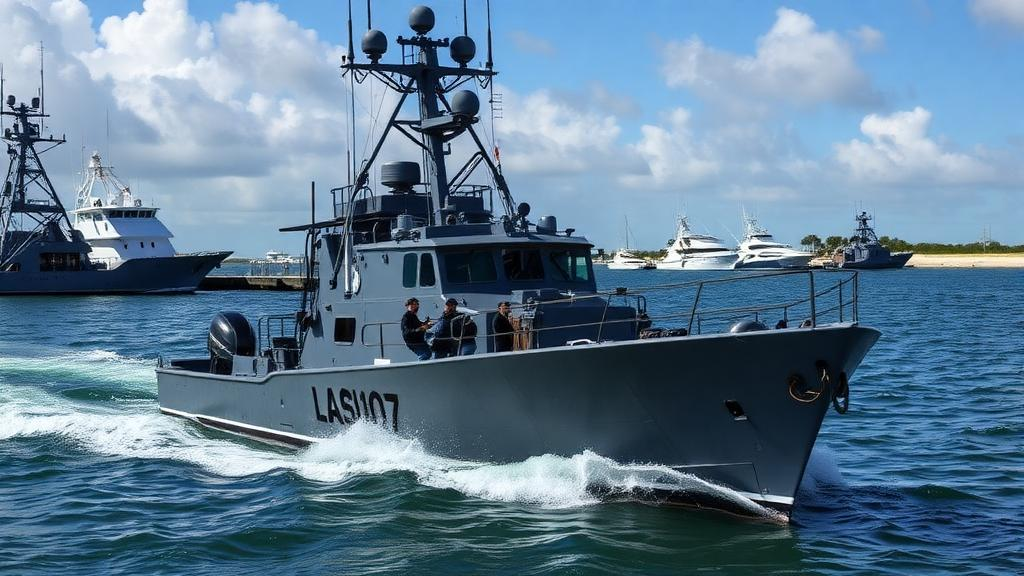
Florida Atlantic University has entered into a strategic partnership with Blue Ops, the maritime division of defense technology company Red Cat Holdings, Inc., that will bring the company’s uncrewed maritime systems operations to FAU’s Harbor Branch Oceanographic Institute in Fort Pierce, Florida. The collaboration establishes a hub for research, development, testing, training and collaboration spanning ocean technology, autonomous systems and national defense, and it positions one of the country’s most established oceanographic research campuses at the center of a rapidly growing sector in which uncrewed vessels are becoming central to how navies and security agencies operate at sea.
The pairing of the two organizations is built on complementary strengths. FAU Harbor Branch occupies a secure, 144-acre campus with a deep-water port, offering direct access to the ocean, waterfront infrastructure, marine scientists and engineers, specialized equipment and decades of accumulated experience in developing technologies for demanding ocean environments. Blue Ops, for its part, brings expertise in uncrewed surface vessels, maritime autonomy, mission systems and open architectures, along with strong connections throughout the defense industry. Together, the partners intend to move research out of the laboratory and into real-world maritime conditions, where emerging technologies must ultimately prove themselves.
FAU President Adam Hasner described the agreement as precisely the kind of strategic partnership that can amplify the strengths of both organizations. Florida Atlantic contributes the world-class oceanographic resources of Harbor Branch, expertise in autonomous systems and national defense, and a pipeline of talented students and researchers, while Blue Ops contributes advanced maritime technologies and defense industry connections. According to Hasner, the collaboration is expected to move research from the lab to real-world applications, provide students with meaningful opportunities and extend the impact of innovation developed at the university, creating benefits for the region, the state and the nation.
For Blue Ops, the attraction of Harbor Branch lies in the ability to test and refine hardware in the same conditions it is designed to face. Barry Hinckley, president of Blue Ops, said the partnership gives the company an opportunity to advance its uncrewed surface vessels, develop and test new maritime technologies, and help build the skilled workforce needed as autonomous systems become more central to maritime operations. He noted that Harbor Branch brings together engineers, scientists, students and industry in an environment where technologies can be evaluated in the real-world maritime conditions for which they are designed, and that by working alongside FAU researchers and supporting the university’s educational mission, the company can help prepare both the talent and the technologies needed to strengthen America’s maritime capabilities.
The technical scope of the work planned at Fort Pierce is broad. The location will support Blue Ops’ research and development in ocean technology, autonomous systems and national defense, including engineering, testing and evaluation; land- and water-based demonstrations; personnel training; and equipment maintenance and support. Uncrewed surface vessels, the core platform class involved, are robotic boats that operate on the water’s surface without crews aboard, relying on onboard computers, sensors and communications links for navigation and mission execution. Developing such systems requires iterative testing in variable sea states, validation of autonomy software against unpredictable conditions, and integration of payloads ranging from sensors to communications equipment, all of which benefit from immediate access to open water and expert marine support.
The partnership also creates a structured pathway for people as well as technology. It opens opportunities for joint research, graduate scholarships, paid internships, outreach activities and shared use of specialized scientific equipment and support services. For students in engineering, oceanography, computer science and related fields, the presence of an operating defense technology company on a university research campus offers direct exposure to the design, fabrication, deployment and evaluation cycles that define modern maritime robotics, experience that is difficult to replicate in classroom settings alone and that is increasingly sought by employers in both the defense and commercial ocean sectors.
The agreement aligns closely with FAU’s institutional research priorities. National defense and autonomous systems constitute one of four Areas of Research Emphasis in the university’s 2026-31 strategic plan. Through its Autonomous Systems Initiative, FAU brings together faculty across multiple colleges and institutes to advance research, education and workforce development across air, ground, underground, surface and underwater environments. The university has built decades of expertise in autonomous systems, artificial intelligence, robotics, cybersecurity, sensing and marine technologies, and that expertise has increasingly been directed toward supporting national defense and security missions.
Harbor Branch’s own research record underpins the collaboration. At the Fort Pierce campus, Michael Twardowski, the Edwin A. Link Ocean Technology and Defense Endowed Professor and director of the Center for Marine Applied Technology and Engineering, has spent more than 30 years advancing optical sensing, underwater imaging and autonomous marine systems, including extensive research conducted with the U.S. Office of Naval Research. Jason Hallstrom, interim executive director of FAU Harbor Branch, called the partnership a natural extension of what Harbor Branch has done for decades, bringing scientists, engineers and technology developers together to solve complex ocean challenges. Having Blue Ops on site, he said, connects industry with the institute’s researchers, facilities and students, accelerating innovation while providing valuable real-world experience and workforce development opportunities for the next generation of engineers and scientists.
The deal also carries a regional economic dimension. The Business Development Board of Palm Beach County, the county’s economic development organization focused on attracting and retaining businesses, played an important role in bringing Blue Ops to the area. Kelly Smallridge, the board’s president and CEO, said Palm Beach County is at the forefront of technology and that partnerships like this show how the region’s assets can come together to create new opportunities. She pointed to Florida Atlantic’s research expertise, talent pipeline and focus on national defense and autonomous systems as making the university a strong partner for technology companies, and she argued that bringing Blue Ops to Harbor Branch further connects research, industry and workforce development while strengthening the Palm Beaches as a hub for advanced technology.
As Blue Ops establishes its presence at Harbor Branch, the partners plan to pursue joint research, engineering and testing, workforce development, internships, graduate opportunities and technology demonstrations focused on maritime autonomy, ocean technology and national defense. The collaboration reflects a broader trend in which universities with coastal research infrastructure are becoming landing points for defense technology firms seeking access to seawater testing environments, academic expertise and engineering talent. If the partnership delivers on its stated goals, Fort Pierce could emerge as a notable node in the growing ecosystem of American maritime autonomy, where academic oceanography and defense innovation share the same dock.
Subject of Research: A university-industry partnership establishing uncrewed maritime systems operations and autonomous ocean technology research at FAU Harbor Branch Oceanographic Institute.
Article Title: Blue Ops to bring maritime defense operations to FAU Harbor branch
Article References: Blue Ops to bring maritime defense operations to FAU Harbor branch. (n.d.). Original publication
Image Credits: AI Generated
DOI: Not provided
Keywords: uncrewed surface vessels, maritime autonomy, FAU Harbor Branch, ocean technology, national defense, autonomous systems, Florida Atlantic University, Red Cat Holdings, workforce development, marine engineering, Fort Pierce, research partnership
Cite Scienmag News
Denise Maddox. (October 4, 2026). Blue Ops Brings Uncrewed Maritime Defense Operations to FAU Harbor Branch. Scienmag. https://scienmag.com/blue-ops-brings-uncrewed-maritime-defense-operations-to-fau-harbor-branch/
Denise Maddox. "Blue Ops Brings Uncrewed Maritime Defense Operations to FAU Harbor Branch." Scienmag, 4 October 2026, https://scienmag.com/blue-ops-brings-uncrewed-maritime-defense-operations-to-fau-harbor-branch/. Accessed 4 October 2026.
Denise Maddox. "Blue Ops Brings Uncrewed Maritime Defense Operations to FAU Harbor Branch." Scienmag. October 4, 2026. https://scienmag.com/blue-ops-brings-uncrewed-maritime-defense-operations-to-fau-harbor-branch/


