


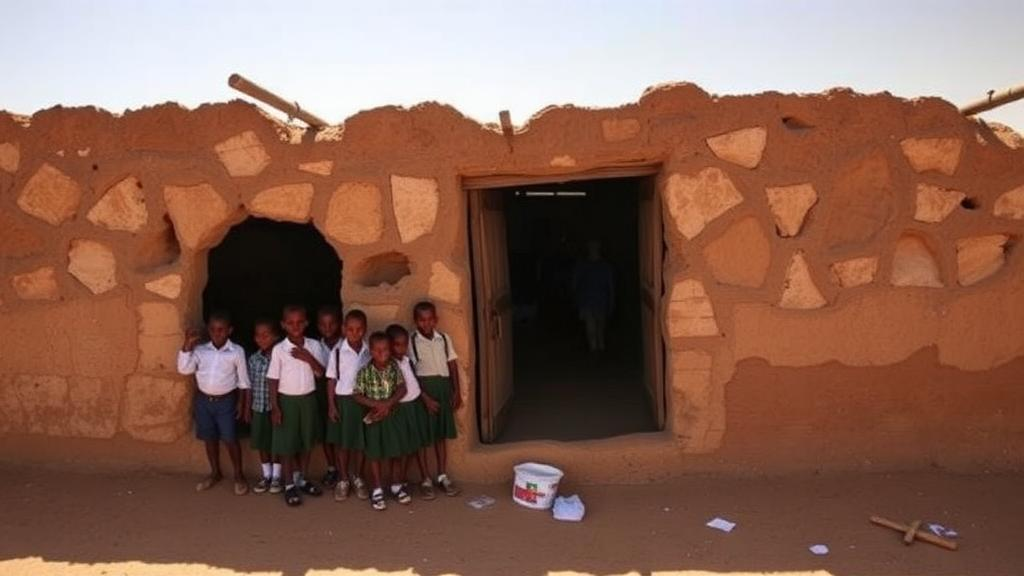
In a remote settlement in southern Ethiopia, a school exists. Classrooms were built, teachers were assigned, and children enroll. Yet according to a new study published in Discover Education, that school delivers what the researchers call a hollow promise: physical availability without the materials, language support, safety, or sustained funding that would make the right to education real. The research, led by Tolossa Bahiru Gari of Addis Ababa University with colleagues Ambissa Kenea Boru and Getahun Yacob Abraham, turns the standard logic of educational accountability on its head. Instead of asking whether governments and aid agencies have ticked the boxes of emergency schooling, it asks the children themselves whether their rights have been honored. Their answer, delivered in their own words, is a devastating indictment of a system that treats displaced children as temporary guests rather than permanent citizens.
The setting is Bishan Gurracha, a town in Ethiopia’s Oromia region roughly 264 kilometers from Addis Ababa along the highway to Hawassa. It hosts one of the largest settlements for people displaced from the Somali Region during the violence of 2018, accommodating around 2,000 households. A single school was established to serve the displaced community. The stakes of the question extend far beyond one settlement. Globally, the number of forcibly displaced people rose from 38.1 million in 2000 to 89.3 million by 2021, with internally displaced persons outnumbering refugees. Children make up roughly 42 percent of the internally displaced population, and Ethiopia hosts one of the largest IDP populations in the world, its displacement driven by armed conflict, inter-communal violence, and political instability.
Methodologically, the study is a qualitative narrative inquiry rooted in a social-constructivist paradigm, which holds that reality is best understood through the subjective experiences of the people living it. The researchers purposively sampled sixteen internally displaced children aged 13 to 18, nine of them female, conducting semi-structured interviews in Afaan Oromoo alongside structured field observations of classrooms, sanitation facilities, and administrative buildings. To reduce institutional bias, the team spent an initial week conducting independent classroom observations and site visits to build rapport, deliberately distancing themselves from school administrators during the assent process and assuring children that their participation would not affect grades, teacher relationships, or household aid. Ethical approval came from Addis Ababa University’s College of Education and Behavioral Studies, with parental consent and child assent secured, trauma-informed listening protocols in place, and all identifiers anonymized.
The analytical engine of the study is a fusion of two frameworks. The first is Katarina Tomasevski’s 4A’s scheme, the operational standard under international human rights law for evaluating the right to education: Availability, meaning functioning institutions with adequate resources; Accessibility, meaning education that is physically reachable and economically affordable without discrimination; Acceptability, meaning education that is safe, high-quality, and culturally appropriate; and Adaptability, meaning schooling that evolves to meet the needs of learners in changing circumstances. The second is the New Sociology of Childhood, which treats children not as passive recipients of aid but as active social agents capable of critiquing the systems designed for them. The 4A’s identify what is missing and who is accountable; the sociological lens explains how that absence damages children’s dignity and agency.
What emerged from the thematic analysis is a pattern the authors call hollow availability. The state and humanitarian organizations, including the NGO Jigdo, provided buildings and initial supplies, but the support was transient. One child recalled the arc plainly: on arrival, the community and government offered a warm welcome and even their own clothes, but after two or three years the support stopped completely and the government forgot about them. Another described receiving food rations, school uniforms, and educational materials at the beginning, only to see them cease after a few years. Under Tomasevski’s framework, availability is a permanent, non-negotiable state obligation, not a one-time act of charity. The withdrawal of school feeding programs and material aid therefore represents not a funding gap but a structural withdrawal of children’s rights, shifting the burden of persistence onto the children themselves.
The deficits compound at every level. Classrooms lack reference books, sports fields, and sufficient space; children report being asked to contribute their own money to buy textbooks despite their families’ poverty. Teachers are stretched across subjects outside their specialization, particularly in ICT and Amharic, diluting instructional quality. Sanitation is a gendered crisis: toilets lack water and privacy, and female students report having no menstrual hygiene products, forcing absences that turn biology into a barrier to education. Teachers reportedly deliver lessons from personal mobile phones because the school lacks books. The physical environment itself violates acceptability standards: apart from two blocks built by Jigdo, classrooms are uninsulated tin structures where, after nine in the morning, intense heat makes teaching and learning extremely difficult. Kitchen smoke drifts into classrooms, and the principal’s office had its roof blown off by wind months before the researchers arrived, still unrepaired for lack of funding.
Perhaps the most consequential finding concerns language. The displaced children arrived educated in Af-Somali, but the host region’s medium of instruction is Afaan Oromoo. With no bridging programs or language support, many children were pushed back into lower grades because they could not read or write in the new medium. The authors term this linguistic dispossession: the system treats a child’s existing knowledge as a deficit rather than an asset, demanding that the child adapt to the school rather than the school adapt to the child. Combined with reading materials that do not match learners’ interests and a curriculum designed without consulting them, the result is functional exclusion from an education that exists on paper. Children reported never having participated in decision-making about the interventions meant for them, a top-down approach the study links to what it provocatively names a Sociology of Neglect, in which authorities exploit the unstable legal status of displaced populations to treat education as temporary charity rather than a basic right.
Beneath all of this runs the study’s most haunting concept: burdened agency. When state support evaporated, families were forced into a survival-education trade-off. One child explained that families prioritized food and shelter over educational costs, limiting school attendance. Another described working as a daily laborer after school to sustain himself and his parents. The trade-offs extend beyond schooling: because the settlement’s health center is so poorly equipped, families sell limited aid rations to buy medications from private pharmacies, sacrificing the right to learn for the right to survive. A teacher recounted a parent asking for his child’s clearance to leave after just nine months, saying he could not stay even one night because it seemed something was going to eat his children. These are not choices made freely; they are high-stakes decisions forced on children by systemic failure, and they contradict the Guiding Principles on Internal Displacement, which guarantee displaced persons an adequate standard of living including health and education services.
The study’s conclusions are a call to reframe accountability itself. Current emergency-education metrics, enrollment figures and completed infrastructure, measure compliance, not rights. The authors argue that physical availability is a hollow victory if not matched by accessibility, acceptability, and adaptability, and they propose a Rights-Restoration Model that centers children’s voices as the primary measure of whether education is real. Their recommendations are concrete: regional education bureaus should move the Bishan Gurracha school out of temporary humanitarian aid and into the permanent town education budget, end the practice of requiring poor children to fund their own textbooks, provide essential learning materials, and open a fully stocked free medical clinic inside the settlement so that health and education no longer compete for the same scarce resources. The researchers also acknowledge limits: sixteen participants in one settlement cannot be generalized, and future work should triangulate perspectives from NGOs, officials, and educators, ideally through longitudinal designs tracking how withdrawal of state support shapes children’s life trajectories.
What makes this research resonate far beyond a single Ethiopian settlement is its methodological inversion. By shifting the evaluative lens from duty bearers to rights holders, it demonstrates that children as young as thirteen can serve as precise witnesses to institutional failure, naming the exact moment welcome turned to neglect. The study repositions the 4A’s framework from a passive government checklist into an active rights contract, and it redirects the research agenda from a question of how displaced children survive to a far more uncomfortable one: how systems fail them. For the millions of internally displaced children worldwide, the message is stark. A school building is not a right. A right is a school with books, water, teachers who know their subjects, a language the child understands, and a state that does not forget.
Subject of Research: Educational accountability and the right to education for internally displaced children in Ethiopia
Article Title: Rights holders analysis of educational accountability for displaced children in Bishan Gurracha Ethiopia
Article References: Gari, T. B., Boru, A. K., & Abraham, G. Y. (2026). Rights holders analysis of educational accountability for displaced children in Bishan Gurracha Ethiopia. Discover Education, 5(1), Article 1042. https://doi.org/10.1007/s44217-026-02203-4
Image Credits: AI Generated
DOI: 10.1007/s44217-026-02203-4
Keywords: internally displaced children, right to education, Ethiopia, educational accountability, 4A's framework, New Sociology of Childhood, humanitarian education, linguistic dispossession, burdened agency, Bishan Gurracha, child rights, qualitative research
Cite Scienmag News
Courtney Benton. (October 4, 2026). When Schools Are Shells: Displaced Children in Ethiopia Expose a Hollow Right to Education. Scienmag. https://scienmag.com/when-schools-are-shells-displaced-children-in-ethiopia-expose-a-hollow-right-to-education/
Courtney Benton. "When Schools Are Shells: Displaced Children in Ethiopia Expose a Hollow Right to Education." Scienmag, 4 October 2026, https://scienmag.com/when-schools-are-shells-displaced-children-in-ethiopia-expose-a-hollow-right-to-education/. Accessed 4 October 2026.
Courtney Benton. "When Schools Are Shells: Displaced Children in Ethiopia Expose a Hollow Right to Education." Scienmag. October 4, 2026. https://scienmag.com/when-schools-are-shells-displaced-children-in-ethiopia-expose-a-hollow-right-to-education/


