


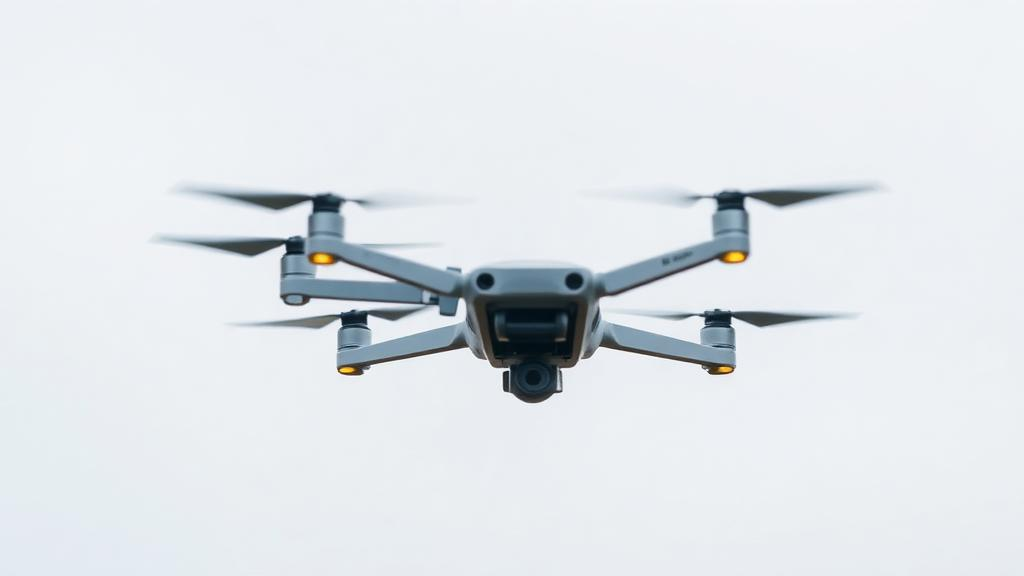
A coaxial-rotor aircraft, or CRA, is a deceptively simple machine: two rotors spinning in opposite directions on a single mast, no tail rotor, no tilting mechanisms, just counter-rotating blades that cancel each other’s torque while generating lift. That compact geometry gives coaxial drones a small footprint, strong payload capacity, and impressive agility, which is exactly why they are attractive candidates for swarm operations. But flying dozens of them in tight formation is a formidable control problem, and a new study in the International Journal of Machine Learning and Cybernetics proposes a way to solve it by combining a classical nonlinear control technique with an adaptive neural network.
The research, led by Yiran Wei and Ming He of the Army Engineering University of the PLA in Nanjing, together with colleagues at the Beijing Institute of Technology and the National Key Laboratory on Near-Surface Detection, tackles two goals that usually pull against each other: rapid response and stability maintenance. A formation that reacts quickly to command changes tends to oscillate, while a formation tuned for smoothness tends to lag. The team’s answer is a decentralized adaptive tracking control method built on a leader-follower coordination strategy, in which each aircraft in the cluster is responsible for its own tracking behavior while the group as a whole follows a virtual leader.
The virtual leader idea is central to how the scheme scales. Rather than designating one physical drone as the boss whose failure would doom the mission, the researchers define a mathematical reference trajectory that every aircraft in the cluster tries to track, offset by its assigned position in the formation. Each CRA then adjusts its relative position to its neighbors to hold the overall shape. Because the coordination is decentralized, no single aircraft has to broadcast commands to the whole swarm, and the control burden does not grow explosively as the cluster expands. This design philosophy echoes a broad body of work on multi-agent formation control, from graph-based model predictive approaches to flocking-inspired swarm navigation, but the new study adapts it specifically to the dynamics of coaxial rotors.
To get there, the authors first built a mathematical model of a single CRA and then extended it to the cluster system. The model separates the aircraft’s motion into two subsystems with distinct jobs. The position subsystem maintains the formation by adjusting where each aircraft sits relative to the others, while the attitude subsystem is responsible for driving each aircraft’s orientation to a desired stable state. This split matters because coaxial aircraft are underactuated: they have fewer independent control inputs than degrees of freedom, so position is controlled indirectly through attitude. Getting the attitude loop right is therefore a precondition for getting the position loop right.
For the position subsystem, the team turned to back-stepping control, a well-established nonlinear design method that works backward through the layers of a system’s dynamics. In a back-stepping design, the controller treats some of the internal states of the aircraft, such as velocity components, as virtual controls for the outer states, such as position. It designs a stabilizing law for the outer loop, computes what the virtual controls would need to be to achieve it, and then steps inward, designing control laws for each successive layer until it reaches the true physical inputs. The result is a controller that respects the nonlinear coupling in the aircraft’s equations of motion rather than approximating them with a linearized model, which is why back-stepping has become a favorite tool for quadrotors and, increasingly, for coaxial platforms.
The attitude tracking controller is where the machine learning enters. Coaxial rotors generate complicated aerodynamic interactions, including blade-vortex interactions between the upper and lower rotors, that are difficult to model precisely. Rather than trying to capture every disturbance term analytically, the researchers designed an adaptive radial basis function neural network, or RBFNN, that learns the unknown nonlinearities online. An RBFNN is a particular class of neural network in which each neuron responds to inputs within a localized region of the input space, using a radial basis function such as a Gaussian centered at a particular point. This locality gives RBFNNs a powerful theoretical property: under mild assumptions, they can approximate any continuous nonlinear function over a compact domain. In the control context, that means the network can represent the lumped uncertainty in the attitude dynamics, whatever its exact form, and the adaptive tuning laws adjust the network weights in real time as the aircraft flies.
Critically, the team did not simply trust the neural network to behave. The stability of both the position and attitude controllers is mathematically proven using Lyapunov theory, the standard framework for demonstrating that a controlled system’s energy-like function decreases over time, driving the tracking errors to zero or to a bounded neighborhood of zero. The Lyapunov analysis ties the neural network’s weight adaptation to the error dynamics, ensuring that the learning process itself cannot destabilize the aircraft. This combination of learning-based approximation with rigorous stability proof is what distinguishes the approach from purely empirical machine learning controllers, and it addresses one of the biggest obstacles to deploying neural networks on real flight hardware.
Verification proceeded in two stages. First, the team ran numerical simulations of intelligent tracking scenarios, and then they moved to software-in-the-loop, or SITL, simulations, in which the flight control code runs on a simulated autopilot environment closer to real deployment conditions. SITL testing is a standard bridge between pure simulation and flight tests because it exposes the controller to computational delays, discretization effects, and software architecture issues that idealized numerical models ignore. Across both verification stages, the reported trajectories of the CRAs were smooth and continuous, with excellent position response and minimal amplitude vibration, the two qualities the study set out to reconcile.
The choice of coaxial platforms for cluster flight is not arbitrary. Compared with conventional multirotors, coaxial aircraft offer higher thrust-to-footprint ratios and better tolerance to rotor damage, and recent work has explored their use in everything from micro-scale twin-rotor systems with internet-of-things control to coaxial tilt-rotor designs with finite-time and adaptive attitude controllers. Earlier studies have applied back-stepping sliding mode control to coaxial trajectory tracking, fuzzy logic methods with time-delay estimation, dynamic inversion for compound coaxial helicopters, and adaptive neural network approaches for coaxial micro aerial vehicles. The new study’s contribution is to bring these threads together at the cluster level, pairing the back-stepping structure that has proven effective for single-aircraft tracking with neural network adaptation and a decentralized formation architecture.
The implications reach beyond any single aircraft type. Formation tracking of aerial swarms underpins applications ranging from perimeter surveillance and cooperative sensing to search-and-rescue and coordinated defense missions, and the field has been moving steadily toward controllers that can handle unmodeled dynamics, switching communication topologies, and uncertain environments. By demonstrating that an RBFNN-augmented back-stepping controller can deliver both fast formation response and stable flight for a coaxial cluster, validated through Lyapunov-guaranteed stability analysis and software-in-the-loop testing, the researchers offer a template that other swarm platforms could adapt. The work was supported in part by the National Natural Science Foundation of China, the National Key Research and Development Program of China, and the National Key Laboratory on Near-Surface Detection, and the authors report no conflicts of interest. The next step for this line of research, as with all simulation-validated control schemes, will be demonstrating the same smooth, vibration-free tracking on physical aircraft flying in the open air.
Subject of Research: Decentralized adaptive formation tracking control of coaxial-rotor aircraft clusters using back-stepping and RBF neural networks
Article Title: Intelligent tracking control of CRA cluster via back-stepping and RBFNN strategy
Article References: Wei, Y., He, M., Pan, Z., Wu, H., Liu, C., & Jing, P. (2026). Intelligent tracking control of CRA cluster via back-stepping and RBFNN strategy. International Journal of Machine Learning and Cybernetics, 17(9), Article 445. https://doi.org/10.1007/s13042-026-03215-0
Image Credits: AI Generated
DOI: 10.1007/s13042-026-03215-0
Keywords: coaxial rotor aircraft, formation control, back-stepping control, RBF neural network, adaptive control, leader-follower strategy, Lyapunov stability, UAV swarm, software-in-the-loop simulation, flight control, intelligent tracking, multi-agent systems
Cite Scienmag News
Blake Davidson. (October 4, 2026). Neural Network Meets Back-Stepping: Smarter Flight Control for Coaxial Drone Swarms. Scienmag. https://scienmag.com/neural-network-meets-back-stepping-smarter-flight-control-for-coaxial-drone-swarms/
Blake Davidson. "Neural Network Meets Back-Stepping: Smarter Flight Control for Coaxial Drone Swarms." Scienmag, 4 October 2026, https://scienmag.com/neural-network-meets-back-stepping-smarter-flight-control-for-coaxial-drone-swarms/. Accessed 4 October 2026.
Blake Davidson. "Neural Network Meets Back-Stepping: Smarter Flight Control for Coaxial Drone Swarms." Scienmag. October 4, 2026. https://scienmag.com/neural-network-meets-back-stepping-smarter-flight-control-for-coaxial-drone-swarms/


