


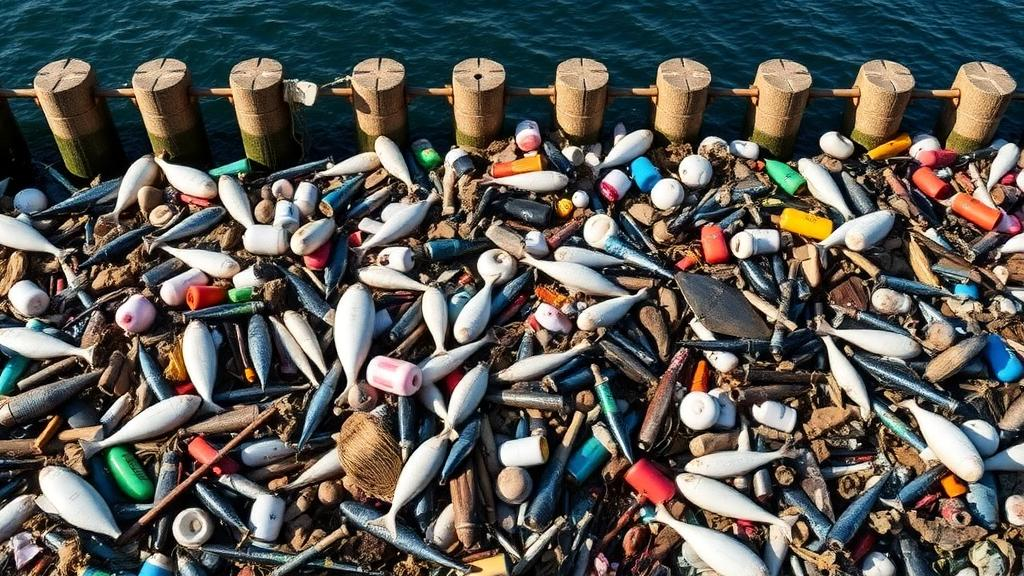
Along the windswept coast of Mar del Plata, Argentina’s largest coastal city and home to the country’s most important commercial harbour, the rocky arms known as groynes that jut into the South Atlantic have long been magnets for anglers. A new study now reveals that these popular fishing platforms are also accumulating a startling quantity of discarded fishing gear. Researchers surveyed 45 artificial groynes across the city and recorded a total of 2,146 fishing-related debris items, painting the most detailed picture yet of how recreational fishing leaves its mark on urban shorelines in Argentina. The work, published in Environmental Science and Pollution Research, is the first study in the country to both quantify fishing debris on groynes and chemically identify the plastics involved.
The research was carried out by Maximiliano Manuel Hernandez and Juan Pablo Seco Pon of the Grupo Ecología y Conservación de Aves Marinas y Costeras at the Instituto de Investigaciones Marinas y Costeras, part of the National University of Mar del Plata and CONICET. Their approach was systematic: every groyne was inspected and each item of fishing debris was classified by origin as either recreational or non-recreational. The team then tested whether debris abundance varied according to three characteristics of the structures themselves, namely the construction material of the groyne, its orientation relative to prevailing winds and waves, and its location along the urban coastline. This design allowed them to separate the influence of physical structure from the influence of human fishing pressure.
The results pointed clearly to recreational anglers as the dominant source of the litter. Recreational debris was more abundant than non-recreational material across the surveyed groynes, and accumulation was greatest on groynes built with orthoquartzite rocks. That geological detail matters more than it might first appear. Orthoquartzite blocks create a rough, crevice-rich surface that snags line, netting and packaging far more effectively than smoother concrete or other materials. Previous work on artificial breakwaters in Chile and elsewhere has shown that structural complexity enhances the trapping of anthropogenic litter, and the Mar del Plata findings extend that pattern to fishing-specific debris on the south-western Atlantic coast.
Among the thousands of items recorded, three categories dominated both in abundance and in how frequently they appeared across sites: monofilament fishing line, bait bags, and ropes. Monofilament nylon is a particularly insidious form of litter because it is nearly invisible underwater, yet it persists for years and poses severe entanglement risks. Studies from northern Patagonia have documented kelp gulls killed and injured by discarded monofilament lines at recreational fisheries, and global reviews identify entanglement and ingestion of fishing gear as major threats to seabirds, turtles and marine mammals. Bait bags and rope fragments, meanwhile, break down into smaller fragments that can enter the food web.
To understand what these plastics are actually made of, the researchers took the analysis a step further than most beach surveys. They used Fourier-transform infrared spectroscopy, or FTIR, to determine the chemical composition of 357 plastic fishing debris items. The technique works by shining infrared light through a sample and reading the characteristic absorption fingerprints of its polymer bonds, allowing precise identification of plastic types that look identical to the naked eye. The dominant polymers turned out to be polyamide, polyethylene and polystyrene, a trio that maps neatly onto fishing practice. Polyamide is the nylon used in monofilament lines and nets, polyethylene is common in bait packaging and bags, and polystyrene appears in floats and rigid gear components.
Identifying polymer types is not merely an academic exercise. Different polymers carry different hazard profiles, both in their inherent chemistry and in the additives they contain, such as plasticisers and flame retardants that can leach into seawater and be transferred to wildlife that ingests them. Polyamide line, for example, can shed microfibers as it weathers, and beached fishing gear has been shown to release microplastics over time. Because fishing debris is often trapped in intertidal zones where it is repeatedly wetted and dried, abraded by sand and exposed to intense ultraviolet radiation, these structures can act as slow-release sources of microplastics and associated chemicals directly into productive coastal waters.
The study’s most actionable finding concerns where the debris comes from. The trapped recreational debris primarily originates from fishers using the immediate or nearby groyne areas, rather than drifting in from distant waters or from the commercial fleet. That local provenance is, paradoxically, good news for managers. If most of the litter is dropped by the people standing on the groynes themselves, then identifying preferential fishing sectors would allow waste management efforts to be concentrated where they will do the most good. Targeted bins, signage, line-recycling stations and periodic clean-ups at the most heavily used groynes could intercept a large fraction of the debris before it reaches the water.
Mar del Plata offers an ideal setting for this kind of assessment. The city hosts Argentina’s most significant commercial harbour and serves as a key destination for recreational fishing, drawing large numbers of anglers to its coastal defences. It is also a major tourist destination, and the combination of dense human use and engineered shoreline makes its groynes both fishing platforms and potential debris traps. Earlier Argentine studies have documented marine debris on the region’s sandy beaches and in the Mar Chiquita coastal lagoon, and previous work by some of the same researchers has examined anglers’ perceptions and attitudes towards fishing litter, including a conservation programme designed to promote responsible disposal in a coastal reserve. The new groyne survey complements that social science by providing hard numbers on what actually ends up in the environment.
The broader context is sobering. Global estimates suggest that a substantial share of fishing gear enters the ocean each year, and marine debris is now recognised as one of the most pervasive pollution problems facing coastal ecosystems, with documented impacts ranging from ingestion by megafauna to the transfer of hazardous chemicals into food webs and, potentially, human consumers through seafood. Coastal defence structures have emerged in recent years as underappreciated accumulation hotspots, with studies describing artificial breakwaters as functioning like garbage bins for intertidal habitats. What happens on a groyne does not stay on a groyne: storms, tides and wave action eventually liberate trapped items, making these structures reservoirs of pollution that leak into the marine environment over time.
For Argentina, the study establishes a baseline that did not previously exist. No earlier research in the country had combined a city-wide census of fishing debris on groynes with polymer-level chemical identification, and the authors argue that their findings provide a foundation for concentrated, spatially targeted waste management policies. The logic is straightforward: because the debris is overwhelmingly local in origin, the solution is local too. By mapping where recreational fishers cluster and directing infrastructure and outreach to those hotspots, Mar del Plata could reduce the flow of monofilament, bait bags and rope into the South Atlantic. As coastal cities worldwide grapple with the legacy of decades of plastic use, this study shows that sometimes the most effective interventions are also the simplest, aimed squarely at the people and places where the pollution begins.
Subject of Research: Fishing-related debris accumulation and polymer composition on artificial groynes in Mar del Plata, Argentina
Article Title: Assessment of fishing-related debris in artificial groynes along the largest coastal city in Argentina
Article References: Hernandez, M. M., & Seco Pon, J. P. (2026). Assessment of fishing-related debris in artificial groynes along the largest coastal city in Argentina. Environmental Science and Pollution Research. https://doi.org/10.1007/s11356-026-38255-0
Image Credits: AI Generated
DOI: 10.1007/s11356-026-38255-0
Keywords: marine debris, fishing gear, artificial groynes, Mar del Plata, recreational fishing, microplastics, FTIR spectroscopy, polyamide, polyethylene, polystyrene, coastal pollution, Argentina
Cite Scienmag News
Reese Ellison. (October 4, 2026). Thousands of Fishing Debris Items Pile Up on Argentina’s Most Famous Fishing Groynes. Scienmag. https://scienmag.com/thousands-of-fishing-debris-items-pile-up-on-argentinas-most-famous-fishing-groynes/
Reese Ellison. "Thousands of Fishing Debris Items Pile Up on Argentina’s Most Famous Fishing Groynes." Scienmag, 4 October 2026, https://scienmag.com/thousands-of-fishing-debris-items-pile-up-on-argentinas-most-famous-fishing-groynes/. Accessed 4 October 2026.
Reese Ellison. "Thousands of Fishing Debris Items Pile Up on Argentina’s Most Famous Fishing Groynes." Scienmag. October 4, 2026. https://scienmag.com/thousands-of-fishing-debris-items-pile-up-on-argentinas-most-famous-fishing-groynes/


