


When Russian forces attacked Ukraine on multiple fronts in February 2022, the international research community responded with remarkable speed. Within forty-eight hours, the hashtag #ScienceForUkraine was mobilizing support for scholars whose laboratories, universities, and careers had been thrown into chaos. The episode reinforced a widespread assumption about academics in wartime: because their qualifications are internationally sought after, researchers are often imagined as privileged migrants, people with the resources and connections to decide for themselves whether to stay or go, and where to relocate if they leave. A new study suggests that this picture is, at best, incomplete — and that the forces reshaping Ukraine’s scholarly geography had been at work for years before the full-scale invasion began.
In an article published in Population and Development Review, Michael Zaslavsky of the University of Wisconsin-Madison and Aliakbar Akbaritabar of the Max Planck Institute for Demographic Research and the University of Rostock set out to test the assumption of free scholarly mobility under conditions of armed conflict. Their conclusion is pointed. The full-scale invasion certainly made the displacement of Ukrainian researchers visible to the world, but the data show that researchers were already leaving conflict-affected regions for other parts of Ukraine and for destinations abroad after Russia illegally annexed Crimea and fighting erupted in the Donbas in 2014. Scholarly mobility during war, the authors argue, cannot simply be understood as a matter of individual choice.
The methodological core of the study is as elegant as it is ambitious. Rather than relying on surveys or administrative records, which are difficult to collect in wartime and often unavailable at fine geographic resolution, the researchers turned to one of the richest digital trails that scholars leave behind: their scientific publications. Every paper records the institutional affiliations of its authors — the universities, research institutes, and other organizations to which they are professionally connected. By examining affiliation data for tens of thousands of researchers, region by region, and tracking how those affiliations changed between 2009 and 2022, the authors were able to estimate scholarly mobility across more than a decade at an unusually fine geographical level.
This bibliometric approach has real technical advantages. Publication records are continuously produced, publicly available, and timestamped, which means they capture movements as they happen rather than retrospectively. They also cover researchers who might never appear in migration statistics, including those who move between institutions within a country without ever crossing a border. The trade-off, which the authors acknowledge, is that publication histories reveal when and where a scholar’s institutional base changed, but not why any individual moved. Still, aggregated across tens of thousands of careers, the affiliation trail offers a powerful lens on how a national research system reorganizes itself under the pressure of war.
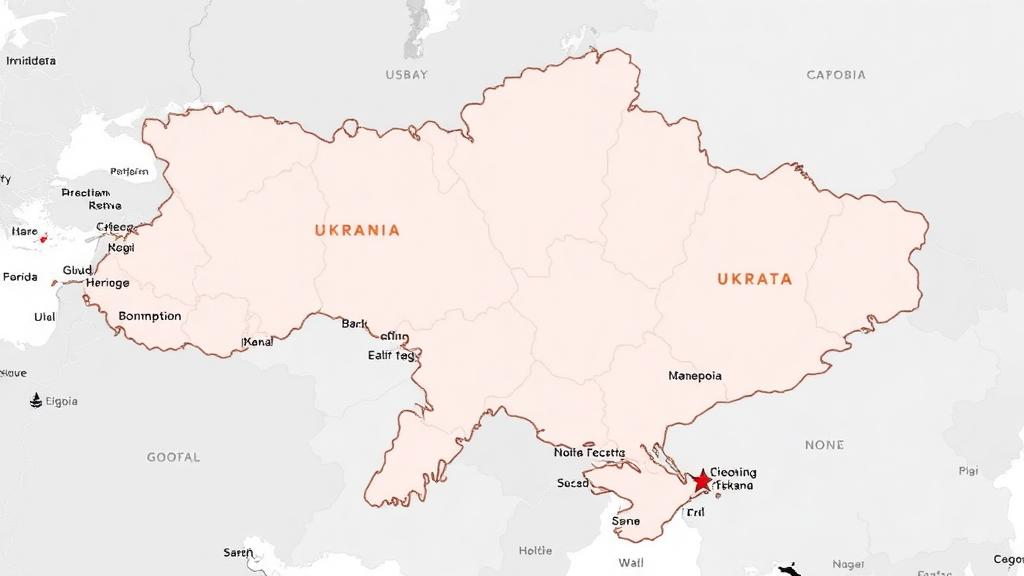
The results reveal a redrawing of Ukraine’s scholarly map after 2014 — but not a single uniform pattern. Between 2015 and 2017, Donetsk and Luhansk, the two main regions of the Donbas, were losing researchers on balance to other parts of Ukraine. For every 1,000 actively publishing scholars, roughly 54 more researchers were leaving than arriving in Donetsk, and about 46 more in Luhansk. These are substantial net losses for regions that historically anchored significant parts of the country’s research capacity, and they occurred while armed conflict was actively disrupting the institutions those researchers depended on.
When the authors examined mobility across national borders, Crimea stood out most sharply. International migration there produced a net loss of approximately 117 researchers per 1,000 actively publishing scholars. Donetsk also recorded a substantial international loss, at about 66 per 1,000. Behind these headline figures, however, different dynamics were at work. In some regions, the imbalance arose because more researchers left for institutions abroad; in others, it reflected fewer arrivals from other countries. Even so, the overall direction was consistent: more scholars left than arrived in the east of the country, and the changes were not confined to the territories directly touched by fighting.
That last finding may be the study’s most consequential. War, the data suggest, was associated not only with researchers leaving Ukraine but also with changes in how those who remained were distributed within the country. Internal relocation — from contested or destabilized regions toward other Ukrainian regions — operated alongside international emigration, meaning that the geography of Ukrainian science was being reorganized from within even as the country lost researchers abroad. Any account that reduces the phenomenon to brain drain, the authors argue, misses this internal dimension entirely. Scholars did not simply exit; they moved between regions, and those movements redistributed expertise in ways that will shape regional research capacity for years to come.
One result genuinely surprised the research team. The expectation going in was that more developed regions would retain their own researchers and attract new ones, functioning as safe havens of academic activity. Instead, the authors found that these regions could also be places from which scholars were better able to relocate. Zaslavsky offers a possible explanation: researchers based in better-connected, more developed regions tend to have stronger links to other research institutions, and therefore more opportunities to move when crisis hits. In other words, the very resources that make a region academically strong may also make its scholars more mobile — a finding that complicates any simple mapping of conflict impact onto regional disadvantage.
The study’s implications extend well beyond Ukraine. Because researchers carry knowledge, professional networks, and opportunities for collaboration with them, where they move matters for both the places they leave and the places that receive them. Qualifications and international connections, the authors emphasize, do not necessarily protect researchers from forced displacement — nor do they guarantee that those who want to leave can actually do so. Wartime scholarly migration, on this evidence, is shaped by constraint as much as by opportunity, and treating it as a free market of talent misrepresents the reality on the ground.
There is also a practical lesson for how the research community monitors and responds to crises. Publicly available bibliometric data, the authors argue, can complement surveys, administrative records, and qualitative research, helping to track where research systems are losing scholars and where those researchers are relocating while a crisis is still unfolding. Such knowledge is not merely descriptive. When countries eventually face the task of rebuilding research communities and institutions after conflict, knowing which regions lost scholars, which absorbed them, and which lost them across borders becomes essential groundwork for reconstruction. For Ukraine, a country whose scholarly map has now been redrawn twice — after 2014 and again after 2022 — that groundwork has already begun.
Subject of Research: Internal and international migration of researchers in Ukraine during armed conflict, 2009 to 2022
Article Title: Tracking researchers in Ukraine through war and armed conflict:
Article References: Tracking researchers in Ukraine through war and armed conflict:. (n.d.). Original publication
Image Credits: AI Generated
DOI: Not provided
Keywords: Ukraine, scholarly mobility, armed conflict, bibliometrics, brain drain, Donbas, Crimea, research migration, demography, Population and Development Review, displacement, research systems
Cite Scienmag News
Courtney Benton. (October 4, 2026). War redrew Ukraine’s scholarly map long before the 2022 invasion, study finds. Scienmag. https://scienmag.com/war-redrew-ukraines-scholarly-map-long-before-the-2022-invasion-study-finds/
Courtney Benton. "War redrew Ukraine’s scholarly map long before the 2022 invasion, study finds." Scienmag, 4 October 2026, https://scienmag.com/war-redrew-ukraines-scholarly-map-long-before-the-2022-invasion-study-finds/. Accessed 4 October 2026.
Courtney Benton. "War redrew Ukraine’s scholarly map long before the 2022 invasion, study finds." Scienmag. October 4, 2026. https://scienmag.com/war-redrew-ukraines-scholarly-map-long-before-the-2022-invasion-study-finds/


