


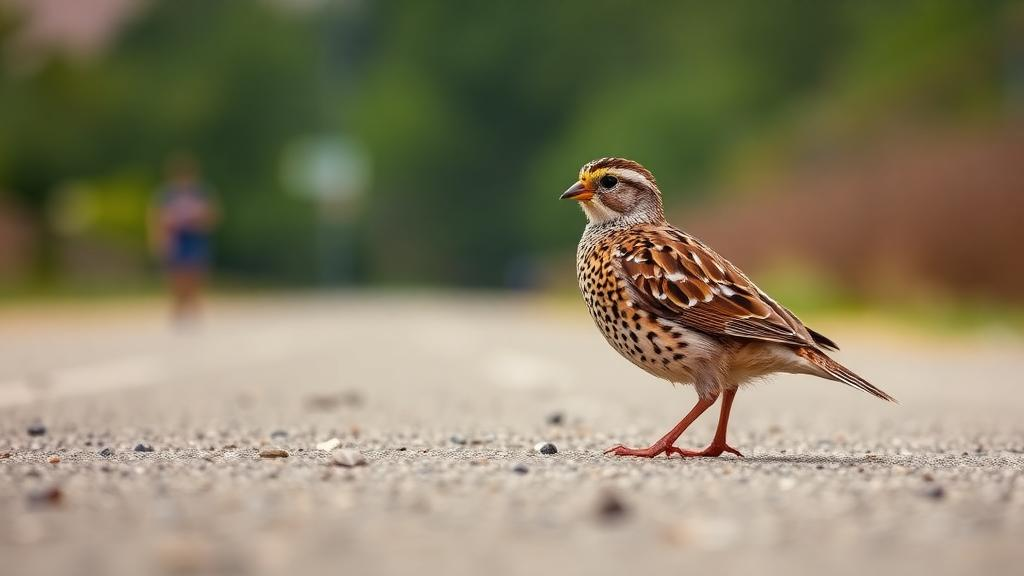
The northern bobwhite, the iconic whistling quail of the American South, has been disappearing for decades, and a new study suggests the concrete is closing in faster than many conservationists feared. Researchers led by Katherine S. Miller of the Caesar Kleberg Wildlife Research Institute at Texas A&M University-Kingsville combined four decades of citizen-science bird counts with federal projections of human population growth to forecast the species’ fate across Texas, Oklahoma, and Louisiana through 2050. Their conclusion is stark: as cities such as Houston, Dallas-Fort Worth, and Oklahoma City continue to sprawl, bobwhite abundance is projected to keep falling, with some metropolitan areas expected to reach effectively zero birds on survey routes. The findings, published in the open-access journal Discover Conservation, are among the first to build a spatially explicit, quantitative bridge between urban expansion and the decline of a single grassland-shrubland bird across an entire multi-state region.
The scale of the historical decline is sobering. Drawing on the North American Breeding Bird Survey, a long-running citizen science program in which volunteers count birds along 40-kilometer roadside routes, the team found that average bobwhite abundance across the study area collapsed from 45.73 birds per route in 1972 to 11.55 birds per route in 2012. That represents a 76.8 percent loss over just 42 years, and it mirrors broader national trends: Breeding Bird Survey estimates indicate bobwhites across the United States have been declining at roughly 3 percent per year since 1966, with some parts of the range losing more than 90 percent of their birds. Because bobwhites are both a beloved game bird and an umbrella species, meaning the habitat they require also sustains dozens of other grassland and shrubland birds, their disappearance signals trouble for entire ecosystems.
To capture the boom-and-bust variability that makes quail populations notoriously difficult to track, the researchers smoothed the annual counts using five-year rolling averages, then interpolated the route-level data into abundance maps with a resolution of four square kilometers using kriging and inverse distance weighting in a geographic information system. They sampled 1,000 random points across the three states, a number chosen carefully because larger samples triggered spatial autocorrelation detectable by Moran’s I statistics, and extracted abundance values at each point for every rolling-average year. The resulting time series revealed a distinctive geographic fingerprint of decline, sweeping from Laredo in South Texas northeastward to Tulsa in Oklahoma, with a smaller parallel pattern in central Louisiana running from Leesville and Alexandria toward Monroe.
The key innovation of the study lies in how it quantifies urbanization. Rather than relying on political boundaries or human census counts alone, the team used impervious surface, the rooftops, roads, and parking lots that seal the ground against water infiltration and nutrient cycling, as their metric of development. Impervious surface data come from the National Land Cover Database and, crucially, have been projected forward to 2100 through the Environmental Protection Agency’s Integrated Climate and Land-use Scenarios, or ICLUS, program. ICLUS combines housing density projections with travel-time weighting from urban cores to estimate how much pavement will blanket the landscape in future decades. Because these projections exist at specific temporal points, 2020, 2030, 2040, and 2050, they allowed the researchers to translate future growth directly into predicted quail abundance.
When the team plotted bobwhite abundance against impervious cover using a segmented regression designed to detect a single break point, the result was striking. The breakpoint occurred at a mere 0.77 percent impervious surface cover, a threshold so low it suggests bobwhites begin responding negatively to human development long before the landscape looks urban to the human eye. The statistical fit was modest, with an r-squared of 0.0617, which the authors acknowledge reflects the enormous influence of local factors such as rainfall, predation, hunting, and grazing on year-to-year quail numbers. Yet the direction was unambiguous, and the model supported the team’s hypothesis that correlates of human population growth would be inversely related to bobwhite abundance. Areas with the highest quail counts consistently showed impervious surface values of only 3 to 4 percent.
Projecting forward with a natural logarithmic relationship between impervious surface and abundance, the researchers found that all ten of the major metropolitan areas they examined are expected to lose bobwhites through 2050. Around Dallas-Fort Worth and Shreveport, populations were already critically low by 2010, at 2.44 and 1.31 birds per route respectively, and are projected to hit zero. Elsewhere the declines are still dramatic: Tulsa is expected to fall from 14.67 to 10.83 birds per route, Corpus Christi from 22.86 to 13.35, and the Rio Grande Valley from 30.95 to 22.10. In Lafayette, Louisiana, where abundance indices hovered around 4 to 5 birds per count in 2010, numbers are projected to drop by more than half within four decades. The Texas Triangle of Dallas-Fort Worth, Houston, and the Interstate 35 corridor linking San Antonio and Austin will see continued erosion of already depleted populations.
Perhaps the most concerning projection involves South Texas, which harbors some of the best contiguous bobwhite habitat remaining in the state. In 2010, quail abundance indices around Corpus Christi and the Rio Grande Valley were double those of Dallas-Fort Worth and Houston, yet the model forecasts declines exceeding 40 percent as human populations in the region grow. The study also highlights the San Marcos corridor between San Antonio and Austin, which once sustained quail populations through 2010 but has been squeezed by rapid urban growth and changing land use. The authors note that habitat patches and movement corridors, planned with tools such as least-cost pathway modeling and landscape resistance surfaces, could still buffer some of these losses if conservationists act before the pavement arrives rather than after.
The mechanisms linking pavement to quail decline are well established in the ecological literature. Fragmentation of natural habitat into smaller, more isolated patches reduces nesting success and elevates predation and parasitism rates, while raising the probability of local extinction and lowering the chances of recolonization, a dynamic particularly punishing for grassland birds whose occupancy depends on the spatial structure of habitat. Connectivity among remaining patches becomes ever more critical for population persistence and gene flow as the matrix between them hardens. The authors also caution that their roadside survey methodology, which by design follows mostly paved routes, introduces a bias they acknowledge, though the consistency of the survey across states and decades makes the large-scale trend robust. They further note that impervious surface is creeping into wildlands through oil and gas development, though previous studies in Oklahoma found largely neutral effects of energy infrastructure on bobwhite space use, a relationship the authors say deserves further analysis.
Climate change adds another layer of threat. Audubon climate models estimate that if North American temperatures rise by 3.0 degrees Celsius, the bobwhite will lose 11 percent of its range, with losses concentrated in Mexico, the central Rio Grande Valley, and the western edge of the Texas range. The study’s authors argue that future research must examine the combined effects of climate change and habitat loss, and they emphasize that their approach, pairing Breeding Bird Survey data with ICLUS urbanization projections, can be readily adapted to model future abundance for many other bird species beyond the bobwhite.
Ultimately, the message for quail managers is that small-scale habitat work, while valuable, cannot alone reverse a decline driven by forces operating at the scale of entire metropolitan regions. The authors call on biologists to actively engage in regional urban planning, promoting habitat corridors among remaining natural patches and developing conservation strategies at multiple spatial scales that anticipate, rather than react to, future development. With the United States population projected to reach 398 million by 2050, and urban and suburban land expected to expand by more than 25 percent from 2010 levels, the window for proactive planning is narrowing. The bobwhite’s whistled bob-white call, once a soundtrack of the Southern countryside, will persist only where conservationists and planners manage to keep the landscape permeable, both for water and for wildlife.
Subject of Research: Projected impacts of urbanization and impervious surface growth on northern bobwhite quail populations in Texas, Oklahoma, and Louisiana
Article Title: The future of northern bobwhites and urbanization in Texas, Oklahoma, and Louisiana
Article References: Miller, K. S., Okay, A. Z., Brennan, L. A., Wu, X. B., Peterson, M. J., Hannusch, H., Hernández, F., Grahmann, E. D., & Perotto-Baldivieso, H. L. (2025). The future of northern bobwhites and urbanization in Texas, Oklahoma, and Louisiana. Discover Conservation, 2(1), Article 43. https://doi.org/10.1007/s44353-025-00061-z
Image Credits: AI Generated
DOI: 10.1007/s44353-025-00061-z
Keywords: northern bobwhite, urbanization, impervious surface, habitat fragmentation, Texas, Oklahoma, Louisiana, Breeding Bird Survey, ICLUS, population decline, grassland birds, conservation planning
Cite Scienmag News
Margaret Porter. (October 4, 2026). Asphalt and Absence: Urban Sprawl Is Quietly Erasing the Bobwhite Quail Across the South. Scienmag. https://scienmag.com/asphalt-and-absence-urban-sprawl-is-quietly-erasing-the-bobwhite-quail-across-the-south/
Margaret Porter. "Asphalt and Absence: Urban Sprawl Is Quietly Erasing the Bobwhite Quail Across the South." Scienmag, 4 October 2026, https://scienmag.com/asphalt-and-absence-urban-sprawl-is-quietly-erasing-the-bobwhite-quail-across-the-south/. Accessed 4 October 2026.
Margaret Porter. "Asphalt and Absence: Urban Sprawl Is Quietly Erasing the Bobwhite Quail Across the South." Scienmag. October 4, 2026. https://scienmag.com/asphalt-and-absence-urban-sprawl-is-quietly-erasing-the-bobwhite-quail-across-the-south/


