


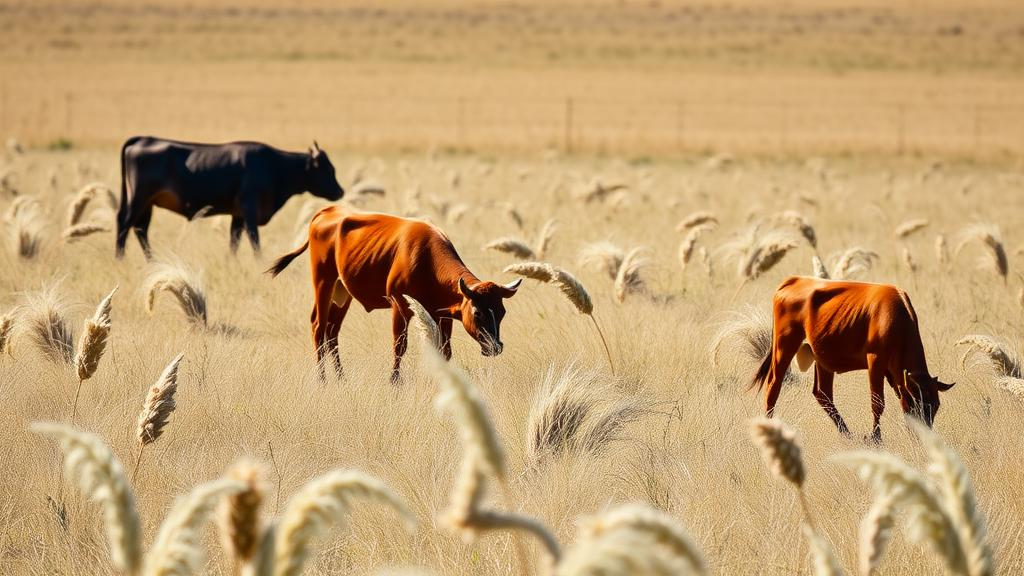
Across the vast grasslands of southeastern South America, the fate of dozens of bird species now rests largely in the hands of cattle ranchers. A new study conducted in the Flooding Pampas of Argentina offers some of the clearest evidence yet that the way livestock graze a landscape—and whether clumps of tall tussock grasses survive on it—can determine which birds thrive and which quietly disappear. The research, published in Discover Conservation by Facundo Niklison, David Bilenca and Mariano Codesido of CONICET and the University of Buenos Aires, compared bird communities on ten cattle ranches managed under two contrasting grazing systems, and found that both the management approach and the presence of tussock-forming plants leave measurable fingerprints on the avian assemblage.
The stakes are considerable. Grassland ecosystems once covered roughly 30 to 40 percent of the ice-free land surface, but temperate grasslands have been among the most heavily transformed habitats on Earth, with most of what remains now used for livestock production. The Río de la Plata Grasslands, spanning central Argentina, Uruguay and southern Brazil, form one of the largest Neotropical grassland systems at approximately 700,000 square kilometers, yet protected areas cover less than 3 percent of the Argentine Pampas. That means most surviving grassland habitat sits on private ranches, where decisions about stocking rates, paddock rotation and herbicide use effectively function as conservation policy. The regional avifauna includes 109 species classified as Southeastern South America grassland birds—species that depend extensively, or entirely, on the original native grassland physiognomy.
These birds fall into three broad habitat categories, and the study’s findings hinge on those distinctions. Short-grass species include migratory shorebirds such as the Buff-breasted Sandpiper (Calidris subruficollis) and the American Golden-plover (Pluvialis dominica), which favor closely cropped, homogeneous turf. Tall-grass species, some of them of conservation concern, include the Bay-capped Wren-spinetail (Spartonoica maluroides), a secretive bird that nests and forages among dense tussocks. Broad species, such as the Great Pampa-finch (Embernagra platensis) and the Brown-and-yellow Marshbird (Pseudoleistes virescens), use both short and tall grass. Because each group responds to different vegetation structures, a single grazing prescription cannot serve them all—a tension that lies at the heart of grassland conservation in the region.
The two management systems the researchers compared represent fundamentally different philosophies. Continuous grazing management, the traditional practice in the Flooding Pampas, keeps cattle in the same paddocks throughout the year, which tends to produce spatially homogeneous grasslands with short vegetation and has been linked to negative impacts on birds dependent on tall grass. Ecological process-based management, by contrast, encompasses rotational and controlled grazing designed to achieve more efficient forage use across seasons and to improve grassland composition by regulating resting periods, allowing cool-season grasses to seed and establish. Previous work has shown that input-based practices such as herbicide application and the establishment of introduced pastures can intensify grassland degradation and displace grassland birds in favor of generalists, whereas ecological process-based approaches have been associated with greater vegetation heterogeneity and more diverse avian communities.
To quantify these effects, the team surveyed birds and vegetation during a single breeding season in October and November of 2016, on five ranches under each management type, evenly distributed across the subregion. At each ranch, 25 to 30 count points were systematically placed—one per paddock, separated by at least 150 meters and kept away from fences, drainages and floodplains to avoid edge effects. Observers recorded all birds seen or heard within a 50-meter radius during five-minute counts conducted in the three hours after dawn and the three hours before sunset, yielding 288 count points and a total sampling effort of 1,440 minutes. The surveys documented 3,800 individuals of 41 grassland bird species under continuous grazing and 3,719 individuals of 39 species under ecological process-based management. After each count, observers visually estimated vegetation height, cover and dominant plant species, classifying vegetation into seven height strata and noting the presence or absence of tussock-forming species such as Paspalum quadrifarium, Juncus acutus, Spartina species and Cortaderia selloana.
The statistical analysis, built on generalized linear mixed models with ranch as a random effect, revealed that overall grassland bird abundance was 8 percent higher under ecological process-based management—26.5 versus 24.5 individuals per count point—than under continuous grazing. More striking was the interaction involving tussocks. Broad species, the group driving the overall difference, reached roughly 9.7 individuals per point in tussock-free paddocks under continuous grazing, but nearly doubled to 17.7 individuals where tussocks were present under the same management, and rose to 18.4 and 20.3 individuals per point under ecological process-based management with and without tussocks respectively. In other words, rotational grazing appeared to create conditions suitable for broad species even where tussocks were absent, while traditional continuous grazing only supported comparable numbers where tussock clumps persisted. Tall-grass species, meanwhile, did not respond directly to management type but were almost ten times more abundant in the presence of tussocks—0.4 versus 0.04 individuals per point—an emphatic signal of how much these plants matter for the most habitat-specialized birds.
Short-grass species told a different story entirely: their abundance varied neither with management practice nor with tussock presence. Seven species accounted for 75 percent of total abundance across the study, and none were tall-grass birds; the dominant assemblage included the Southern Lapwing (Vanellus chilensis, 20 percent of individuals), the Grassland Yellow-Finch (Sicalis luteola, 19 percent), the American Golden-plover (11 percent) and the Correndera Pipit (Anthus correndera, 11 percent). Species richness showed no significant association with management practice and only a marginal one with tussocks, averaging 6 species per point with tussocks against 5.4 without. A canonical correspondence analysis then mapped the 37 most frequently detected species against six vegetation variables, revealing a significant association between bird communities and vegetation structure. The first ordination axis separated species along gradients of heterogeneity and height, while the second axis primarily reflected grassland height, tussock presence and lowland occurrence.
The ordination carried important conservation messages. The Bay-capped Wren-spinetail and the Warbling Doradito (Pseudocolopteryx flaviventris) anchored the tall-grass, tussock-associated end of the gradient, while the Buff-breasted Sandpiper and American Golden-plover sat at the opposite extreme, tied to short, homogeneous grass shorter than 10 centimeters—likely because low swards improve both arthropod detection and visibility of avian predators. The threatened Hudson’s Canastero (Asthenes hudsoni), a broad species that nests in tall grasslands but feeds in heterogeneous ones, was associated with tussocks and high structural diversity. Notably, the Bay-capped Wren-spinetail was recorded at fewer than 5 percent of count points, underscoring how rare suitable habitat has become even on semi-natural ranches. The researchers also observed that ranches under continuous grazing happened to hold higher tussock and lowland occupancy in this sample, and that ranch identity explained a substantial share of the variance in bird abundance—suggesting that land-use history, paddock size, stocking rate, topography and fire all shape the conservation value of individual properties.
The practical implications reach beyond Argentina. Studies in the temperate grasslands of the United States Great Plains have found that grazing systems alone often do not significantly affect bird communities, making the Pampas results a reminder that context matters: where tussock-forming plants persist or can be restored, they act as keystone structural features for threatened birds. Because cow-calf production is the predominant activity of the Flooding Pampas, meaningful change must happen at that stage, and ecological process-based management is already available and has been shown to increase production while reducing certain environmental and biodiversity impacts. Yet adoption barriers remain, including lack of knowledge and economic constraints, and different ranching systems face different obstacles. Crucially, the authors caution that rotational grazing does not automatically preserve tussock-dominated grasslands of Paspalum quadrifarium, which serve as refuges for native wildlife and still resemble the original physiognomy of the Pampas. The study’s central lesson is therefore twofold: grazing systems that promote heterogeneity can deliver productive, economic and conservation goals simultaneously, but deliberate preservation of tussock-forming plants within livestock systems is indispensable for safeguarding the region’s most specialized and threatened grassland birds.
Subject of Research: Effects of grazing management and tussock-forming plants on grassland bird communities in the Argentine Flooding Pampas
Article Title: The role of grazing management practices and tussock-forming plants on grassland birds in the Argentine Pampas
Article References: Niklison, F., Bilenca, D., & Codesido, M. (2025). The role of grazing management practices and tussock-forming plants on grassland birds in the Argentine Pampas. Discover Conservation, 2(1), Article 44. https://doi.org/10.1007/s44353-025-00066-8
Image Credits: AI Generated
DOI: 10.1007/s44353-025-00066-8
Keywords: grassland birds, Argentine Pampas, grazing management, tussock grasses, rotational grazing, Flooding Pampas, bird conservation, vegetation structure, Bay-capped Wren-spinetail, livestock production, Neotropical grasslands, habitat heterogeneity
Cite Scienmag News
William Thompson. (October 3, 2026). Cattle Grazing and Tussock Grasses Shape Bird Life in Argentina’s Pampas. Scienmag. https://scienmag.com/cattle-grazing-and-tussock-grasses-shape-bird-life-in-argentinas-pampas/
William Thompson. "Cattle Grazing and Tussock Grasses Shape Bird Life in Argentina’s Pampas." Scienmag, 3 October 2026, https://scienmag.com/cattle-grazing-and-tussock-grasses-shape-bird-life-in-argentinas-pampas/. Accessed 3 October 2026.
William Thompson. "Cattle Grazing and Tussock Grasses Shape Bird Life in Argentina’s Pampas." Scienmag. October 3, 2026. https://scienmag.com/cattle-grazing-and-tussock-grasses-shape-bird-life-in-argentinas-pampas/


