


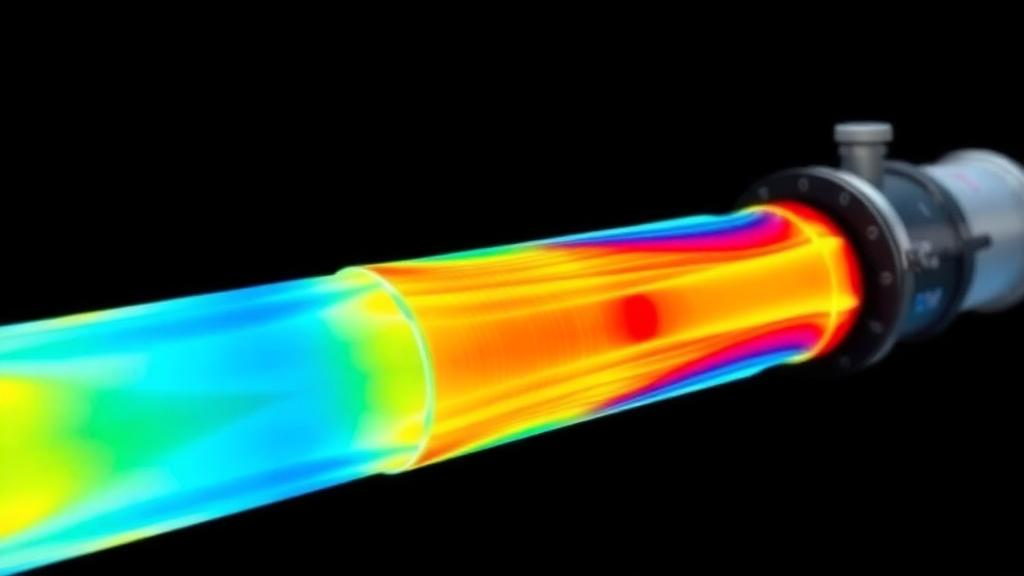
Hypersonic flight remains one of the most demanding challenges in aerospace engineering, and every step toward reusable vehicles, hypersonic propulsion, and high-speed flight testing depends on ground-test facilities that can faithfully reproduce the conditions of the upper atmosphere. A new experimental and numerical study from Konkuk University in Seoul has now provided a detailed characterization of the Mach 6 flow produced by the university’s Ludwieg tube, examining how the temperature of the gas stored in the reservoir shapes the quality and duration of the test flow. The work, published in the International Journal of Aeronautical and Space Sciences, offers reference data that will underpin future free-flight experiments, aerodynamic testing, sensor calibration, and hypersonic propulsion research.
Ludwieg tubes occupy a special niche among supersonic and hypersonic wind tunnels. Conceived by Hubert Ludwieg in the 1950s, these facilities store pressurized gas in a long charge tube behind a fast-acting valve or diaphragm. When the valve opens, an expansion wave races down the tube, and the gas flowing through the nozzle during the brief interval before reflections contaminate the flow is remarkably steady and clean. Because the facility is mechanically simple and efficient, it can deliver high-quality hypersonic flow at a fraction of the cost of conventional blowdown tunnels or shock tunnels, making it an attractive workhorse for laboratories that need frequent, repeatable test conditions.
The Konkuk University team, led by Eunju Kim, Minhyun Han, Jongho Yi, Soo Hyung Park, and Sang Hun Kang, set out to answer a deceptively simple question: what exactly does the flow at the exit of their Mach 6 nozzle look like when the reservoir gas is heated to different temperatures? The answer matters because the reservoir temperature determines the stagnation conditions of the flow, which in turn govern the unit Reynolds number that the facility can simulate. Matching the unit Reynolds number of real flight at altitudes between 10 and 30 kilometers is essential if laboratory measurements of boundary-layer transition, aerodynamic forces, and heat transfer are to be relevant to actual vehicles.
To map the flow, the researchers deployed a pitot rake consisting of 15 probes positioned at the nozzle exit. Pitot probes measure the stagnation pressure of the flow, and when combined with knowledge of the reservoir conditions, these measurements can be converted into local Mach numbers through the Rayleigh pitot tube relation, a classical result from compressible-flow theory that links the ratio of pitot to reservoir pressure with the Mach number for a supersonic flow of known specific heat ratio. By traversing the rake axially and radially, the team reconstructed the pressure field at the nozzle exit in both directions, revealing the structure and uniformity of the jet that test models would actually experience.
The experimental campaign was paired with numerical simulations of the nozzle flow, allowing the researchers to cross-validate their measurements against computational predictions. The comparison delivered a satisfying verdict: the experimentally measured Mach number distributions agreed with the numerical predictions across all the reservoir-temperature conditions tested. Equally important, the measured distributions confirmed that the nozzle-exit flow was axisymmetric, meaning the flow properties were symmetric about the nozzle’s centerline. Axisymmetry is a critical quality for a hypersonic test nozzle, because models placed in the core flow must encounter predictable, uniform conditions; asymmetries introduced by the nozzle contour or boundary-layer development would contaminate force and pressure measurements in ways that are difficult to correct after the fact.
Beyond mapping the flow itself, the team paid close attention to the steady-flow duration, the window of time during which the nozzle delivers stable conditions before disturbances from the starting process or the charge tube degrade the test flow. They measured pressures simultaneously at the reservoir and downstream of the piston to evaluate this duration quantitatively. The results revealed a clear trend: the usable test time shrinks as the reservoir gets hotter. At a reservoir temperature of 373 kelvin, the steady-flow duration was approximately 91 milliseconds. Raising the temperature to 473 kelvin shortened it to about 79 milliseconds, and at 573 kelvin the facility offered roughly 69 milliseconds of steady flow.
Those numbers may sound vanishingly short, but in the world of hypersonic ground testing they represent a substantial and workable measurement window. Impulsive facilities routinely deliver test times measured in single-digit milliseconds, forcing researchers to design instrumentation with extremely fast response and to accept limited data per run. A window approaching a tenth of a second allows multiple sensor readings, more complete force measurements, and better-resolved observations of phenomena such as boundary-layer transition. The systematic mapping of how test time trades off against reservoir temperature gives facility users a practical design rule: they can select the heating level that provides the Reynolds number they need while knowing exactly how much measurement time they will have.
Reservoir heating also plays a decisive role in suppressing a notorious enemy of hypersonic wind tunnels: condensation. When gas expands rapidly through a hypersonic nozzle, it cools dramatically, and if the static temperature drops far enough, components of the air, most notably water vapor and even nitrogen and oxygen at extreme conditions, can condense into droplets. Condensation releases latent heat, alters the pressure and Mach number of the flow, and can seed spurious disturbances that corrupt measurements. The experimental results obtained in this study were consistent with the suppression of nozzle-exit condensation under the high-Mach-number conditions tested, confirming that heating the reservoir before a run keeps the expanding gas above the condensation threshold and preserves the integrity of the hypersonic flow.
The combination of condensation suppression and controlled reservoir temperatures allowed the facility to stably simulate unit Reynolds numbers corresponding to flight altitudes of 10 to 30 kilometers, the band where many hypersonic and reentry vehicles operate during critical phases of their trajectories. This capability positions the Konkuk Ludwieg tube as a reference environment for Mach 6 testing in Korea and beyond. The authors note that the results provide reference data for the Mach 6 flow environment of their facility and support future applications including free-flight experiments, in which models are released to fly freely through the test section so that their dynamic motion can be recorded; aerodynamic testing of configurations relevant to hypersonic vehicles; calibration of pressure and heat-flux sensors under realistic hypersonic conditions; and research into hypersonic propulsion, where scramjet and ramjet inlet flows must be understood at flight-relevant Mach numbers.
The study also reflects a broader trend in hypersonic research: the pairing of careful experimental characterization with numerical simulation as a mutual check. No single ground-test facility or computational model is perfect, but when a 15-probe pitot rake survey and a numerical prediction of the same nozzle flow agree across multiple temperature conditions, researchers gain confidence both in the facility and in the tools used to design future experiments. The work was supported by the Korea Research Institute for Defense Technology Planning and Advancement through a grant funded by the Defense Acquisition Program Administration, as part of the Reusable Unmanned Space Vehicle Research Center, underscoring the connection between fundamental facility characterization and Korea’s ambitions in reusable spaceflight and hypersonic technology. As hypersonic programs worldwide race toward flight demonstration, studies like this one quietly supply the verified flow environments on which every credible test result ultimately depends.
Subject of Research: Mach 6 nozzle-exit flow characterization in a Ludwieg tube under varying reservoir temperatures
Article Title: Experimental and Numerical Investigation of Mach 6 Flow in a Ludwieg Tube Under Different Reservoir Temperatures
Article References: Kim, E., Han, M., Yi, J., Park, S. H., & Kang, S. H. (2026). Experimental and Numerical Investigation of Mach 6 Flow in a Ludwieg Tube Under Different Reservoir Temperatures. International Journal of Aeronautical and Space Sciences. https://doi.org/10.1007/s42405-026-01259-8
Image Credits: AI Generated
DOI: 10.1007/s42405-026-01259-8
Keywords: Ludwieg tube, hypersonic wind tunnel, Mach 6, nozzle flow, reservoir heating, pitot rake, Rayleigh pitot relation, unit Reynolds number, condensation suppression, steady-flow duration, Konkuk University, aerodynamic testing
Cite Scienmag News
Violet Maxwell. (October 3, 2026). Mach 6 Ludwieg Tube Study Maps Nozzle Flow Across Reservoir Temperatures. Scienmag. https://scienmag.com/mach-6-ludwieg-tube-study-maps-nozzle-flow-across-reservoir-temperatures/
Violet Maxwell. "Mach 6 Ludwieg Tube Study Maps Nozzle Flow Across Reservoir Temperatures." Scienmag, 3 October 2026, https://scienmag.com/mach-6-ludwieg-tube-study-maps-nozzle-flow-across-reservoir-temperatures/. Accessed 3 October 2026.
Violet Maxwell. "Mach 6 Ludwieg Tube Study Maps Nozzle Flow Across Reservoir Temperatures." Scienmag. October 3, 2026. https://scienmag.com/mach-6-ludwieg-tube-study-maps-nozzle-flow-across-reservoir-temperatures/


