


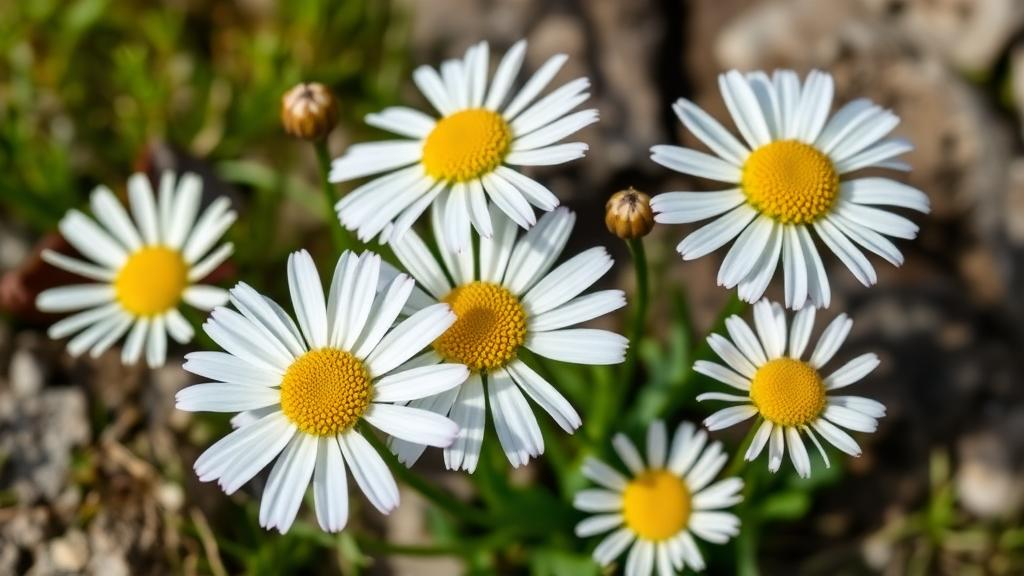
High in the mountains of northwestern Yunnan, China, a small, silvery-leaved daisy relative clings to life under some of the harshest conditions a plant can face. Ajania sericea, endemic to the Dali region and currently the southernmost known member of its genus anywhere in the world, endures intense ultraviolet radiation, biting cold, desiccating winds, and chronic drought. Now, a team of researchers at Dali University has sequenced and compared the chloroplast genomes of this alpine specialist and three neighboring Asteraceae species that share its habitat, uncovering a set of candidate molecular features that may underpin how unrelated lineages converge on similar survival strategies at altitude. The study, published in BMC Genomics, offers a rare window into whether plants that evolved separately but live side by side in extreme environments carry parallel signatures in their plastid DNA.
The research focused on four sympatric species: Ajania sericea, Aster brachytrichus, Anaphalis pannosa, and Leontopodium dedekensii. Although all belong to the vast sunflower family, they sit on different branches of the Asteraceae tree, which makes them an ideal natural experiment. If species from distinct lineages living in the same alpine setting show shared chloroplast genomic features, those features could plausibly relate to environmental response rather than shared ancestry. The team sequenced, assembled, and annotated the complete chloroplast genomes of all four species, then layered on analyses of codon usage, repeat composition, variable regions, selection pressure, and phylogenetic relationships to build a comprehensive comparative picture.
Structurally, the four plastomes turned out to be remarkably conservative. Each exhibited the typical quadripartite architecture found across most flowering plants, consisting of a pair of inverted repeat regions separated by a large single-copy and a small single-copy region. Guanine-cytosine content peaked in the inverted repeats, ranging from 42.99 to 43.07 percent, a pattern consistent with the elevated GC levels typically observed in these conserved segments. Gene content was similarly stable, with between 142 and 145 gene copies annotated in each genome. The differences that did emerge were subtle but informative: Anaphalis pannosa and Leontopodium dedekensii had both lost the ycf15 gene, and Anaphalis pannosa additionally lacked the transfer RNA gene trnT-GGU. These small-scale gene losses, along with variation at the boundaries of the inverted repeats and differences in repeat sequence composition, provide potential markers for distinguishing closely related species within the family.
Beyond gross structure, the researchers probed how the coding sequences themselves are used. Codon usage bias across the four plastomes was generally weak, and the preferred codons predominantly ended in adenine or thymine, reflecting the AT-rich character of chloroplast genomes. Two complementary approaches, the neutrality plot and the effective number of codons plot, suggested that mutational pressure alone could not fully explain the observed patterns. Factors beyond mutation, potentially including natural selection, appear to contribute to shaping codon preferences in these genomes. That conclusion matters because it hints that even the fine-grained mechanics of translation in alpine chloroplasts may not be entirely neutral, opening the door to functional interpretations of codon-level patterns in extreme environments.
One of the most practically valuable findings concerns DNA barcoding. By scanning the alignment of the four plastomes for regions of elevated sequence divergence, the team identified five hypervariable loci: petN, trnY-GUA, pafI-trnS-GGA, ndhC-trnV-UAC, and rpl32. These segments, which mutate faster than the surrounding genome, are prime candidates for developing DNA barcodes capable of discriminating Asteraceae species, a family so large and morphologically diverse that traditional identification is often difficult. Hypervariable chloroplast regions have long been sought as barcodes because they combine the advantages of plastid inheritance, including haploidy and lack of recombination, with enough variability to separate closely related taxa. The five regions flagged here could feed directly into future studies of interspecific differentiation and species delimitation across the daisy family.
To place the four species in evolutionary context, the researchers reconstructed phylogenetic trees using both maximum likelihood and Bayesian inference, two methods that rely on different statistical philosophies. The resulting topologies were fully consistent, a reassuring sign of robustness. Within this framework, Ajania sericea was most closely related to Ajania nematoloba, confirming its generic placement and providing a phylogenetic anchor for interpreting its genomic features. Reliable species trees are essential groundwork for any claim of convergent molecular evolution, because shared features must be distinguished from those simply inherited from a common ancestor.
The heart of the adaptation story lies in the analysis of selection. By calculating the ratio of nonsynonymous to synonymous substitution rates, known as Ka/Ks, across all protein-coding genes, the team assessed which genes might be evolving under relaxed constraint or positive selection. The verdict was clear for most of the genome: the vast majority of chloroplast protein-coding genes are under purifying selection, meaning that harmful mutations are being steadily weeded out, a hallmark of genes essential to survival. Only a handful of genes, including rpl14, rpl33, and rps2, showed relatively elevated Ka/Ks values or candidate signals of selection. These genes encode components of the chloroplast ribosome, the molecular machine that translates plastid proteins, and their elevated divergence in alpine species is intriguing given the demands that cold and high light place on plastid protein synthesis.
When the researchers integrated sequence variation, selection signals, and functional annotation into a single framework, a coherent picture emerged. Five genes stood out as candidates associated with alpine response: rpl14 and rpl33, both ribosomal protein genes tied to chloroplast translation; petN and ndhC, components of the photosynthetic electron transport chain; and ndhF, part of the chloroplast NADH dehydrogenase-like complex involved in redox regulation. Together, these genes point toward three interlinked processes, namely translation, photosynthetic electron transport, and redox homeostasis, as the chloroplast functions most plausibly shaped by life at high elevation. The logic is biologically appealing: alpine plants must keep photosynthesis running under intense light and cold while avoiding oxidative damage, and the plastid NADH dehydrogenase-like complex participates in cyclic electron flow and stress-related redox balancing, making its subunits plausible targets of environmental selection.
Not every result pointed toward adaptation, and the negative findings are just as instructive. The team compared chloroplast genomes from three Ajania sericea samples collected at different elevations and found them highly similar, with no clear elevation-associated plastome differentiation within the range examined. This suggests that, at least for this species and this elevational span, the plastid genome does not track altitude in a simple, linear fashion, and that any adaptive variation may be shared across populations or reside elsewhere in the genome. The authors are careful to frame their candidate genes as shared molecular response features rather than proven adaptations, a scientifically appropriate level of caution for a comparative study without reciprocal experiments or functional validation.
The broader significance of the work is twofold. For evolutionary biologists, it provides new chloroplast genomic evidence that sympatric Asteraceae species from different lineages may harbor convergent candidate features linked to alpine environments, enriching the growing literature on how plants respond genetically to mountain life. For taxonomists and conservationists, the five hypervariable regions identified here offer ready-made tools for species discrimination and population studies in one of the world’s largest plant families. As sequencing costs continue to fall, comparative plastomics of co-occurring species in other extreme habitats, from deserts to Arctic tundra, could reveal whether the same translation, electron transport, and redox genes recur as molecular common denominators of environmental stress response, or whether each habitat writes its own signature into the chloroplast genome.
Subject of Research: Comparative chloroplast genomics of sympatric alpine Asteraceae species to identify molecular features associated with alpine adaptation
Article Title: Comparative chloroplast genomics of Ajania sericea and sympatric Asteraceae species identifies shared candidate molecular features associated with alpine adaptation
Article References: Yang, H., Wu, S., He, Q., Xin, H., Li, W., & Chen, X. (2026). Comparative chloroplast genomics of Ajania sericea and sympatric Asteraceae species identifies shared candidate molecular features associated with alpine adaptation. BMC Genomics. https://doi.org/10.1186/s12864-026-13312-7
Image Credits: AI Generated
DOI: 10.1186/s12864-026-13312-7
Keywords: chloroplast genome, Ajania sericea, Asteraceae, alpine adaptation, molecular evolution, codon usage bias, Ka/Ks selection, DNA barcoding, phylogenetics, Yunnan, photosynthetic electron transport, redox regulation
Cite Scienmag News
Juliet Wilcox. (October 3, 2026). Alpine Daisy Relatives Share Chloroplast Clues to Surviving Life on High. Scienmag. https://scienmag.com/alpine-daisy-relatives-share-chloroplast-clues-to-surviving-life-on-high/
Juliet Wilcox. "Alpine Daisy Relatives Share Chloroplast Clues to Surviving Life on High." Scienmag, 3 October 2026, https://scienmag.com/alpine-daisy-relatives-share-chloroplast-clues-to-surviving-life-on-high/. Accessed 3 October 2026.
Juliet Wilcox. "Alpine Daisy Relatives Share Chloroplast Clues to Surviving Life on High." Scienmag. October 3, 2026. https://scienmag.com/alpine-daisy-relatives-share-chloroplast-clues-to-surviving-life-on-high/


