


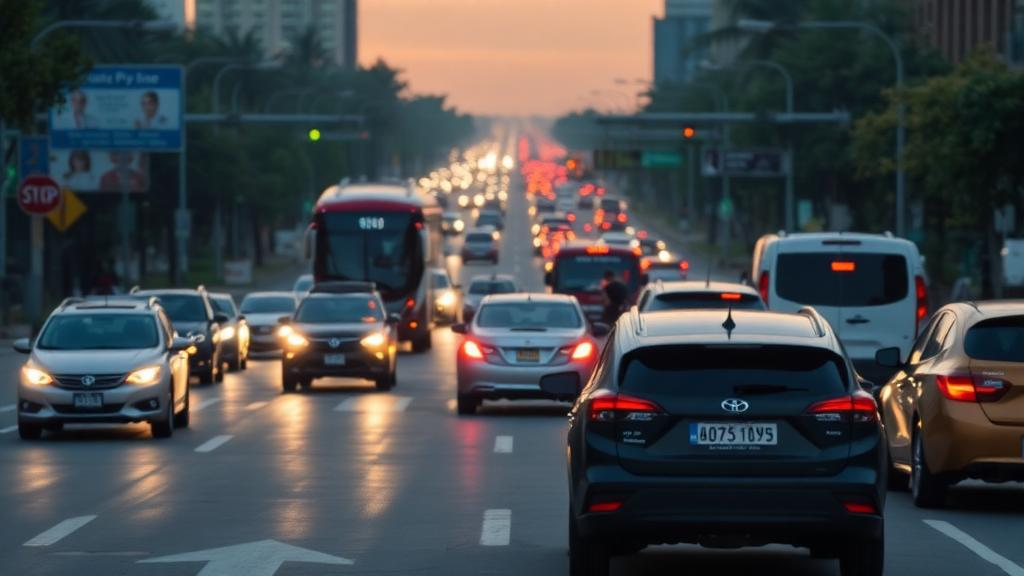
Living beside a busy road may do more than fray your nerves. One of the largest studies ever conducted on environmental noise and mental health has found that long-term exposure to road traffic noise is associated with a significantly higher risk of developing depression, and that a single quiet side of a home may offer meaningful protection. The findings, drawn from nearly three million Danish adults followed for up to 18 years, add depression to the growing list of health harms attributed to the constant hum of modern transportation.
The research, published in The Lancet Regional Health – Europe, was led by Anne Marie Kirkegaard and Mette Sørensen of the Danish Cancer Society together with colleagues from Aarhus University and other Danish institutions. The team assembled a nationwide cohort of 2,941,456 residents aged 25 to 65 who had no history of depression when follow-up began on 1 January 2000, or at their 25th birthday, whichever came later. Over a mean follow-up of 12 years, 413,818 participants developed depression, defined either as a first hospital contact for the illness or as redeeming at least two antidepressant prescriptions within one year.
What sets the study apart is the extraordinary precision of its exposure assessment. Using the validated Nordic Prediction Method, the researchers modelled road traffic noise at every residential address in Denmark for the years 1995, 2000, 2005, 2010 and 2015, incorporating three-dimensional building polygons, terrain data, traffic intensity, vehicle composition, speed limits, road type and even the presence of noise barriers. Crucially, they estimated noise not only at the most exposed façade of each building, a metric known as LdenMax, but also at the least exposed façade, LdenMin, which often faces a courtyard or garden and typically houses bedrooms. Annual values were interpolated between model years, and one- and five-year time-weighted averages were calculated for every participant across their entire residential history.
The results were striking. For every interquartile-range increase of 11.7 decibels in five-year mean noise at the most exposed façade, the risk of depression rose by 4 percent after full adjustment for sex, age, education, income, cohabitation, country of origin, area-level socioeconomic indicators, green space and air pollution. When the researchers additionally accounted for the noise contrast between façades, the hazard ratio climbed to 1.10, meaning a 10 percent increase in risk per interquartile range. The association with the quieter façade was even more pronounced: each 8.9-decibel increase in five-year mean LdenMin was linked to a 7 percent higher risk of depression, suggesting that sound levels during rest and sleep may be especially consequential for mental health.
Perhaps the most novel discovery concerned the difference between the two façades, a quantity the researchers call delta-Lden. Across every stratum of overall exposure, from quiet neighbourhoods below 50 decibels to loud ones above 65, no change in depression risk was observed when the contrast between façades was below roughly 10 decibels. But above that threshold, risk fell steadily as the contrast grew. In other words, having a genuinely quiet side to the home appeared to buffer the mental health effects of street-facing noise, likely by providing a restorative indoor environment that promotes undisturbed sleep. Previous research has shown that bedrooms facing away from streets are associated with less self-reported sleep disturbance, and sleep disruption is itself a well-established risk factor for depression.
The biological plausibility of the noise–depression link rests on well-characterised stress pathways. Experimental studies have demonstrated that transportation noise activates the hypothalamic-pituitary-adrenal axis and the sympathetic nervous system, triggering the release of stress hormones such as cortisol. Chronic neuroendocrine activation is associated with systemic and cerebral oxidative stress and inflammation, mechanisms that parallel depression-like phenotypes observed in animal models. Nighttime noise, in particular, fragments sleep and shortens sleep duration, and both are recognised contributors to depressive illness. Over years, this cumulative physiological wear may also promote maladaptive coping and unhealthy lifestyles, compounding the direct biological effects.
The study also revealed a troubling pattern of social inequality. Hazard ratios were consistently higher among participants with lower socioeconomic status: those with only basic education, lower incomes, blue-collar jobs or unemployment showed stronger noise–depression associations than their more advantaged counterparts. The pattern echoes an earlier German study that found elevated depressive symptoms only among people with 13 or fewer years of schooling. The authors suggest that people with fewer psychosocial resources may have less resilience to buffer environmental stress, while wealthier households may be better able to invest in sound insulation, choose quieter residences or access support networks that mitigate emotional strain. Road traffic noise, the findings imply, may be quietly widening existing mental health disparities.
Quantifying the population-level burden, the researchers estimated a population attributable fraction for noise at the most exposed façade. Applied to the national annual count of new depression cases in Denmark in 2017, this corresponded to approximately 1,277 incident depression cases per year attributable to residential road traffic noise. Sensitivity analyses strengthened confidence in the result: restricting the outcome to prescriptions with an explicit depression indication, to prescriptions alone, or to hospital contacts alone all yielded consistent estimates, with hospital-diagnosed cases showing the strongest associations. Analyses in an independent sub-cohort of 138,987 participants from the Danish National Health Survey produced comparable hazard ratios, and additional adjustment for smoking, alcohol, physical activity and diet changed the estimates only marginally.
The study is not without limitations. Registry-based outcome definitions capture primarily moderate to severe depression and may miss milder cases treated wholly in primary care, which would bias estimates toward the null and mean the true associations could be even stronger. Noise exposure was modelled outdoors rather than measured indoors, and the researchers lacked information on bedroom orientation, façade insulation and daily activity patterns. Residual confounding cannot be excluded, although E-value calculations indicated that an unmeasured confounder would need moderately strong associations with both exposure and outcome to explain away the findings.
Even so, the implications for urban planning are hard to ignore. The authors argue that policies should prioritise reducing indoor noise levels by ensuring at least one silent room in every dwelling, whether through building orientation, courtyard design, noise barriers or improved façade insulation. Because the protective effect of a quiet façade appeared even among residents of relatively noisy streets, targeted mitigation could deliver mental health benefits across the exposure spectrum. As cities densify and traffic persists as an inescapable feature of urban life, this study makes the case that how we design our homes, and which way our bedrooms face, may matter as much for our minds as for our sleep.
Subject of Research: The association between residential road traffic noise exposure and the incidence of depression in Danish adults
Article Title: Residential road traffic noise and incidence of depression in Denmark: a nationwide cohort study
Article References: Kirkegaard, A. M., Poulsen, A. H., Thygesen, L. C., Raaschou-Nielsen, O., Ketzel, M., Jensen, S. S., & Sørensen, M. (2026). Residential road traffic noise and incidence of depression in Denmark: a nationwide cohort study. The Lancet Regional Health – Europe, 71, Article 101883. https://doi.org/10.1016/j.lanepe.2026.101883
Image Credits: AI Generated
DOI: 10.1016/j.lanepe.2026.101883
Keywords: road traffic noise, depression, Denmark, cohort study, environmental health, noise exposure, sleep disturbance, quiet façade, socioeconomic inequality, public health, urban planning, mental health
Cite Scienmag News
Glenn Wilkins. (October 3, 2026). Traffic Noise Raises Depression Risk in Landmark Study of Nearly Three Million Adults. Scienmag. https://scienmag.com/traffic-noise-raises-depression-risk-in-landmark-study-of-nearly-three-million-adults/
Glenn Wilkins. "Traffic Noise Raises Depression Risk in Landmark Study of Nearly Three Million Adults." Scienmag, 3 October 2026, https://scienmag.com/traffic-noise-raises-depression-risk-in-landmark-study-of-nearly-three-million-adults/. Accessed 3 October 2026.
Glenn Wilkins. "Traffic Noise Raises Depression Risk in Landmark Study of Nearly Three Million Adults." Scienmag. October 3, 2026. https://scienmag.com/traffic-noise-raises-depression-risk-in-landmark-study-of-nearly-three-million-adults/


