


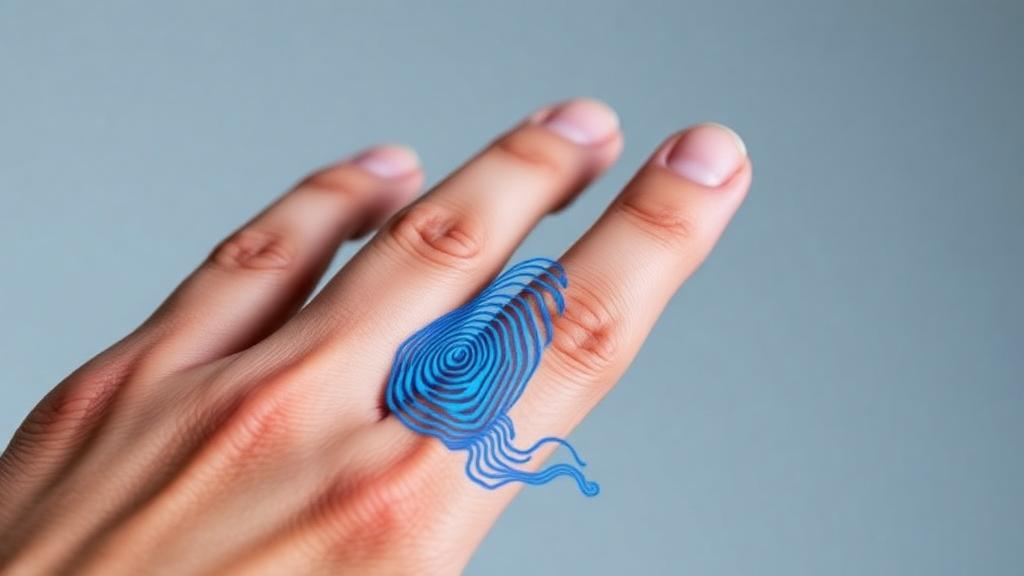
Biometric authentication has long been dominated by the fingerprint, but the humble fingerprint carries well-known weaknesses. Skin conditions, cuts, moisture, and the very act of pressing a finger onto a sensor can all degrade the quality of the captured sample. A research team led by Noboranjan Dey of the American International University-Bangladesh, working with M. Srinivas and R. B. V. Subramanyam of the National Institute of Technology Warangal, has now turned to a different part of the hand altogether: the middle finger knuckle. In a study published in Neural Computing and Applications, the researchers describe a deep learning model called MFKR Net that identifies people from contactless images of the unique crease and texture patterns on the back of the middle finger, achieving a reported accuracy of 90.90 percent on a publicly available dataset.
The appeal of the finger knuckle as a biometric trait lies in its combination of permanence and accessibility. The wrinkled skin over the knuckle joint forms distinctive crease lines and fine texture patterns that are stable over time and highly individual, much like a fingerprint. Unlike a fingerprint, however, the knuckle surface can be imaged without physical contact, which sidesteps the deformation problems that plague touch-based sensors. Contactless acquisition also raises fewer hygiene concerns and reduces user hesitation, factors that have become increasingly relevant in shared workplace environments and on personal devices where sensors are touched by many hands.
To make sense of knuckle images, the team built MFKR Net around two architectural ideas borrowed from the efficient deep learning literature: inverted residual blocks and depthwise convolutional layers. Inverted residual blocks, popularized by the MobileNet and EfficientNet families of networks, invert the traditional bottleneck structure of a convolutional block. Instead of compressing the input to a narrow layer and then expanding it, an inverted residual block first expands the input into a high-dimensional space, applies a lightweight depthwise convolution there, and then projects the result back down to a compact representation. A residual connection, which adds the block’s input to its output, allows information to flow across the block unchanged when that is useful, easing the training of deeper networks.
Depthwise convolution is the second key ingredient. In a standard convolution, each filter slides across all channels of the input image simultaneously, mixing spatial and channel information in a single operation. That is computationally expensive. Depthwise convolution instead applies a separate filter to each channel independently, handling spatial patterns channel by channel, and pairs this with a pointwise convolution that mixes information across channels. The combination, known as depthwise separable convolution, drastically reduces the number of parameters and the arithmetic required, which matters for a model that might one day run on modest hardware rather than a data center GPU. The authors also employ squeeze-and-excitation attention, a mechanism that lets the network learn to weight the importance of different feature channels dynamically, amplifying the channels that carry the most discriminative knuckle information and suppressing those that do not.
The input to the network is not an ordinary photograph. The researchers worked with photometric stereo images of the middle finger knuckle, a technique that captures the surface under multiple lighting directions to reveal fine three-dimensional structure. This matters because the discriminative power of the knuckle lies largely in its geometry: the deep crease lines and the subtle ridges of skin between them. Photometric stereo imaging preserves that relief information far better than a single flat photograph, giving the network richer cues about the shape of the creases that make each knuckle unique.
When the model was evaluated on a publicly available knuckle dataset, it reached 90.90 percent accuracy, and the authors report low false-rejection and false-acceptance rates, the two standard error measures in biometric testing. The false-rejection rate measures how often a legitimate user is turned away, a frustration that erodes trust in a system, while the false-acceptance rate measures how often an impostor is waved through, the more security-critical failure mode. Balancing both is the central challenge of biometric system design, and the reported figures suggest that MFKR Net achieves a useful operating point for practical deployment, particularly in small-scale settings such as office access control or device unlocking rather than nation-scale identification systems.
One of the more compelling aspects of the study is its use of Grad-CAM, a visualization technique that reveals which parts of an image a convolutional network relies on when making a decision. Grad-CAM works by tracing the gradients flowing into the final convolutional layers to produce a heat map of the regions that most influenced the classification. In this case, the visualizations showed that MFKR Net concentrates its attention on the crease and texture regions of the knuckle, exactly the areas that biometric theory predicts should carry the most identifying information. That kind of interpretability evidence is valuable because it suggests the network is learning genuine biometric features rather than exploiting spurious correlations in the dataset, such as lighting artifacts or background clutter.
The work sits within a broader research effort on knuckle-based biometrics that stretches back nearly two decades. Early studies demonstrated that the finger knuckle surface could serve as a personal identifier, and subsequent work developed coding schemes, phase-based matching algorithms, and three-dimensional surface key point methods for knuckle matching. More recently, deep learning approaches have taken over the field, including prior work on three-dimensional finger knuckle identification and an earlier study by the same authors using ensemble learning for middle finger knuckle identification. MFKR Net continues that trajectory by emphasizing efficiency: by building on lightweight convolutional primitives, the model aims to deliver competitive accuracy without the computational burden of large general-purpose networks.
The authors see potential applications in forensic investigations, where knuckle prints left on surfaces could supplement other trace evidence, and in small-scale authentication environments such as workplaces and personal devices. They have also released their code openly on GitHub and evaluated their model on a publicly available dataset from the Hong Kong Polytechnic University, an explicit invitation for other researchers to replicate and extend the results. Reproducibility of this kind is still the exception rather than the rule in biometrics research, where datasets are often proprietary and results difficult to verify independently, so the open release is a meaningful gesture for the field.
Challenges remain before knuckle recognition appears in everyday devices. The reported accuracy, while strong, still leaves roughly one in eleven decisions incorrect, and real-world deployments must contend with variations in lighting, hand pose, and image quality that are harder to control than a curated laboratory dataset. Larger and more diverse datasets will be needed to confirm that the model generalizes across populations and aging hands. Nevertheless, the study adds to a growing body of evidence that the back of the hand holds a biometric signature worth taking seriously, and that carefully engineered, computationally efficient neural networks can extract that signature from a simple contactless image. As contactless authentication becomes the norm rather than the exception, the middle finger knuckle may find itself doing far more work than it ever expected.
Subject of Research: Contactless biometric identification using middle finger knuckle patterns and deep learning
Article Title: Enhanced contactless middle finger knuckle recognition using inverted residual and depthwise convolutional networks
Article References: Dey, N., Srinivas, M., & Subramanyam, R. B. V. (2026). Enhanced contactless middle finger knuckle recognition using inverted residual and depthwise convolutional networks. Neural Computing and Applications, 38(19), Article 774. https://doi.org/10.1007/s00521-026-12505-1
Image Credits: AI Generated
DOI: 10.1007/s00521-026-12505-1
Keywords: biometrics, middle finger knuckle, deep learning, inverted residual blocks, depthwise convolution, contactless authentication, personal identification, Grad-CAM, photometric stereo, neural networks, feature extraction, security
Cite Scienmag News
Denise Maddox. (October 3, 2026). Your Knuckle Creases Could Soon Replace Your Fingerprint as a Digital Key. Scienmag. https://scienmag.com/your-knuckle-creases-could-soon-replace-your-fingerprint-as-a-digital-key/
Denise Maddox. "Your Knuckle Creases Could Soon Replace Your Fingerprint as a Digital Key." Scienmag, 3 October 2026, https://scienmag.com/your-knuckle-creases-could-soon-replace-your-fingerprint-as-a-digital-key/. Accessed 3 October 2026.
Denise Maddox. "Your Knuckle Creases Could Soon Replace Your Fingerprint as a Digital Key." Scienmag. October 3, 2026. https://scienmag.com/your-knuckle-creases-could-soon-replace-your-fingerprint-as-a-digital-key/


