


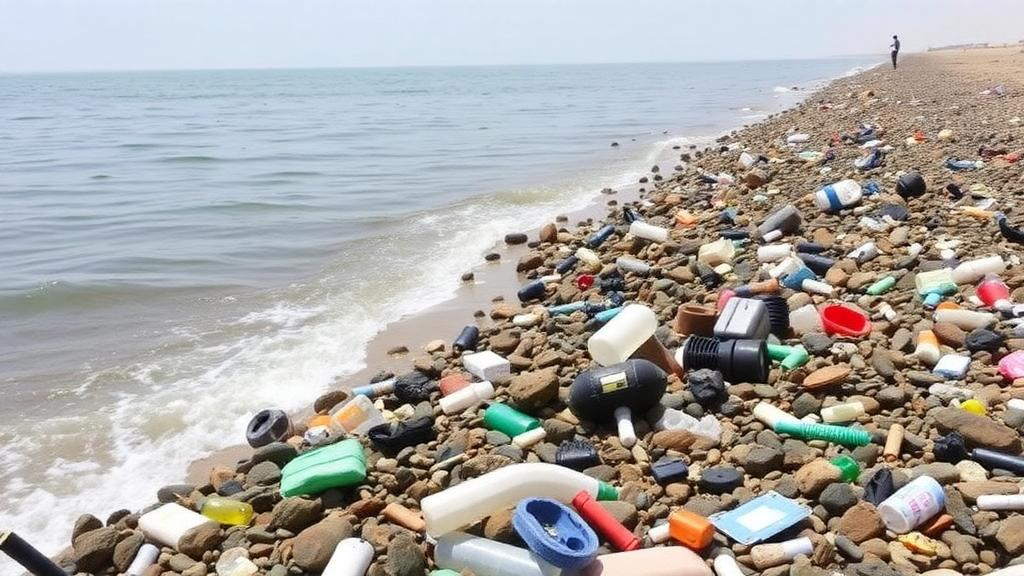
On a single day in April 2024, a heavy storm swept across the Muscat coast of Oman, and by the following morning the beaches at Ghubra and Qurm told a striking story. Debris that had accumulated in streets, wadis, and drainage channels far inland had been flushed seaward by surface runoff, piling up along the shoreline in quantities that researchers had not recorded at those sites before. That natural experiment, captured almost by accident in the middle of a systematic beach survey, now anchors one of the most detailed transect-level assessments of marine litter ever conducted along the Sea of Oman, and its findings carry implications that stretch well beyond the Sultanate’s shores.
The study, carried out by Al Ayiham Al Siyabi and Sachinandan Dutta of the Department of Marine Science and Fisheries at Sultan Qaboos University, examined four coastal localities representing very different patterns of human use: Barka and Seeb, dominated by residential and light commercial activity with limited tourism infrastructure, and Ghubra and Al Qurm, popular recreational and tourist destinations with heavy pedestrian traffic. Across these sites, the team surveyed a total of 7,200 square meters of beach using twenty-four belt transects, each 100 meters long and 3 meters wide, oriented parallel to the waterline and spaced 5 to 10 meters apart to ensure spatial independence. Every visible item of litter measuring 2.5 centimeters or larger was recorded, collected, bagged by transect, and transported to the laboratory, where items were washed, dried, counted, and classified by material type and intended use according to the OSPAR Marine Litter Monitoring Guideline and the UNEP/IOC National Beach Survey Guidelines.
The numbers that emerged are sobering. In total, the researchers retrieved 2,193 individual items weighing a combined 67,588.90 grams, yielding a mean abundance of 0.31 items per square meter. Plastics dominated the haul, accounting for 62 percent of all items collected and 23,689.83 grams by weight. Fabric came second in abundance at 13 percent of items, and remarkably contributed the highest weight of any category at 31,659.20 grams, followed by plastic and processed wood at 3,753.59 grams. Foam, glass, metals, paper, cotton, and other materials appeared in comparatively small quantities, with metal and glass counts generally remaining below 20 items at every location. The highest concentration of plastic by weight, 11,705.5 grams, was recorded at Ghubra, a finding the authors link to urbanization and intensive commercial activity in the area.
The plastic figure of 62 percent sits below the global average of roughly 75 percent but aligns almost exactly with the 61 percent recorded along Omani coasts in earlier work, a consistency the researchers suggest may reflect Oman’s relatively effective plastic waste management policies and lower per capita plastic consumption compared with many other nations. Regional context underscores how variable the picture can be. Surveys in Qatar have documented plastic abundances as high as 1.98 items per square meter, with plastics making up 71 percent of litter, while studies in Saudi Arabia have found plastics comprising 75 percent of beach trash, particularly near heavily visited beaches and populated areas. Along the Gulf of Oman more broadly, previous work reported contamination ranging from 0.43 to 6.01 items per square meter, and research in mangrove habitats of the Sea of Oman has found litter densities from 0.83 to 21.92 items per square meter, with plastics comprising 73 to 96 percent of waste and microplastic sediment concentrations reaching up to 256 pieces per kilogram.
Perhaps the most dramatic finding concerns the storm. Ghubra and Al Qurm were sampled on April 17, 2024, one day after a major rainfall event, during which the sites received between 65 and 90 millimeters of rain. The post-rainfall collections showed significantly increased litter weights, particularly in Transect 1, the transect closest to the sea and the one that would ordinarily be expected to carry the least debris. The researchers attribute this surge to surface runoff generated by the intense rainfall, which transported debris from inland areas directly to the coast. Supporting evidence came in the form of processed wood found at both sites, material likely carried downstream by floodwaters from terrestrial sources. The pattern echoes findings from around the world: researchers on the Seine River in France recorded a tenfold increase in riverbank macrolitter following rainfall events, and other studies have documented strong correlations between rainfall intensity and microplastic abundance in estuaries.
Yet the authors are careful to emphasize that rainfall alone cannot explain the distribution of litter along the Omani coast. Barka and Seeb, which were sampled before the April storm and experienced minimal rainfall, still exhibited variable and sometimes substantial litter weights. Barka and Seeb experience higher fishing activity than the tourist-oriented Ghubra and Qurm, and the high fabric litter counts at Barka, more than 150 items, likely reflect discarded fishing ropes and related gear, since fishing-related debris typically constitutes 5 to 15 percent of litter in coastal surveys worldwide. Meanwhile, municipal management emerged as another decisive factor: Ghubra, Qurm, and Seeb fall under the jurisdiction of Muscat municipality, which actively conducts beach cleaning, whereas Barka does not enjoy the same level of municipal attention. Statistical analysis of the transect data found no significant differences in mean litter weights or counts among the four locations, but the authors argue that site-specific factors such as fishing intensity and cleaning regimes clearly shape local patterns.
One of the study’s most distinctive contributions is its brand-level characterization of litter, an approach rarely documented in Oman. Among the identifiable branded items, bottled water brands dominated overwhelmingly. Humayl Water was the most frequently identified brand with 36 items, representing 27 percent of branded litter, followed by Sarooj Water with 16 items at 11 percent, Barzman Water with 14 items, and Oman Chips with 7 items. Brands such as Pepsi, Rani, Aquafina, Mahmood Trading EST, and Asafwah appeared in smaller numbers, each contributing between one and five pieces. The researchers stress that brand identification reflects post-consumer behavior and local market availability rather than direct corporate responsibility for littering. The dominance of local bottled water brands simply mirrors which products are most heavily consumed in the study area, but the pattern makes an unmistakable point: packaged bottled water is the single largest identifiable contributor to marine litter in the Sea of Oman.
That finding resonates with a growing body of research on bottled water itself. Independent investigations have revealed significant variation in microplastic contamination among bottled water brands and even among bottles of the same brand purchased in different parts of the world, with studies showing that the vast majority of particles found in single-use plastic bottled water match the composition of the PET bottle and its polypropylene and polyethylene cap components. In other words, the environmental footprint of bottled water begins long before an empty bottle is discarded on a beach, and the Omani survey adds a visible, macro-scale endpoint to that lifecycle. The stakes are considerable: an estimated 4.8 to 12.7 million metric tons of improperly disposed plastic enter the ocean annually, and plastic pollution is estimated to cost marine ecosystems roughly 13 billion dollars each year, with the Asia-Pacific maritime industry alone suffering annual losses of 1.26 billion dollars from litter-related damage.
The ecological consequences documented across the broader literature give these numbers real weight. Marine litter entangles and suffocates wildlife, perforates and blocks gastrointestinal tracts in animals that ingest it, and leaches toxic chemicals into the food web. Lost and abandoned fishing gear continues to capture and kill marine organisms through so-called ghost fishing long after it is discarded. Litter can even serve as a raft for invasive species and pathogens, transporting organisms to ecosystems where they do not belong. Because roughly 80 percent of marine litter originates on land, much of it carried to the sea by stormwater outflows that frequently bypass filtration systems, the pathways traced in the Omani study are not local curiosities but a microcosm of a global mechanism.
The authors close with a set of recommendations that flow directly from their data. Improved stormwater filtration is needed to intercept land-based debris before rainfall events can flush it seaward, a need made vivid by the post-storm litter surges at Ghubra and Qurm. The 62 percent dominance of plastics argues for targeted policies to reduce single-use plastics and strengthen local recycling, while public awareness campaigns should focus on the items most commonly littered, above all bottled water packaging. Crucially, the team calls for a long-term, standardized scientific monitoring program to track trends, pinpoint sources, and measure whether interventions actually work, alongside cross-sectoral collaboration among environmental, municipal, and regional bodies. The study also acknowledges its own limitations, including a modest sample of four sites with three transects each and uneven temporal coverage across sites, factors that may limit statistical power. Even so, as a site-specific baseline that simultaneously captures spatial variability, post-rainfall dynamics, and brand-level source indicators, the work fills a conspicuous gap in a region where the tide of plastic shows no sign of receding on its own.
Subject of Research: Marine litter distribution, composition, and rainfall-driven transport along the Sea of Oman coastline
Article Title: Spatial distribution, composition, and rainfall-driven dynamics of marine litter along the Sea of Oman, Sultanate of Oman
Article References: Al Siyabi, A. A., & Dutta, S. (2026). Spatial distribution, composition, and rainfall-driven dynamics of marine litter along the Sea of Oman, Sultanate of Oman. Discover Oceans, 3(1), Article 20. https://doi.org/10.1007/s44289-026-00129-1
Image Credits: AI Generated
DOI: 10.1007/s44289-026-00129-1
Keywords: marine litter, plastic pollution, Sea of Oman, stormwater runoff, coastal pollution, Oman, beach survey, bottled water, rainfall, microplastics, waste management, fishing gear
Cite Scienmag News
Reese Ellison. (October 3, 2026). Rainfall and Plastic: New Survey Reveals What Litters Oman’s Sea of Oman Coastline. Scienmag. https://scienmag.com/rainfall-and-plastic-new-survey-reveals-what-litters-omans-sea-of-oman-coastline/
Reese Ellison. "Rainfall and Plastic: New Survey Reveals What Litters Oman’s Sea of Oman Coastline." Scienmag, 3 October 2026, https://scienmag.com/rainfall-and-plastic-new-survey-reveals-what-litters-omans-sea-of-oman-coastline/. Accessed 3 October 2026.
Reese Ellison. "Rainfall and Plastic: New Survey Reveals What Litters Oman’s Sea of Oman Coastline." Scienmag. October 3, 2026. https://scienmag.com/rainfall-and-plastic-new-survey-reveals-what-litters-omans-sea-of-oman-coastline/


