


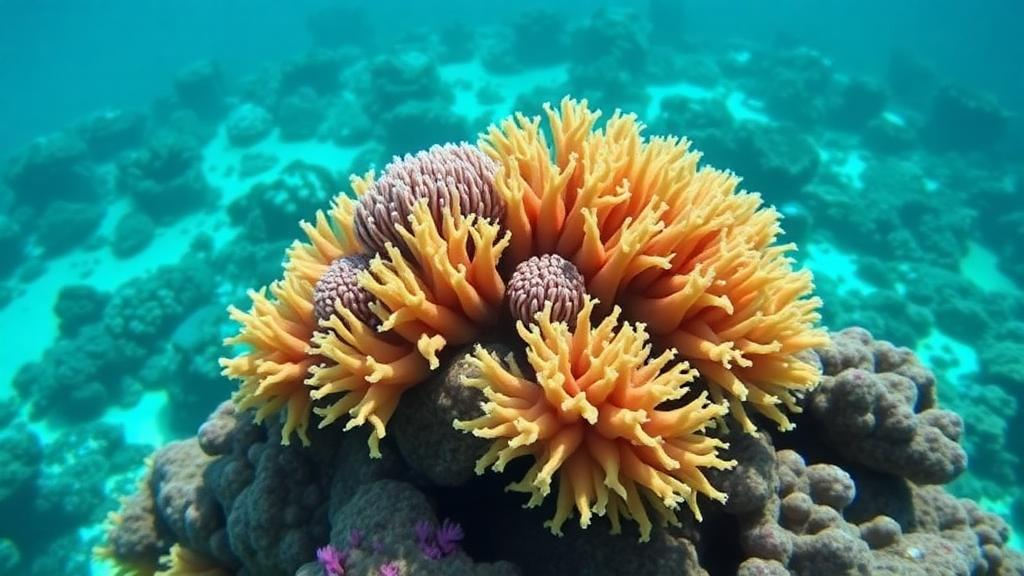
On the World Heritage-listed Ningaloo Reef, off the remote coast of Western Australia, some of the ocean’s most important architects have been keeping a secret. Scientists at Curtin University have now determined, for the first time, when the massive Porites corals that dominate this reef system reproduce, and their findings are forcing a rethink of how reef recovery actually works. The research, published in the journal Marine Biology, provides the first reproductive baseline for these keystone species at Ningaloo, a benchmark that could prove decisive as marine heatwaves intensify across the Indo-Pacific.
The significance of the study lies in a distinction that is often overlooked in public discussions of coral bleaching. When a reef survives a heatwave, headlines tend to celebrate survival itself. But as lead author David Juszkiewicz, a PhD candidate in Curtin’s Coral Conservation and Research Group, explains, survival is only half the equation. A damaged reef does not recover merely because some of its corals remain alive; it recovers because those surviving colonies produce eggs and sperm, fertilize them, and release larvae that settle, grow, and gradually rebuild the three-dimensional structure that thousands of other species depend on. Without successful reproduction, even a reef full of living corals is, in demographic terms, a population with no future.
This is why knowing the reproductive calendar of reef-building corals matters so much. Coral spawning is a remarkably synchronized phenomenon: colonies of the same species release their gametes in coordinated bursts, often tied to lunar cycles, water temperature, and other environmental cues. If scientists do not know when a given species spawns, they cannot measure whether that species is reproducing successfully after a disturbance, cannot detect sublethal heat stress that suppresses fertility, and cannot plan restoration work that depends on collecting eggs and larvae at precisely the right moment. The Curtin team set out to close that knowledge gap for Ningaloo’s most important reef-builders.
The researchers examined 20 massive coral colonies drawn from across Ningaloo Reef, focusing on the genus Porites, a group of slow-growing, long-lived corals that create and maintain much of the structural habitat throughout the Indo-Pacific. These corals can form enormous boulder-like colonies that persist for centuries, making them both ecological cornerstones and valuable archives of environmental history. By sampling the reproductive tissues of these colonies, the team could determine whether individual corals were developing eggs and sperm and therefore preparing to spawn.
The results revealed a clear pattern for two of the three species studied. Porites lutea and Porites lobata, both major contributors to reef construction at Ningaloo, showed evidence that they were preparing to spawn during the reef’s annual early autumn mass spawning period. This finding establishes the first reproductive baseline for these species at the site, giving scientists and managers a reference point against which future reproductive activity can be measured. If marine heatwaves strike the region in coming years, researchers will be able to return to these corals and assess whether their reproductive output has declined, a far more sensitive indicator of long-term reef health than survival alone.
The third species told a different story. Porites australiensis showed no signs of reproduction during either of the team’s sampling periods, suggesting that it may spawn at a different time of year entirely. That possibility raises an important complication: some of Ningaloo’s major reef-building corals may not follow the reproductive schedules assumed from studies elsewhere. The implication is that year-round monitoring of reproductive activity will be needed to build a complete picture of how different species contribute to reef recovery and how they respond, individually, to thermal stress. A single annual spawning survey could easily miss the reproductive peak of a species that breeds outside the conventional window.
Perhaps the most striking finding concerns geography. Ningaloo’s Porites corals appear to reproduce in early autumn, whereas populations of the same species recorded further north, near Dampier on the Pilbara coast, have been observed spawning in late spring and early summer. That seasonal offset is more than a curiosity. As senior author Associate Professor Zoe Richards, leader of the Coral Conservation and Research Group in Curtin’s School of Molecular and Life Sciences, points out, if Ningaloo’s corals are reproductively isolated from reefs just 300 kilometres to the north, those northern populations may be unable to replenish Ningaloo if its corals are lost to heatwaves or cyclones. The two regions would effectively function as separate genetic stocks, despite their relative proximity, meaning that larval connectivity between them cannot be assumed when planning conservation at a regional scale.
The practical consequences for restoration programs are immediate. Many modern reef restoration efforts rely on capturing coral spawn during spawning events, rearing the larvae, and resettling them onto degraded reef areas. Timing is everything in this work. If scientists miss a spawning event, they may have to wait an entire year for the next opportunity to collect reproductive material. A reliable reproductive calendar for keystone species like Porites lutea and Porites lobata allows managers to plan collection expeditions, laboratory work, and outplanting schedules with confidence, rather than gambling on an uncertain window. The new baseline transforms what was previously guesswork into a scheduled, repeatable operation.
Independent experts have welcomed the benchmark. Dr Thomas Holmes, Program Manager for the WA Reef Regen Program at the Western Australian Marine Science Institution, who was not involved in the study, emphasized that heat stress does not simply determine whether corals live or die. It can also reduce reproduction, meaning corals may produce fewer eggs and sperm for years after a major bleaching event. That delayed fertility cost makes reproduction one of the most important indicators of a reef’s long-term health and resilience. With a baseline now established for some of Ningaloo’s most important reef-builders, any future heatwave impact on the region can be assessed against measurable reproductive data, informing coral regeneration activities with evidence rather than assumption.
The project was undertaken with funding from the Minderoo Exmouth Research Station and involved co-authors from the Curtin University Medical Research Institute, James Cook University and The University of Western Australia. As climate change continues to push ocean temperatures upward, the study underscores a broader lesson for reef science: recovery is a reproductive process, not just a survival outcome. Reefs cannot rebuild themselves unless their corals successfully produce the next generation, and protecting that capacity requires knowing exactly when, where, and how it happens. For Ningaloo, the clock has finally been read; for reefs elsewhere, the message is that similar baselines are urgently needed before the next marine heatwave arrives.
Subject of Research: Reproductive timing and spawning patterns of massive Porites corals at Ningaloo Reef, Western Australia
Article Title: New insights into coral reproductivity could help protect our reefs
Article References: New insights into coral reproductivity could help protect our reefs. (n.d.). Original publication
Image Credits: AI Generated
DOI: Not provided
Keywords: coral reproduction, Ningaloo Reef, Porites, coral spawning, marine heatwaves, reef recovery, coral restoration, Curtin University, Marine Biology, reef resilience, Western Australia, larval connectivity
Cite Scienmag News
Violet Maxwell. (October 2, 2026). Coral Spawning Clock Revealed: Ningaloo’s Reef-Builders Reproduce on Their Own Schedule. Scienmag. https://scienmag.com/coral-spawning-clock-revealed-ningaloos-reef-builders-reproduce-on-their-own-schedule/
Violet Maxwell. "Coral Spawning Clock Revealed: Ningaloo’s Reef-Builders Reproduce on Their Own Schedule." Scienmag, 2 October 2026, https://scienmag.com/coral-spawning-clock-revealed-ningaloos-reef-builders-reproduce-on-their-own-schedule/. Accessed 2 October 2026.
Violet Maxwell. "Coral Spawning Clock Revealed: Ningaloo’s Reef-Builders Reproduce on Their Own Schedule." Scienmag. October 2, 2026. https://scienmag.com/coral-spawning-clock-revealed-ningaloos-reef-builders-reproduce-on-their-own-schedule/


