


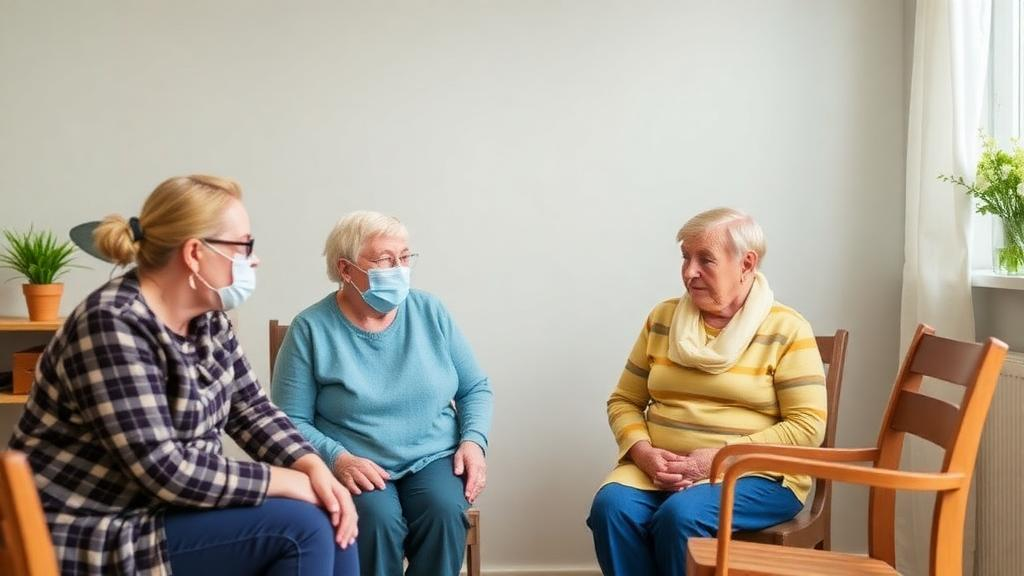
People living with severe mental illness in supported housing often describe lives marked by passivity, loneliness and a quiet sense of being forgotten by the very staff who are meant to help them. A new qualitative study from Lund University and Linnaeus University in Sweden suggests that a carefully structured occupational therapy intervention can begin to change that picture. The intervention, called Active in My Home, or AiMH, was designed to place occupational engagement, participation in society and personal recovery at the centre of everyday life in congregate supported housing settings. In a study published in the Scandinavian Journal of Occupational Therapy, sixteen residents who completed the programme were interviewed about their experiences, both immediately after the twelve-week course and again six to nine months later, and their accounts reveal a striking pattern of renewed confidence, new friendships and a changed relationship with the staff around them.
The context matters for understanding why the researchers undertook this work. Supported housing in Sweden, particularly the type classified as Type 1 in the Simple Taxonomy for Supported Accommodation, offers residents a room or small flat of their own alongside common areas for meals and socialising, with staff support available between twelve and twenty-four hours a day. Yet previous research has consistently shown that residents in these settings report feeling neglected, at risk of leading passive and isolated lives, and in need of encouragement to engage in meaningful activity. Occupational therapy expertise is rarely available in these facilities, and none of the six municipalities involved in the study, four urban and two rural in southern Sweden, had an occupational therapist working directly with supported housing residents. Tailored, activity-based and recovery-oriented interventions of this kind remain rare in Swedish supported housing, which the researchers describe as making their development and evaluation an urgent matter.
The AiMH intervention rests on four theoretical cornerstones drawn from occupational therapy research: engagement in meaningful everyday activities as a fundamental human need essential for health and well-being; the re-motivation process, which addresses how to encourage and sustain an individual’s motivation to engage in occupations; the principles of personal recovery, understood as a process through which a person works to regain a meaningful life despite the challenges of mental illness; and sensory modulation, which focuses on how sensory experiences can either calm or stimulate a person, allowing adjustments that enable engagement. The intervention was developed collaboratively, incorporating the views of service users, staff and relatives, and was pilot tested and revised through co-production before the main study. It was delivered by an occupational therapist who received two days of training and ongoing supervision, and it followed a manualised structure of eight biweekly sessions over twelve weeks, five of them individual and three group-based, each lasting roughly thirty to forty-five minutes.
A distinctive feature of the design was the involvement of the housing staff themselves. All staff were invited to workshops built around short pre-recorded digital lectures of about fifteen minutes each, with attendance mandatory for designated support staff. The first workshop addressed meaningful occupations, recovery and re-motivation; the second covered sensory stimuli and modulation; and a third, held halfway through the intervention, assessed the housing context and considered changes that could benefit residents’ occupational engagement. Each participant was also assigned a staff member as an AiMH supporter, who worked with the resident on a shared worksheet between sessions and encouraged the use of newly learned strategies both within the housing setting and in the wider community. Session themes included topics such as getting to know one’s own senses and stress management, and finding inspiration and setting goals, with practical exercises such as drawing an activity circle to visualise the variety of daily occupations. Each participant also received a sum corresponding to twenty euros, specifically allocated to facilitate engagement in a desired occupation, creating what the researchers describe as an incentive to plan and carry out meaningful activities.
Twenty-nine residents took part in the intervention across seven housing units, and twenty agreed to be interviewed, of whom sixteen completed at least one of the two interview occasions, producing twenty-three interviews in total. The interviews were semi-structured and open-ended, guided by the intervention’s structure, and were conducted by occupational therapists with clinical and research experience of the target group. Particular ethical care was taken given the mental vulnerability of participants, who could have a support person present and could divide the interview into several sessions if needed. The researchers analysed the material using manifest content analysis, staying close to the informants’ actual statements, and distilled the findings into one overarching theme and four categories.
The main theme that emerged was described as boosting personal recovery by discovering new capacities and activity opportunities. Participants reported feeling valued simply by being offered a course, with one informant, Karin, saying that it showed that people cared, and another, Petra, describing how she was positively affected by all the opportunities that had opened up. The positive impact appeared to endure over time, with some participants continuing to feel more seen and acknowledged months after completing the programme. This sense of being noticed and invested in was, for many, a novel experience within the housing setting and appeared to act as a catalyst for broader change in how they managed everyday life.
The first of the four categories concerned a stimulating change in the approaches and interaction of the staff. Residents perceived that staff had come to know them better, showed more respect for personal choice, and were more responsive and encouraging, which fostered self-confidence and independence. Staff applied new knowledge about sensory modulation by organising so-called sensory days, during which participants made rice pads for weighted stimulation or used warmth and rhythmic movement. Structured support through the course material helped residents reflect on life goals and establish daily routines, even though some found the early stages of change messy and difficult. Notably, several participants reported needing less staff support over time as they benefited from new strategies and newfound friendships, describing greater control over daily life and reduced sensitivity to stressors such as loud noise.
The second and third categories highlighted the inner work that the intervention made possible. Residents described that opportunities to reflect on personal recovery were essential: learning sensory strategies helped some see paths to well-being beyond medication, with Karin likening the effect to receiving an injection of kindness in the psyche, while others valued practical tools such as breathing techniques and crisis-management strategies. Reflecting on activity timelines evoked memories that created renewed purpose, and participants spoke of discovering goals and dreams, from getting out of bed more often to training as a hairdresser or applying for a job at a second-hand store. Reflection combined with exploration of new activities appeared to initiate a positive cycle of change: visual tools such as activity pie charts helped residents identify imbalances in how they spent their time, and many began dancing, exercising, baking or walking to the forest and the sea. One participant enrolled in a nursing assistant programme, while another performed publicly as a musician.
The fourth category concerned the power of the group format itself. Interacting with fellow participants and staff fostered trust, motivation and a sense of community, with structured, well-prepared sessions experienced as far more meaningful than the informal kitchen gatherings that had preceded them. Listening to others’ experiences deepened mutual understanding, and new friendships emerged that reduced dependence on staff; two participants who had initially been sceptical of group settings developed a close friendship and used their intervention money to attend a social event together. The researchers conclude that AiMH filled a gap in occupational therapy provision in Swedish supported housing, contributed to a more supportive housing climate, increased residents’ sense of security and connectedness, and has potential to shift the caregiving culture toward recovery-oriented support. They acknowledge limitations, including incomplete longitudinal data and the brevity of some interviews with a cognitively vulnerable group, but argue that continued access to tailored occupational therapy interventions in supported housing should be prioritised, since residents remain a low-priority group for rehabilitation and staff training internationally.
Subject of Research: Occupational therapy intervention for personal recovery and occupational engagement among residents of supported housing for people with severe mental illness
Article Title: Supportive housing residents’ experiences of the intervention active in my home
Article References: Tjörnstrand, C., Brunt, D., Bejerholm, U., Eklund, M., & Argentzell, E. (2025). Supportive housing residents’ experiences of the intervention active in my home. Scandinavian Journal of Occupational Therapy, 32(1), Article 2528803. https://doi.org/10.1080/11038128.2025.2528803
Image Credits: AI Generated
DOI: 10.1080/11038128.2025.2528803
Keywords: supported housing, occupational therapy, mental illness, personal recovery, occupational engagement, sensory modulation, re-motivation, qualitative research, Sweden, staff support, peer support, psychiatric disabilities
Cite Scienmag News
Glenn Wilkins. (October 2, 2026). Occupational Therapy Course Helps Supported Housing Residents Rebuild Daily Life and Recovery. Scienmag. https://scienmag.com/occupational-therapy-course-helps-supported-housing-residents-rebuild-daily-life-and-recovery/
Glenn Wilkins. "Occupational Therapy Course Helps Supported Housing Residents Rebuild Daily Life and Recovery." Scienmag, 2 October 2026, https://scienmag.com/occupational-therapy-course-helps-supported-housing-residents-rebuild-daily-life-and-recovery/. Accessed 2 October 2026.
Glenn Wilkins. "Occupational Therapy Course Helps Supported Housing Residents Rebuild Daily Life and Recovery." Scienmag. October 2, 2026. https://scienmag.com/occupational-therapy-course-helps-supported-housing-residents-rebuild-daily-life-and-recovery/


