


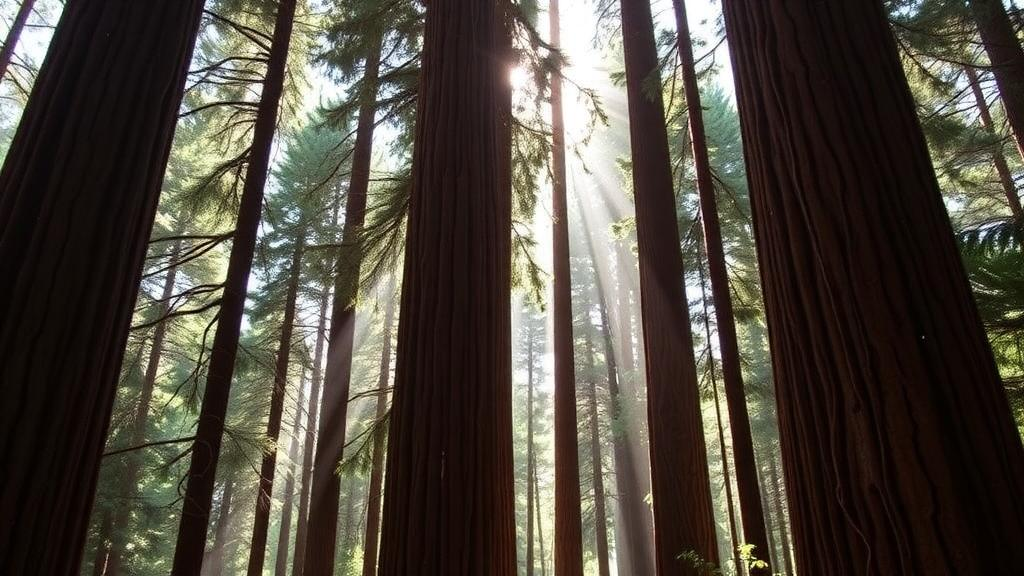
California’s coast redwoods have spent millions of years perfecting life in a narrow climatic comfort zone. The tallest trees on Earth thrive in the cool, fog-bathed corridors of the state’s coastline, where average annual temperatures hover around 59 degrees Fahrenheit. But a new study from the University of California, Davis, suggests that as heatwaves push temperatures past 100 degrees and average yearly warmth continues to climb, these giants respond by throttling back the very process that sustains them: photosynthesis. The research, published in JGR Biogeosciences, is the first to examine directly how heat affects photosynthesis in Sequoia sempervirens, and its findings raise pointed questions about the future of redwood forests across the warmer edges of their range.
Photosynthesis is often described as a tree’s way of eating, and the analogy is more apt than it might first appear. Through this chemical reaction, leaves capture sunlight and use its energy to combine water drawn from the soil with carbon dioxide absorbed from the air, manufacturing the carbon-based sugars that fuel growth, repair, and every other essential function of a tree’s life. When heat stress interferes with that reaction, the consequences ripple through the entire organism. Slower photosynthesis means less carbon captured, less energy for building wood and roots, and reduced capacity to withstand drought, disease, and fire. Lead author Lily Klinek, a Ph.D. candidate in the Plant Optics Lab of the UC Davis Department of Plant Sciences, describes the effect as though the trees simultaneously slow their breathing and, as a result, their eating.
The study’s evidence comes from three summers of field measurements in a redwood forest in Mendocino County, a location within the heart of the species’ range. The research team, which included scientists from UC Davis, Columbia University, The Conservation Fund, and Northern Arizona University, combined field observations with controlled laboratory experiments to isolate the effects of temperature from other environmental variables. During the summers of 2022 and 2024, air temperatures in the study forest climbed above 86 degrees Fahrenheit, and when they did, the researchers recorded something striking: the temperatures of some individual leaves ran nearly 20 degrees Fahrenheit hotter than the surrounding air.
That gap between air temperature and leaf temperature is a diagnostic signal that something has gone wrong with the tree’s cooling machinery. Under normal circumstances, trees regulate their temperature through evapotranspiration, a process Klinek compares to human sweating. Stomata, the microscopic mouth-like pores that dot the surface of every leaf, open to draw in carbon dioxide for photosynthesis. As a side effect of being open, they release water vapor, and the evaporation of that moisture carries heat away from the leaf, cooling it much the way perspiration cools skin. It is an elegant system, but it depends on a steady supply of water and on atmospheric conditions that allow that water to evaporate.
Heatwaves undermine the system at both ends. High temperatures burn off the coastal fog that redwoods depend on for a substantial share of their water, drying the environment precisely when the trees need moisture most. And when water is scarce, closing the stomata is the only way a leaf can avoid losing precious water and overheating. The huge gap Klinek’s team measured between air and leaf temperatures indicated that the leaves likely had shut their pores to conserve water, sacrificing their cooling mechanism in the process, and had overheated as a result. A leaf that cannot cool down is a leaf under duress, and the biochemistry of photosynthesis is famously sensitive to temperature.
The laboratory experiments sharpened the picture in a way field observations alone could not. The researchers placed leaf samples in jars of water, guaranteeing the foliage unlimited access to moisture so the leaves could transpire freely, keeping their stomata open and sweating to their full capacity. Even under these idealized conditions, photosynthesis declined as temperatures rose, with tests conducted at temperatures reaching up to 110 degrees Fahrenheit. The reduction occurred even while the leaves were taking in plenty of carbon dioxide, which means the impairment was not simply a matter of closed pores starving the leaves of raw material. Heat itself appeared to interfere with the photosynthetic apparatus, a phenomenon the study’s published title describes as downregulation of photochemistry.
This distinction matters for anyone trying to forecast the fate of redwood forests. If heat damage occurred only when trees closed their stomata to save water, then well-watered trees, or trees in irrigated or unusually moist sites, might be spared. The lab results suggest otherwise. As Klinek put it, even if the redwood trees have more water to sweat with, the heat might still impair their breathing and functioning. In other words, drought and heat stress compound each other in the field, but heat alone is sufficient to degrade the photosynthetic performance of these trees. That finding complicates simple assumptions that fog subsidies or deep soil moisture can fully buffer redwoods against warming.
The geographic implications are uneven. Coast redwoods occupy a long, narrow band along the California and southern Oregon coast, and their southern, central, and eastern populations already live at the warmer, drier margins of what the species can tolerate. It is in those already vulnerable habitats that the study’s alarm rings loudest. Trees at the edge of the range experience more frequent exceedance of the temperature thresholds at which photosynthesis begins to falter, and they have less climatic buffer in reserve. If warming continues, the zones suitable for vigorous redwood growth may contract or shift, with consequences for the extraordinary carbon stores, biodiversity, and cultural values these forests embody.
One of the most sobering takeaways from the research is how much remains unknown. Klinek notes that scientists do not yet know what the upper temperature thresholds are for redwood photosynthesis and mortality. The current study establishes that heat has a significant impact on photosynthesis and physiology, which she describes as an important start for figuring out which parts of the redwood range are at risk, knowing what to expect, and trying to intervene for the health of redwood ecosystems. Establishing those lethal or sublethal temperature limits will require further work, but the present findings give conservationists and land managers a concrete physiological variable to monitor: the efficiency of photosynthetic chemistry under heat, not merely tree survival or growth rings.
The research was funded by the National Science Foundation and California Forestry and Fire Protection, and it was conducted in cooperation with The Conservation Fund, whose lands provided the field site. Beyond its immediate relevance to redwoods, the study contributes to a broader scientific effort to understand how the world’s great forests will behave as heatwaves intensify. For a species that can live more than two thousand years and rise more than 350 feet, the pace of contemporary climate change presents a challenge no evolutionary history has prepared it for. The image of a redwood quietly closing its stomata and slowing its eating on a scorching afternoon is a small thing, but multiplied across entire forests, it is a signal that even the most iconic and seemingly indestructible organisms on the planet are already adjusting their fundamental biology to a warming world.
Subject of Research: Heat stress effects on photosynthesis in coast redwoods
Article Title: Coast redwoods slow their ‘breathing’ and ‘eating’ when temperatures spike
Article References: Coast redwoods slow their ‘breathing’ and ‘eating’ when temperatures spike. (n.d.). Original publication
Image Credits: AI Generated
DOI: Not provided
Keywords: coast redwoods, photosynthesis, heat stress, stomata, evapotranspiration, climate change, JGR Biogeosciences, UC Davis, Mendocino County, forest ecology, plant physiology, coastal fog
Cite Scienmag News
Gavin Prescott. (October 2, 2026). Heat Stress Forces Coast Redwoods to Slow Photosynthesis, Study Finds. Scienmag. https://scienmag.com/heat-stress-forces-coast-redwoods-to-slow-photosynthesis-study-finds/
Gavin Prescott. "Heat Stress Forces Coast Redwoods to Slow Photosynthesis, Study Finds." Scienmag, 2 October 2026, https://scienmag.com/heat-stress-forces-coast-redwoods-to-slow-photosynthesis-study-finds/. Accessed 2 October 2026.
Gavin Prescott. "Heat Stress Forces Coast Redwoods to Slow Photosynthesis, Study Finds." Scienmag. October 2, 2026. https://scienmag.com/heat-stress-forces-coast-redwoods-to-slow-photosynthesis-study-finds/


