


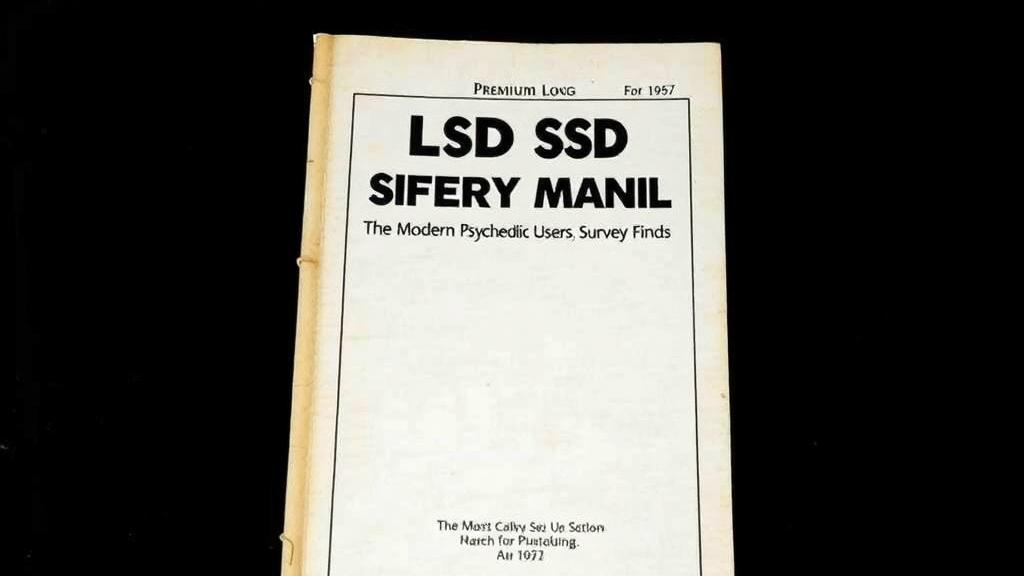
More than half a century before psychedelic-assisted therapy became one of the most closely watched frontiers in psychiatry, a largely forgotten Radcliffe College graduate was quietly writing the first practical safety manual for people taking LSD. Lisa Bieberman, once a follower of the Harvard psychologist and countercultural icon Timothy Leary, published a one-dollar pamphlet in February 1967 titled “Session Games People Play: A Manual for the Use of LSD.” Today, as hundreds of clinical trials test psychedelics for severe post-traumatic stress disorder, depression and even excruciating headaches, a new survey suggests that her advice has aged remarkably well: nearly 600 self-identified psychedelic users endorsed 18 of the 19 recommendations she laid out for safe and meaningful experiences.
The study, led by Daniel Kruger, research associate professor in the School of Public Health and Health Professions at the University at Buffalo, together with Paul Gillis-Smith, program lead at the Center for the Study of World Religious Studies at Harvard Divinity School, was published in the journal Psychedelics. Additional co-authors are affiliated with the Michigan Psychedelic Center at the University of Michigan, Blue Sage Health Consulting in Ann Arbor, the Michigan Psychedelic Society and the Radical Well-Being Center in Southfield, Michigan. The research team set out to test whether a document written in the early days of the psychedelic counterculture could still speak to a generation of users who, in many cases, are experimenting far outside any clinical or regulated setting.
Bieberman’s pamphlet stood apart from the era’s more flamboyant psychedelic rhetoric. While Leary urged a generation to “turn on, tune in, and drop out” and spoke in esoteric terms such as “surrender to the void,” Bieberman focused on something far more mundane and, arguably, more enduring: how to keep a psychedelic session from going badly wrong. She established the Psychedelic Information Center in Cambridge, Massachusetts, and used the pamphlet to offer best practices for all types of psychedelics, with particular attention to first-time users. She also addressed what might go wrong during an LSD or psilocybin mushroom trip, cataloguing the psychological traps that can turn an evening of exploration into a frightening ordeal.
Among her warnings were several that will sound familiar to anyone versed in modern harm reduction. Kruger notes that Bieberman highlighted a number of “games” that may be better avoided during an LSD session, such as running away from one’s companions or becoming convinced that one has unlocked the deepest truths of the universe and must immediately tell the world about them. She recommended that users stay with people they like and trust, avoid going out in public, and clear their minds of negative emotions before beginning. When Kruger first encountered these pragmatic teachings, he wanted to know whether they would hold up today, a timely question given that psychedelic use now exceeds what was seen during the countercultural 1960s.
To find out, the researchers surveyed almost 600 self-identified psychedelic users, recruited through online advertisements and in-person outreach at a psychedelic advocacy event in Ann Arbor, Michigan. The anonymous respondents reported using LSD and psilocybin mushrooms, mescaline, ayahuasca, ketamine and MDMA, also known as ecstasy or molly, primarily within the previous year. They ranged in age from 18 to 85, with an average age of 43, and some identified as psychedelic guides or educators. The breadth of the sample matters, because it captures not only casual experimenters but also people who occupy informal teaching and facilitation roles within a growing community that operates largely beyond the reach of formal medicine.
The results were striking in their consistency. On preparation, the majority of respondents agreed with Bieberman’s statements that one should “be with people who know, like, and trust each other” and “be aware that, even with a guide, you have to do most of the work yourself.” For overall advice, the strongest agreement went to two statements that speak to the emotional arc of a psychedelic experience: “Recognize that the experience will eventually end,” and “Recognize that you may experience anxiety, which does not mean that something is wrong.” Kruger says participants strongly endorsed advice emphasizing interpersonal trust, personal responsibility and psychological preparation, principles that are thought to be foundations of safe and meaningful psychedelic experiences in clinical research.
Not every recommendation found universal favor. Participants neither uniformly agreed nor disagreed with Bieberman’s advice to avoid looking in the mirror during a psychedelic trip, an experience that over the decades has proven frightening for some users. That single point of ambivalence, out of nineteen, underscores how closely the rest of her guidance tracks with contemporary expectations. It also hints at the ways subjective culture around psychedelics has shifted: what was a widely shared caution in 1967 is now a matter of individual preference, while her core counsel about companions, setting and mindset remains close to consensus.
The renewed interest in Bieberman’s work arrives at a moment of extraordinary momentum for psychedelic science. Kruger points out that these drugs are gaining new traction through hundreds of clinical trials and through legal pathways in states such as Oregon and Colorado. The idea, he explains, is to medicalize psychedelics for psychiatric conditions such as severe PTSD and depression, a field he describes as overdue for innovation. There really has not been any big innovation in mental health medications since the selective serotonin reuptake inhibitors were introduced in the 1980s, he notes, and those drugs do not work as well as originally thought. Psychedelics have even been explored for physical conditions such as cluster headaches, which are so painful that some sufferers have reported suicidal ideation.
The clinical evidence emerging from this wave of research is encouraging, according to Kruger. Trials show people are getting better across a range of conditions, and some participants report finding more meaning in life, having greater spiritual connections and improving their relationships. Yet he cautions that while these trials may offer promise to millions, the majority of people experimenting with psychedelics today are doing so outside of any regulated context and with little prevention education. As a public health professional, he argues, the priority is to protect these users. When Bieberman’s pamphlet was published, there were few resources for novice users, and although the term “harm reduction” was still decades from entering the vernacular of drug education and safety, Kruger and his colleagues propose that “Session Games” and Bieberman’s larger body of work are precursors to that approach.
History gives the argument additional weight. Psychedelics were considered a promising therapeutic tool in the mid-20th century, when they were used to treat conditions including neurosis and schizophrenia, alongside general psychotherapy. By the late 1960s, however, the drugs became criminalized and psychedelic therapy waned, leaving a gap of roughly five decades during which informal guides, pamphlets and word-of-mouth wisdom filled the void left by formal medicine. Bieberman’s manual is a surviving artifact from that gap, and the new survey suggests its practical wisdom survived alongside it.
The regulatory landscape is now shifting again. While classic psychedelic drugs remain illegal in the United States at the federal level, Colorado and Oregon have established state-regulated frameworks for supervised therapeutic use, and Kruger predicts that New Mexico is not far behind. He expects more psychedelics-based medications to enter the marketplace in the not-too-distant future, and he frames the challenge in vivid terms: it is a freight train coming down the tracks, he says, so society had better build a train station to safely load passengers on board, or else they will simply try to jump on while the train is moving. In other words, the demand is arriving whether or not the infrastructure exists to meet it safely.
That is where a 59-year-old pamphlet becomes unexpectedly relevant. Bieberman’s guidance anticipated many of the principles now embedded in clinical protocols: screened and trusted companions, careful psychological preparation, an acceptance that difficult emotions may arise without signaling catastrophe, and the reminder that even the most intense experience is temporary. The fact that modern users, surveyed anonymously across a wide age range, endorse nearly all of it suggests that harm reduction for psychedelics is less a novel invention than a rediscovered discipline. For Kruger and his collaborators, the lesson is that public health efforts aimed at recreational and unregulated users need not start from scratch. The tools were drafted decades ago, in a one-dollar Cambridge pamphlet, by a woman history nearly overlooked, and the people most likely to benefit from them appear ready to listen.
Researchers hope the findings will encourage both clinicians and community educators to draw on historical resources as psychedelic use continues to expand. Kruger notes that the 2026 Psychedelic Community Survey is now available for anyone to take, regardless of whether they have experienced psychedelics, with all answers anonymous. He recommends that participants complete the survey on a private computer or device in a private location. As the science advances and legal frameworks multiply, the study stands as a reminder that the conversation about how to use psychedelics safely began long before the current renaissance, and that some of its earliest voices still have something to teach.
Subject of Research: Contemporary agreement with 1967 psychedelic harm reduction advice from Lisa Bieberman's LSD manual
Article Title: Study: Obscure 1967 guide for LSD use still relevant as psychedelics gain in popularity
Article References: Study: Obscure 1967 guide for LSD use still relevant as psychedelics gain in popularity. (n.d.). Original publication
Image Credits: AI Generated
DOI: Not provided
Keywords: psychedelics, LSD, harm reduction, Lisa Bieberman, Timothy Leary, psilocybin, psychedelic-assisted therapy, PTSD, depression, public health, University at Buffalo, survey research
Cite Scienmag News
Courtney Benton. (October 2, 2026). A 1967 LSD Safety Manual Wins Over Modern Psychedelic Users, Survey Finds. Scienmag. https://scienmag.com/a-1967-lsd-safety-manual-wins-over-modern-psychedelic-users-survey-finds/
Courtney Benton. "A 1967 LSD Safety Manual Wins Over Modern Psychedelic Users, Survey Finds." Scienmag, 2 October 2026, https://scienmag.com/a-1967-lsd-safety-manual-wins-over-modern-psychedelic-users-survey-finds/. Accessed 2 October 2026.
Courtney Benton. "A 1967 LSD Safety Manual Wins Over Modern Psychedelic Users, Survey Finds." Scienmag. October 2, 2026. https://scienmag.com/a-1967-lsd-safety-manual-wins-over-modern-psychedelic-users-survey-finds/


