


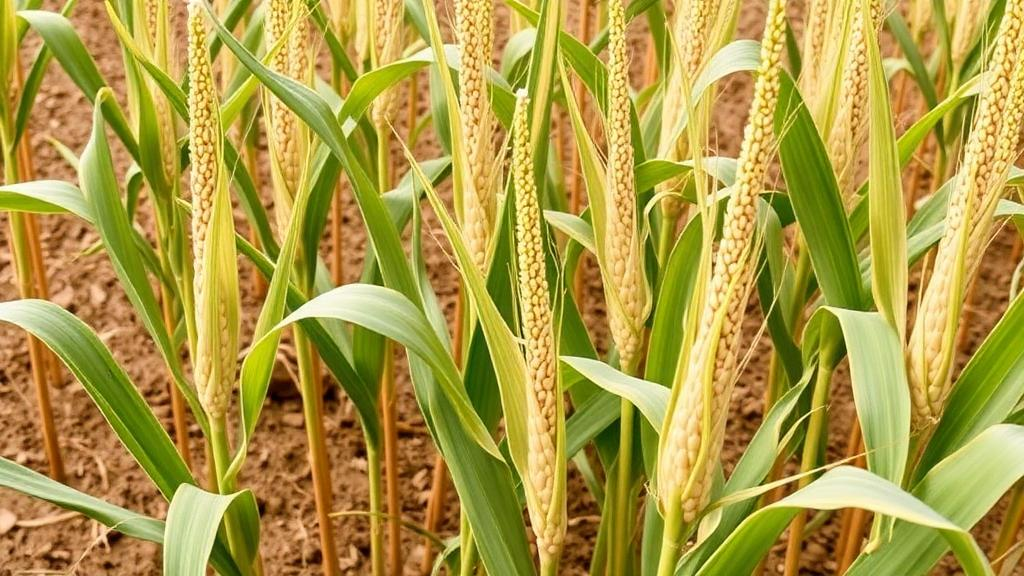
Drought is the single most punishing force acting on global maize production, and nowhere is that pressure more acute than in the arid expanses of Northwest China, where erratic rainfall and evaporative demand can strip a season’s harvest in a matter of weeks. Now, a team of researchers from the Xinjiang Academy of Agricultural Sciences and Northwest A&F University has mapped the genetic architecture of drought tolerance in maize with unprecedented regional specificity, identifying more than 150 genetic variants tied to the traits that decide whether a plant lives, withers, or feeds people. The study, published in BMC Genomics, combines two years of field trials with a genome-wide association analysis of more than 42,000 single-nucleotide polymorphisms, and it delivers something breeders have long needed: a shortlist of genes and DNA markers that can be used to build maize varieties that yield well even when water runs short.
The research began with a deceptively simple question. When water becomes scarce, which measurable characteristics of a maize plant change, and which stretches of DNA govern that change? To answer it, the team assembled a panel of 202 maize inbred lines, the genetically uniform breeding stocks that underpin hybrid maize development. These lines were grown under two contrasting regimes: well-watered conditions, in which irrigation kept plants hydrated throughout the season, and drought stress conditions, in which water was withheld to mimic the deficits that routinely strike the region. The trials ran across two years, an essential design feature because it allowed the researchers to separate genuine genetic effects from the noise of weather, soil, and chance.
Three traits took center stage. The first was plant height, a proxy for overall vegetative vigor under stress. The second was the anthesis-silking interval, the gap in days between the emergence of male flowers and the emergence of the silk threads that catch pollen to form kernels. This interval is one of the most sensitive barometers of drought in maize: when water is scarce, silking is delayed, the interval widens, pollen and silks fall out of sync, and kernels fail to set. The third and most consequential trait was grain yield itself, the ultimate measure of a crop’s value. Alongside the raw measurements, the team calculated a drought resistance index for each trait, a ratio that captures how well a given line maintains its performance under stress relative to its own potential under ample water.
The field data told a familiar but sobering story. Drought stress reduced plant height and slashed grain yield, while stretching the anthesis-silking interval, confirming that reproductive timing is among the first casualties of water deficit. But the variation among the 202 lines was striking. Some lines collapsed under drought, while others held their yield remarkably steady. That variation is the raw material of breeding, and it is precisely what a genome-wide association study is designed to dissect. The researchers genotyped every line at 42,410 single-nucleotide polymorphisms, positions in the genome where a single DNA letter differs among individuals, and then searched for variants whose presence consistently tracked with drought performance.
The statistical engine behind the search was a mixed linear model, an approach that accounts for two confounding forces that can otherwise produce false leads. The first is population structure, the tendency of related maize lines to cluster into genetic families that may share traits for reasons unrelated to the genes under scrutiny. The second is kinship, the pairwise genetic relatedness among all lines in the panel. By modeling both simultaneously, the analysis isolates the true association signal from the echo of ancestry. The result was a set of 158 nonredundant significant SNPs, meaning variants that remained robust after removing redundant signals arising from linked stretches of DNA. Crucially, 12 of these loci were detected repeatedly across different datasets and years, the kind of replication that gives breeders confidence a marker is real rather than a statistical fluke.
The most actionable finding concerned the drought resistance index for grain yield. Thirty-six SNPs were associated with this index, and six of them were also significantly associated with grain yield under drought stress in the 2023 trial season. This overlap matters because it points to variants that do not merely correlate with an abstract index but with the concrete outcome farmers care about: kilograms of grain harvested from a parched field. When the researchers integrated the favorable-allele profiles with the drought resistance index, a clear pattern emerged. Lines with higher drought resistance values generally carried more of the favorable alleles, suggesting that tolerance is built up incrementally from many small genetic contributions rather than from a single master switch.
Within the genomic neighborhoods of the SNPs carrying favorable alleles for drought resistance of grain yield, the team identified 142 candidate genes. These are genes whose proximity to an associated variant, combined with their known or predicted functions, makes them plausible drivers of the observed tolerance. Among them was a gene with the catalog name Zm00001d026018, which encodes a protein called ZmCPK4, a calcium-dependent protein kinase. These enzymes sit at the crossroads of cellular signaling: when a plant senses drought, calcium ion concentrations inside its cells fluctuate, and calcium-dependent protein kinases decode those fluctuations into downstream responses, including adjustments to stomatal behavior, stress hormone signaling, and protective metabolism.
To test whether ZmCPK4 genuinely contributes to drought tolerance rather than merely sitting near a relevant variant, the researchers turned to a classic functional validation strategy. They overexpressed the maize gene in Arabidopsis, a small mustard plant that serves as the workhorse of plant molecular biology, and observed what happened when the engineered plants faced water stress. The result was unambiguous: heterologous overexpression of ZmCPK4 enhanced drought tolerance in Arabidopsis. This kind of cross-species evidence is a critical step beyond correlation. It demonstrates that the gene’s activity can actively confer stress resilience, elevating ZmCPK4 from a statistical hit to a credible target for functional study and, eventually, breeding manipulation.
The broader significance of the work lies in how it converts a messy, multigenic trait into a set of tools. Drought tolerance in maize is a quantitative trait, shaped by many genes of modest effect interacting with the environment, which is why decades of conventional breeding have delivered progress slowly. The SNP markers identified here, particularly the 12 repeatedly detected loci and the 36 variants tied to the drought resistance index for grain yield, can be deployed in marker-assisted selection. In that approach, breeders screen seedlings for favorable DNA variants instead of waiting years to observe field performance, dramatically accelerating the pyramiding of tolerance alleles into elite lines. The finding that favorable alleles accumulate in proportion to drought resistance also suggests a practical scoring system: breeders could tally favorable variants across a candidate line’s genome to predict its tolerance before it ever enters a drought-prone field.
The study also carries a message about where the next generation of climate-resilient crops will come from. The 202 inbred lines analyzed here represent locally adapted germplasm from one of the harshest maize-growing environments on Earth, a living archive of alleles that natural and human selection have tuned to scarce water. As heat waves intensify and irrigation resources tighten across the world’s semi-arid breadbaskets, mining such regional diversity for tolerance genes becomes not just useful but urgent. The candidate genes identified, from signaling kinases like ZmCPK4 to the wider network of 142 genes awaiting functional validation, provide the genomic scaffolding for that effort. The path from a significant SNP in a Beijing or Urumqi dataset to a drought-proof hybrid in a farmer’s field is long, but this study has laid out the map, and the first experimental proof that at least one of its markers leads somewhere real has already been delivered.
Subject of Research: Genome-wide association analysis of drought resistance and yield-related traits in maize inbred lines from Northwest China
Article Title: Genome-wide association analysis of drought resistance and yield-related traits in maize inbred lines in Northwest China
Article References: Liu, Y., Wang, Y., Dong, Y., Abula, A., Qin, T., Han, D., Lv, Y., Zhang, X., Muheyati, A., Yang, J., & Yang, Q. (2026). Genome-wide association analysis of drought resistance and yield-related traits in maize inbred lines in Northwest China. BMC Genomics. https://doi.org/10.1186/s12864-026-13428-w
Image Credits: AI Generated
DOI: 10.1186/s12864-026-13428-w
Keywords: maize, drought tolerance, GWAS, single-nucleotide polymorphisms, grain yield, drought resistance index, candidate genes, ZmCPK4, marker-assisted selection, plant genetics, Northwest China, abscisic acid
Cite Scienmag News
Juliet Wilcox. (October 2, 2026). Scientists Track Down the Genes That Let Maize Survive Drought in China’s Arid Northwest. Scienmag. https://scienmag.com/scientists-track-down-the-genes-that-let-maize-survive-drought-in-chinas-arid-northwest/
Juliet Wilcox. "Scientists Track Down the Genes That Let Maize Survive Drought in China’s Arid Northwest." Scienmag, 2 October 2026, https://scienmag.com/scientists-track-down-the-genes-that-let-maize-survive-drought-in-chinas-arid-northwest/. Accessed 2 October 2026.
Juliet Wilcox. "Scientists Track Down the Genes That Let Maize Survive Drought in China’s Arid Northwest." Scienmag. October 2, 2026. https://scienmag.com/scientists-track-down-the-genes-that-let-maize-survive-drought-in-chinas-arid-northwest/


