


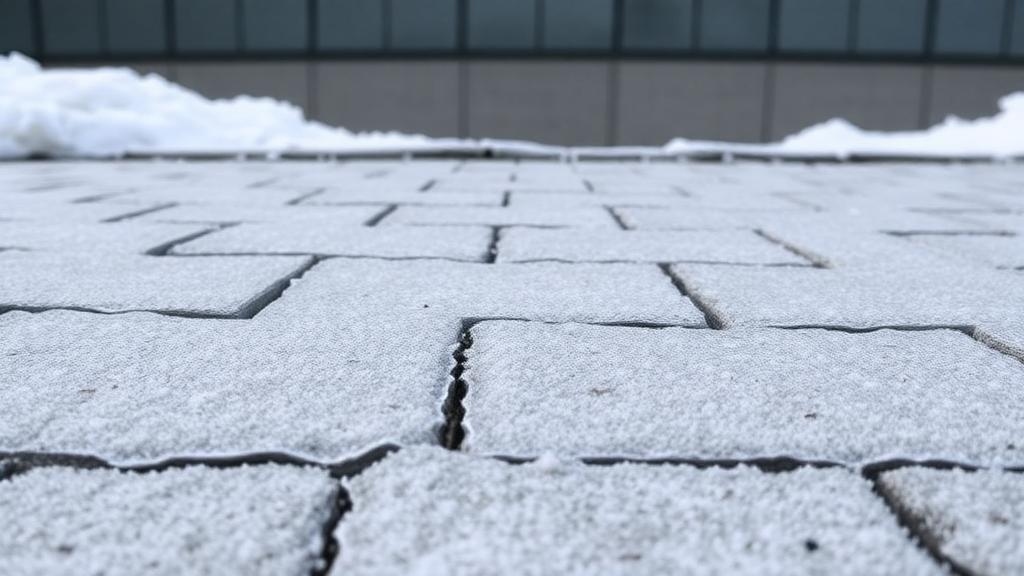
Every winter, the permeable pavements that soak up stormwater in sponge cities face an invisible enemy. Water slips into their deliberately porous skeletons, freezes, expands by roughly nine percent, and then thaws away, leaving behind microscopic scars that accumulate cycle after cycle. For macroporous recycled concrete, a sustainable material built from crushed demolition waste, this freeze–thaw assault is particularly punishing, because its 20 to 30 percent designed porosity gives water easy access to every paste bridge and aggregate interface. A new study published in Case Studies in Construction Materials has now traced, particle by particle, exactly how this damage unfolds inside the material, and the results overturn a long-standing assumption about what makes damaged concrete look deceptively uniform.
The research team, led by Hangli Yang and Haoxiang Luan with colleagues including Fei Geng, Yupeng Xu, Hongke Zheng, and Jianguang Xie, built a three-dimensional discrete element model, or DEM, of macroporous recycled concrete and constrained it with an unusually rich set of laboratory measurements. Unlike continuum models that treat concrete as a smeared material, DEM represents the structure as thousands of individual particles connected by bonds that can stretch, shear, and snap. That makes it possible to watch the internal load-bearing network, known as force chains, reorganize as frost damage accumulates. Because no existing simulation platform can directly solve heat transfer, ice–water phase change, and moisture migration together, the team used an experimentally calibrated equivalent-damage approach, updating contact stiffness and bond strengths cycle by cycle rather than applying a single blanket reduction.
The experimental foundation came from the group’s earlier tests on three concrete mixes, labeled M1–20%, M2–25%, and M5–30%, where the numbers denote paste type and designed porosity. The recycled coarse aggregate, crushed from demolished concrete with particles between 9.5 and 37.5 millimeters, consisted of a natural stone core wrapped in a layer of old cement paste covering 23.1 percent of its surface. The researchers measured an impressive array of properties at different numbers of freeze–thaw cycles: compressive, splitting tensile, and shear strengths of the new paste; nanoindentation elastic moduli of the paste, the old paste, and their interfaces with natural aggregate; the rate at which old paste detached from recycled aggregate; and the mass change, strength, and elastic modulus of full specimens.
One of the most striking findings emerged immediately. The specimens did not simply decay monotonically. Instead, their mass and elastic modulus both rose during the first 40 cycles before declining. The explanation lies in a chemical race: water entering the connected pores promoted continued hydration of residual unhydrated cement, and the additional hydration products partially filled small pores, stiffening the paste and its interfaces faster than early frost microdamage could soften them. Only after about 40 cycles did accumulated microcracking, interfacial debonding, and surface spalling win out, sending stiffness into a steep decline. Freeze–thaw deterioration, the study shows, is a staged process of competing mechanisms rather than a steady slide.
To capture the geometric side of damage, the team converted measured mass loss into a count of lost surface paste particles. Because spalling occurred mainly in new-paste bridge regions rather than in aggregate cores, the net solid mass loss could be mapped onto removal of surface paste elements from the model. The algorithm allowed only particles on the current external surface, identified by a bond coordination number below six, to be deleted, so erosion progressed gradually inward without creating nonphysical internal voids. By 160 cycles, the models had shed 817 particles for the densest mix and up to 1,775 for the most porous one, each removal representing a real loss of load-bearing contact.
Validation against compression tests was convincing. Mean errors in peak stress across all groups and cycle counts ranged from 5.2 to 6.0 percent, while peak-strain errors stayed between 12.0 and 15.5 percent. The simulated elastic moduli, though noisier with errors of 10.8 to 18.1 percent, reproduced the characteristic rise-and-fall trend, and a new porosity-controlled prediction equation for post-freeze–thaw elastic modulus achieved a mean calculation error of just 7.6 percent. After 160 cycles, the peak-stress losses reached 38.3 percent for M2–25%, 35.8 percent for M5–30%, and 32.6 percent for M1–20%, matching the laboratory ordering and confirming that freeze–thaw resistance is governed jointly by porosity and the quality of the paste and its interfaces.
The deepest insight came from tracking force chains, the quasi-linear chains of highly stressed contacts that carry most of the load through granular skeletons. In undamaged and early-cycle specimens, load flowed through a few dominant strong chains concentrated in the specimen center and along inclined diagonal paths, producing the classic X-shaped shear failure. The coefficient of variation of force-chain intensity peaked at 1.847 at 40 cycles, when stress concentration was greatest. As cycling continued, however, the degradation of paste-related interfaces and the loss of surface particles progressively severed these dominant chains, forcing load to redistribute from a few high-capacity paths to many dispersed low-capacity ones. The coefficient of variation fell to 1.609 by 160 cycles.
That decline might superficially look like homogenization, as if the material were becoming more uniform and therefore tougher. The researchers show it is anything but. They call the phenomenon damage-induced pseudo-homogenization: the apparent evening-out of the force-chain distribution arises purely because the strongest load paths have failed, at the very moment peak stress and elastic modulus continue to fall. Simultaneously, the proportion of tensile bond failures grew, rising by 4.3 to 6.3 percent across the groups after 160 cycles, and the macroscopic failure mode shifted from X-shaped shear to longitudinal splitting as cracks found weakened interfaces and coalesced parallel to the loading direction. The toughness index dropped by up to 33.1 percent in the most porous mix, meaning the extra deformation capacity reflected damage, not ductility.
The bond-failure statistics also pinpointed the material’s Achilles’ heel. Across all freeze–thaw states, the failure rate ordering never changed: the interfaces between new and old paste, and between new paste and natural aggregate, failed most often, followed by paste-to-paste bonds, with old-paste-related bonds failing least. After 160 cycles, the fastest-growing failure rates belonged precisely to those new-paste interfaces, identifying them as the weak zones through which frost damage first develops and then transfers into the load-bearing skeleton. Notably, the tensile-failure proportion began climbing after 120 cycles for the densest mix but after only 40 cycles for the most porous one, showing how higher porosity concentrates stress and accelerates the onset of terminal damage.
Beyond its scientific contribution, the work carries practical weight for cold-region infrastructure. Permeable pavements, municipal and airport drainage bases, and sponge-city surfaces built with recycled aggregate can now be evaluated with a model that distinguishes which phases and interfaces are degrading, rather than relying on bulk indicators like mass loss or dynamic modulus that blur the picture. The authors suggest their framework can guide material selection, pore-structure design, durability assessment, and maintenance planning. The study’s validation remains an internal consistency check within a single material system, so independent confirmation on other mixes and laboratories will be the next step. But the central message stands: when ice attacks porous recycled concrete, the most dangerous change is not the damage you can weigh, but the silent rewiring of the force chains that hold the pavement together.
Subject of Research: Mesoscopic discrete element modeling of freeze–thaw deterioration mechanisms in macroporous recycled concrete
Article Title: Mesoscopic DEM study of freeze–thaw deterioration in macroporous recycled concrete: Interfacial damage, particle spalling, and force-chain reconstruction
Article References: Mesoscopic DEM study of freeze–thaw deterioration in macroporous recycled concrete: Interfacial damage, particle spalling, and force-chain reconstruction. (n.d.). https://doi.org/10.1016/j.cscm.2026.e06561
Image Credits: AI Generated
DOI: 10.1016/j.cscm.2026.e06561
Keywords: macroporous recycled concrete, freeze–thaw cycles, discrete element method, force chains, interfacial transition zone, recycled aggregate, surface spalling, pseudo-homogenization, permeable pavement, sponge city, elastic modulus, bond failure
Cite Scienmag News
Denise Maddox. (October 2, 2026). Inside Freezing Concrete: Simulations Reveal How Ice Quietly Rewires Porous Recycled Pavements. Scienmag. https://scienmag.com/inside-freezing-concrete-simulations-reveal-how-ice-quietly-rewires-porous-recycled-pavements/
Denise Maddox. "Inside Freezing Concrete: Simulations Reveal How Ice Quietly Rewires Porous Recycled Pavements." Scienmag, 2 October 2026, https://scienmag.com/inside-freezing-concrete-simulations-reveal-how-ice-quietly-rewires-porous-recycled-pavements/. Accessed 2 October 2026.
Denise Maddox. "Inside Freezing Concrete: Simulations Reveal How Ice Quietly Rewires Porous Recycled Pavements." Scienmag. October 2, 2026. https://scienmag.com/inside-freezing-concrete-simulations-reveal-how-ice-quietly-rewires-porous-recycled-pavements/


