


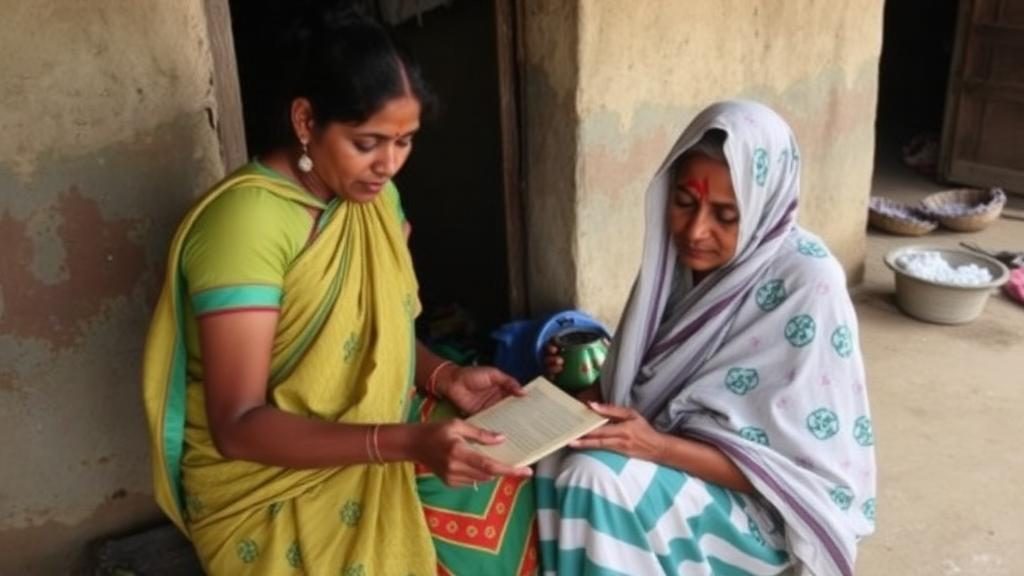
When a family in Bangladesh borrows money to start a small business, the assumption is that the loan will lift them toward economic stability. But a new study suggests that a single medical emergency can quietly undo that progress. Researchers examining microcredit recipient households during the COVID-19 pandemic found that out-of-pocket healthcare spending significantly crowded out essential household consumption, diverting money away from food, education, clothing, and transportation. The findings, published in Discover Social Science and Health, reveal a hidden mechanism by which health shocks erode the intended benefits of microfinance, even among borrowers who appear relatively well-off.
The research team, led by Ruhul Amin of the Bangladesh Institute of Governance and Management together with colleagues at Bangladesh University of Professionals, drew on cross-sectional data from a quasi-experimental project evaluating the fiscal stimulus packages disbursed by the Government of Bangladesh during the pandemic. Between July and August 2023, the team surveyed 751 microcredit entrepreneurs who were beneficiaries of eight different microfinance organizations. The respondents included marginal people and women entrepreneurs, groups that policymakers often target with concessional lending precisely because they are considered economically vulnerable yet capable of productive self-employment.
The analytical framework centered on the crowding-out effect, a well-established concept in health economics. In households without insurance or public coverage, medical bills are paid directly from the family budget, a pattern known as out-of-pocket or OOP expenditure. Because household budgets are finite, every taka spent at the pharmacy or the private clinic is a taka not spent elsewhere. Economists describe this trade-off as crowding out: health spending displaces consumption of other goods and services. For households living near subsistence, the displaced items are rarely luxuries. They are food, school fees, clothing, footwear, and transport, the very components of a minimum standard of living.
The study stratified households into three income groups and examined how OOP health expenses affected both non-food consumption and durable goods purchases. The results were striking in their asymmetry. Across the full sample, out-of-pocket health spending significantly crowded out household non-food consumption. But the impact was greatest among high-income households within this microcredit population, a finding that runs counter to the intuitive expectation that wealthier borrowers would be buffered against medical bills. The researchers also found that OOP health expenses significantly affected durable consumption expenses, such as purchases of household assets, specifically among high-income households.
One possible interpretation is that higher-income microcredit households have more discretionary spending to displace, so their consumption patterns register the shock more visibly in survey data. Poorer households may already be consuming at a floor below which they cannot fall, absorbing health costs instead by borrowing, selling assets, or forgoing care altogether. The study adds weight to this concern with a second key result: outstanding loans were found to be higher as a consequence of OOP health expenses in the middle- and high-income groups. In other words, medical spending did not merely reduce consumption; it pushed households deeper into debt, compounding the financial obligations they had already taken on through microcredit.
This debt dynamic is particularly corrosive in the microcredit context. Microfinance is designed to channel small loans into productive activities, with repayment schedules calibrated to expected business income. When a health emergency forces a household to divert loan capital or business revenue into medical bills, the arithmetic of repayment breaks down. The borrower may then take additional loans, often from informal moneylenders at higher interest rates, to cover both the medical costs and the microfinance installments. The study’s finding that outstanding loans rise with OOP health expenses suggests precisely this spiral, in which health shocks convert productive debt into a burden that undermines the developmental purpose of the original loan.
The timing of the research amplifies its significance. The COVID-19 pandemic placed extraordinary strain on household finances in Bangladesh and across South Asia. Lockdowns disrupted the small trading, tailoring, poultry raising, and food vending businesses that microcredit borrowers typically operate, while the illness itself generated direct medical costs and indirect income losses. Government stimulus packages, including concessional credit lines channeled through microfinance institutions, were intended to cushion these shocks. Yet the new evidence indicates that for many recipient households, healthcare spending remained a competing claim on scarce resources, blunting the stimulus effect that the credit support was designed to achieve.
Methodologically, the study benefits from a targeted sampling frame and institutional grounding. The dataset originated in a research project on the efficacy of pandemic-era fiscal stimulus, funded by the Strengthening Public Financial Management Program of Bangladesh’s Finance Division, and was analyzed with ethical approval from the Bangladesh Institute of Governance and Management’s Institutional Review Board. By surveying verified beneficiaries of eight microfinance organizations and segmenting them by income, the researchers could compare crowding-out effects across the economic spectrum within a single, well-defined population of borrowers. This design isolates the financial behavior of households that share similar access to credit but differ in income, making the income-group contrasts more meaningful than they would be in a general population sample.
The policy implications reach beyond Bangladesh’s borders. Out-of-pocket spending accounts for a large share of total health expenditure in many low- and middle-income countries, and health economists have long warned that such financing systems expose households to catastrophic health expenditures. The new study extends this warning to households that are often assumed to be protected by access to credit. The authors argue that the financial vulnerability created by high OOP health expenses requires integrated health and financial policies rather than isolated interventions in either sector. Their recommendations include strengthening public health services so that borrowers are not forced into costly private care, introducing health insurance schemes tailored to microcredit recipients, implementing targeted subsidy programs for medical emergencies, leveraging technology for service delivery, and promoting financial literacy so households can plan for health shocks.
For the global development community, the message is sobering. Microcredit has been celebrated and criticized in roughly equal measure over the past four decades, but this study identifies a specific, measurable channel through which its benefits can evaporate: the household medical bill. If a loan intended for a sewing machine is consumed by a hospital stay, the borrower is left with debt but no productive asset, and the poverty-reduction logic of microfinance collapses. The researchers’ evidence that this dynamic operated even among relatively high-income borrowers during the pandemic suggests that health financing reform is not merely a complement to financial inclusion but a precondition for it. Without protection against health shocks, the study concludes, the intended impact of microcredit support will continue to be undermined by the quiet arithmetic of the family budget, in which every taka spent on illness is a taka taken from dinner tables, schoolbooks, and the small businesses that development programs are built to nurture.
Subject of Research: The crowding-out effect of out-of-pocket healthcare expenditure on household consumption among microcredit recipient households in Bangladesh during the COVID-19 pandemic
Article Title: Association of out of pocket healthcare expenditure with household consumption among marginal people and women entrepreneurs in Bangladesh during the COVID 19 pandemic
Article References: Amin, R., Farabi, M. N. S., Gayen, K., & Dey, S. R. (2026). Association of out of pocket healthcare expenditure with household consumption among marginal people and women entrepreneurs in Bangladesh during the COVID 19 pandemic. Discover Social Science and Health. https://doi.org/10.1007/s44155-026-00464-w
Image Credits: AI Generated
DOI: 10.1007/s44155-026-00464-w
Keywords: out-of-pocket expenditure, crowding-out effect, microcredit, household consumption, healthcare financing, Bangladesh, COVID-19, women entrepreneurs, health insurance, financial vulnerability, health economics, microfinance
Cite Scienmag News
Courtney Benton. (October 2, 2026). Health Bills Squeeze Microcredit Households in Bangladesh, Study Finds. Scienmag. https://scienmag.com/health-bills-squeeze-microcredit-households-in-bangladesh-study-finds/
Courtney Benton. "Health Bills Squeeze Microcredit Households in Bangladesh, Study Finds." Scienmag, 2 October 2026, https://scienmag.com/health-bills-squeeze-microcredit-households-in-bangladesh-study-finds/. Accessed 2 October 2026.
Courtney Benton. "Health Bills Squeeze Microcredit Households in Bangladesh, Study Finds." Scienmag. October 2, 2026. https://scienmag.com/health-bills-squeeze-microcredit-households-in-bangladesh-study-finds/


