


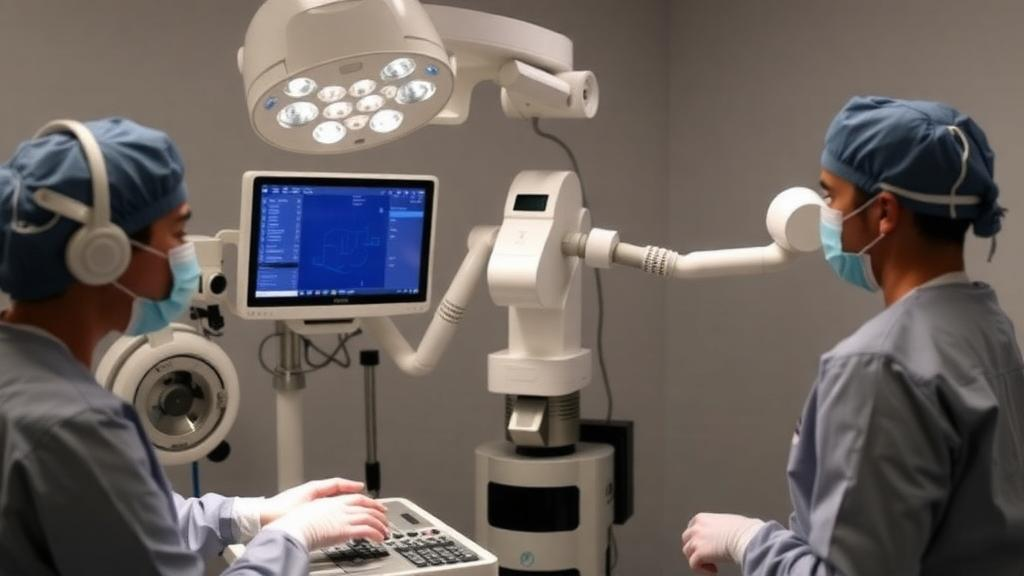
Robotic surgery has quietly transformed the modern operating room, but it has also created an uncomfortable paradox for surgical education. The very machines that give patients smaller incisions and faster recoveries can leave trainees watching from the periphery, their hands hovering over bedside instruments rather than resting on the console controls. A new qualitative study published in Global Surgical Education, the journal of the Association for Surgical Education, takes a close look at why attending surgeons hesitate to hand over the robotic console to general surgery residents, and whether a simple documentation tool called a robotic portfolio might change the calculus of trust.
The research team, led by Laura Washburn of the University of Pittsburgh Medical Center together with colleagues at the University of Pittsburgh School of Medicine and The Ohio State University Wexner Medical Center, interviewed thirteen faculty surgeons who regularly operate robotically alongside general surgery trainees. Using purposive sampling, the investigators deliberately recruited attending surgeons across different subspecialties and career stages, ensuring that the findings would not simply reflect the habits of one narrow surgical niche. The most common robotic case types represented in the faculty’s practices were hernia repairs, followed by colorectal and bariatric procedures, a mix that mirrors the bread-and-butter robotic workload at many academic centers.
The methodological approach was deliberately open-ended. Semi-structured interviews allowed the faculty to describe in their own words how they decide, case by case, whether a resident is ready to take the console. Transcripts were analyzed verbatim using inductive thematic analysis, the widely used qualitative technique associated with Braun and Clarke, in which themes emerge from the data rather than being imposed by a pre-existing framework. This matters because entrustment is not a purely technical judgment; it is a human decision shaped by experience, context, and intuition, and only an open-ended method can surface those subtleties.
What emerged was a striking metaphor borrowed from clinical medicine: entrustment as a kind of pre-test probability. Just as a clinician estimates the likelihood of disease before ordering a diagnostic test, attending surgeons described forming an internal estimate of a resident’s readiness before ever stepping into the operating room. Factors feeding that estimate include the trainee’s prior operative experiences, their reputation among colleagues, their demonstrated initiative, and the complexity and risk profile of the planned case. The higher this pre-test probability, the more willing the attending is to grant autonomy from the first port placement to the final closure.
But the pre-test probability is only the opening bid. The study found that faculty consistently insist on validating their initial estimate through direct observation before fully entrusting a resident with the robotic console. No matter how impressive a resident’s documented experience looks on paper, attendings want to see the trainee’s hands move, watch how they handle tissue, and gauge their responses to unexpected findings in real time. This validation step is a safeguard rooted in patient safety, and it explains why objective credentials alone rarely unlock autonomy; they open the door, but only demonstrated performance walks the trainee through it.
It is precisely at this juncture that the robotic portfolio enters the story. The researchers developed a sample resident portfolio containing objective details about the trainee’s robotic experiences, including case volumes, console time, and procedural roles. When faculty reviewed the portfolio during the interviews, they described it as genuinely informative, and several reported that it raised their pre-test probability of prospective entrustment. In practical terms, the portfolio functions like a well-documented history in clinical reasoning: it does not replace the diagnostic test of direct observation, but it meaningfully shifts the starting point, making attendings more inclined to plan for resident console time rather than default to supervision.
The robotic platform itself emerged as a double-edged sword in the entrustment equation. On the promoting side, faculty highlighted the dual console, which lets attending and trainee sit at linked stations and swap control of the instruments instantly, and telestration, the technique of drawing on the video feed to guide the trainee’s next move. These features create teaching moments that are difficult or impossible in traditional laparoscopy, where the attending and trainee share a single camera and awkward instrument exchanges. The dual console in particular lowers the perceived risk of granting autonomy, because the attending can reclaim control within a fraction of a second if the dissection strays into danger.
On the challenging side, the study participants emphasized that residents must adapt to the robotic console itself, learning to interpret tactile visual cues in an environment where their hands never touch tissue. The robotic system translates hand movements into scaled instrument motions and filters out natural tremor, but it also strips away the haptic feedback that open and laparoscopic surgeons rely on. Trainees must learn to read tissue resistance through visual deformation, instrument interaction, and subtle changes in the operative field. Faculty described this perceptual recalibration as a genuine learning curve, one that complicates simple judgments about how much console experience should translate into entrustment.
The implications reach well beyond the two academic centers studied. Robotic surgery training has documented barriers to resident console time, and prior work has shown that trainees often struggle with the transition from bedside assistant to console surgeon. The findings suggest that competency-based, rather than time-based, progression is achievable if programs give faculty better information about what each resident has actually done. A portfolio that aggregates console hours, completed procedures, simulator performance, and bedside roles could standardize the conversation between attending and trainee before the case begins, replacing vague impressions with shared data. At the same time, the study is a caution against treating any document as a substitute for observation; faculty in this research remained clear that validation at the console is non-negotiable.
For surgical educators, the roadmap is now more concrete. Programs adopting robotic portfolios should pair them with structured opportunities for direct observation, deliberate use of dual-console teaching, and telestration-based coaching tailored to the perceptual demands of the robotic environment. For residents, the message is that documented experience builds the attending’s pre-test probability, but earning full entrustment still requires demonstrating skill when the attending is watching. And for patients, the reassurance is that the system of graduated autonomy, with all its built-in skepticism, remains firmly anchored in safety. As robotic platforms proliferate across hospitals worldwide, understanding the psychology of surgical trust may prove as important as the technology itself, and this study offers one of the clearest portraits yet of how that trust is built, tested, and ultimately granted at the console.
Subject of Research: Faculty entrustment of general surgery residents in robotic surgery and the use of a resident robotic portfolio to support prospective entrustment decisions
Article Title: Entrustment of general surgery residents in robotic surgery and utility of a robotic portfolio to promote prospective entrustment
Article References: Entrustment of general surgery residents in robotic surgery and utility of a robotic portfolio to promote prospective entrustment. (n.d.). https://doi.org/10.1007/s44186-026-00555-x
Image Credits: AI Generated
DOI: 10.1007/s44186-026-00555-x
Keywords: robotic surgery, surgical education, resident autonomy, entrustment, general surgery residency, competency-based assessment, dual console, telestration, qualitative research, thematic analysis, surgical training, operative autonomy
Cite Scienmag News
Courtney Benton. (October 1, 2026). How Surgeons Decide to Trust Residents at the Robotic Console. Scienmag. https://scienmag.com/how-surgeons-decide-to-trust-residents-at-the-robotic-console/
Courtney Benton. "How Surgeons Decide to Trust Residents at the Robotic Console." Scienmag, 1 October 2026, https://scienmag.com/how-surgeons-decide-to-trust-residents-at-the-robotic-console/. Accessed 1 October 2026.
Courtney Benton. "How Surgeons Decide to Trust Residents at the Robotic Console." Scienmag. October 1, 2026. https://scienmag.com/how-surgeons-decide-to-trust-residents-at-the-robotic-console/


